Detailed Explanation of Paris polyphylla Planting Techniques and Management Methods
Chonglou (Paris polyphylla), a traditional Chinese medicine name. It is the dried rhizome of the Liliaceae plant Yunnan Paris polyphylla (Paris polyphylla var. yunnanensis) or Qiye Yizhihua (Paris polyphylla). Its taste is bitter, its nature slightly cold; it has slight toxicity. It has the effects of clearing heat and detoxifying, reducing swelling and relieving pain, cooling the liver and calming convulsions. It is commonly used for boils and carbuncles, sore throat and swollen gums, snake and insect bites, bruises and injuries, and infantile convulsions.
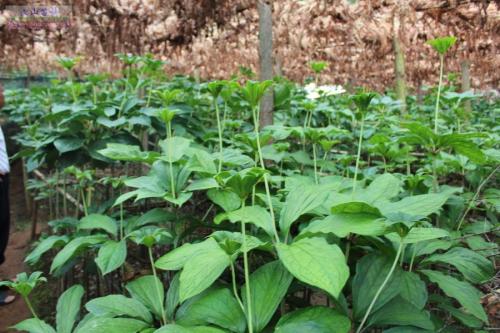
Planting Methods
1. Soil selection: Chonglou has no strict requirements for climate and soil type, but it is best to choose shaded gentle slope land or flat land with shorter sunlight hours, and to plant in night-damp soil, ash-bubble soil, or humus soil that is loose in texture and relatively strong in both water retention and water permeability.
2. Land preparation and fertilization: Chonglou roots are not deep. After general land preparation, form beds 120-150 cm wide, apply 3000-5000 kg of farmyard manure or forest humus fertilizer per mu, then dig trenches, cover with fertilizer, and shallow hoe once to make the plow layer uniformly fertile and the soil level and fine, ready for planting.
3. Thinning and replanting seedlings: For Chonglou planted in mid to late May, thin the direct-seeded plot, and at the same time check the beds and fill gaps. Before thinning, water first, use a wooden pry to lift the seedlings, and when replanting, water to settle the roots, making full use of small seedlings to ensure a full stand and sufficient density.
4. Cultivation and weeding: The aboveground part of Chonglou grows weakly, so special attention must be paid to loosening the soil and weeding. Generally from late May to early June, there is a lot of heavy rain, and the soil easily becomes compacted, so drainage and waterlogging prevention must be timely. Cultivate frequently, loosen the soil shallowly, and remove weeds at any time.
5. Timely shading: Chonglou likes shade and fears strong light. Throughout the entire growth period, a light transmittance of 40-50% is best. Therefore, after emergence and transplanting, shading measures must be taken. Where conditions permit, shade nets are best; where conditions do not permit, inserting branches for shade may be used.
6. Topdressing and earthing up: Chonglou has the growth pattern that when it flowers above, the tubers below swell. Generally, growth is fastest from mid to late June to August, so heavy topdressing must be applied in early June, using 2000-3000 kg of cattle and sheep barn manure or farmyard manure plus 20-30 kg of superphosphate per mu.
7. Timely harvesting: Chonglou can be harvested in autumn before and after the stems fall, that is, from November to December, or before sprouting the following spring. The tubers mostly grow in the surface soil and are easy to dig, but care must still be taken to keep the tubers intact. After digging them out, wash them clean, slice them while fresh, and sun-dry them.
Before Chonglou emerges, it is mostly the dry season; after emergence, it is mostly the rainy season. The rainy season lasts as long as 3-4 months. During the rainy season, note that the seedbed should not accumulate too much water, and clean debris from drainage ditches at any time, so that excessive water accumulation does not cause disease. The disease most easily caused by water accumulation is root rot. In the early stage, the plant shows no symptoms; finally the entire rhizome rots, the aboveground plant wilts, and it gradually dies.
Symptoms of root rot in Yunnan Paris polyphylla: In the early stage of disease onset, the aboveground part shows mild wilting, leaves droop, and the tuberous roots become soft. Gradually, yellow-brown water-soaked rotten patches appear on the roots and spread, changing from yellow to dark brown, until the tuberous roots rot and give off a peculiar foul odor. In the late stage, the aboveground part withers and dies.
Pathogen: It is mainly caused by high field humidity, water accumulation, high temperature in June-July, and wounds on the rhizome, making it vulnerable to infection by pathogens. Both fungi and bacteria can cause root rot.
Occurrence characteristics: Root rot is a soil-borne disease. The pathogen overwinters on diseased residues in the soil. Root rot is likely to occur in cultivated land with heavy clay soil, low-lying terrain, poor drainage, continuous rainy weather, excessively wet and waterlogged soil, and plots with continuous cropping for many years.