How to Grow Phedimus spurius 'Schorbusser Blut' and Points to Note
Phedimus spurius 'Schorbusser Blut' (also known as Dragon's Blood Sedum) is a succulent in the Crassulaceae family, genus Phedimus. It has a delicate, dainty appearance, is very cold-hardy and drought-tolerant, and has a strong ability to propagate, making it suitable as a groundcover plant or lawn grass. In an environment with large temperature differences and plenty of sunlight, the leaf color becomes even more vivid, a lovely bright red.
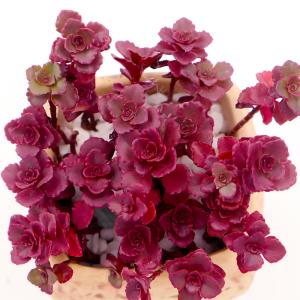
How to grow Phedimus spurius 'Schorbusser Blut'
1. Soil: Choose a growing medium that is loose and highly breathable. You can mix peat soil and granular soil in a 3:2 ratio. You may also mix in materials such as pine needles or bone meal, but it is best to choose only one; soil that is too complex is actually not good for the growth of Phedimus spurius 'Schorbusser Blut'.
2. Light: Phedimus spurius 'Schorbusser Blut' likes a sunny environment, so it needs to be given enough light. If there is not enough light, water cannot evaporate, the stem nodes will stretch out, and the leaves will loosen and turn green, so it will no longer be the imposing "Dragon's Blood Sedum" but just an ordinary succulent plant.
3. Water: Phedimus spurius 'Schorbusser Blut' is a relatively drought-tolerant plant. In summer, give it appropriate shade and cooling, provide very little water, or even cut off water entirely; if you do water, it should be in the evening. In other seasons, water only when the soil is dry, but reducing watering appropriately can make it look more attractive.
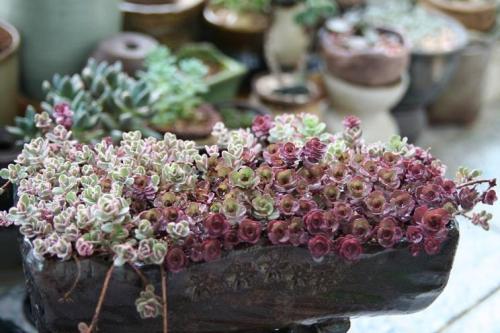
Points to note when growing Phedimus spurius 'Schorbusser Blut'
1. Plant in a shallow pot: The root system of Phedimus spurius 'Schorbusser Blut' is relatively shallow, so try to choose a shallow pot for planting; a pot that is too large will instead hinder the plant's growth.
2. Appropriate exposure: With long-term growth, the lower leaves will drop off at varying lengths, which is a normal phenomenon. When bare stem nodes appear, you can prune by cutting off the bare parts to encourage branching and grow new leaves.