A Detailed Guide to the Planting Methods and Key Technical Points for Adam's Needle
Adam's needle, also known as pineapple flower, thick-leaved yucca, and Adam's needle yucca, is an evergreen shrub in the Agavaceae family, genus Yucca. It is native to eastern and southeastern North America, and is cultivated throughout China south of North China. It is highly adaptable and tolerant of waterlogged conditions, with large flowers, a beautiful form, and green leaves, and is often cultivated as an excellent garden ornamental tree.

Propagation Methods of Adam's Needle
1. Division propagation: In spring from February to March, when the root sucker buds emerge from the ground, they can be divided and replanted. When dividing, it is best for each bud to retain some fleshy roots. First dig a hole and apply fertilizer, then bury the separated sucker buds in it. Do not bury too deep; just slightly cover the top. Alternatively, cut off the portion of the stem with the clustered leaves at the top, keeping a 9-12 cm section of stem, remove part of the leaves leaving about 7 leaves, and bury it in a 12-15 cm deep hole, then water after burying.
2. Cutting propagation: Adam's needle cuttings are taken in spring or early summer. Dig up the stems, strip off the leaves, cut into 10 cm lengths. Thick stems can be split lengthwise into 2-4 pieces, laid flat in a trench with the longitudinal cut face down, covered with 5 cm of soil, and kept moist. They sprout 20-30 days after cutting.
3. Seed propagation: Seed propagation of Adam's needle requires artificial pollination. Artificial pollination is best done in May. About 70 days after pollination the seeds mature, and they are sown in late September of the same year. Seedlings emerge after one month, with a germination rate of about 40% or more.
Cultivation Methods of Adam's Needle
1. Planting method: Adam's needle has densely growing, widely spreading leaves with sharp tips. When digging them up, first tie them up; they can be planted bare-root or with native soil. Apply sufficient base fertilizer before planting, water thoroughly after planting, remove the ties, and spread out the leaves.
2. Routine management: The care and management of Adam's needle is extremely simple; it only needs pruning of dead branches and withered leaves, and timely removal of the flower stalks after blooming. Pay attention to proper earthing up and fertilizing to promote the emergence of flower spikes.
3. Pest and disease control: Adam's needle is commonly affected by brown spot disease and leaf spot disease, which can be sprayed with a 1000-fold dilution of 70% thiophanate-methyl wettable powder. Insect pests include scale insects, whiteflies, and noctuid moths, which can be killed by spraying with a 1000-fold dilution of 40% omethoate emulsifiable concentrate.
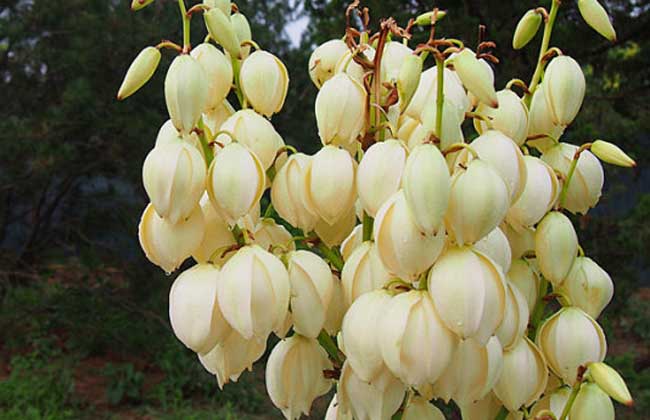
Cultivation Value of Adam's Needle
Medicinal value: Adam's needle flowers contain medicinal components such as isosarsasapogenin, tigogenin, and gitogenin. They are pungent and slightly bitter in taste, neutral in nature, and have the effects of relieving cough and calming asthma. They are often decocted in water at 3-9 grams for internal use to treat bronchial asthma, cough, and other conditions.