A Detailed Guide to Scutellaria baicalensis Planting Methods and Key Techniques
Scutellaria baicalensis (Latin scientific name: Scutellaria baicalensis Georgi), also known as shancha root and tujincha root, is a perennial herbaceous plant of the genus Scutellaria in the family Lamiaceae; its fleshy rhizome is thick, its leaves are firm and papery, lanceolate to linear-lanceolate, its raceme inflorescences are terminal on stems and branches, its corolla is purple, purplish-red to blue, its filaments are flat, its style is slender, its disc is annular, its ovary is brown, its nutlets are ovoid, and its flowering and fruiting period is from July to September.
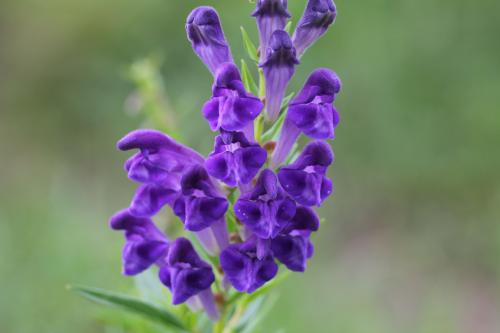
Scutellaria baicalensis prefers warmth and tolerates severe cold; its underground parts can endure low temperatures of -30°C. It is drought-tolerant but afraid of waterlogging; when planted in poorly drained or rainy areas, the growing environment is poor, growth is poor, and root rot is easily caused.
I. Planting Methods
Scutellaria baicalensis is mainly propagated by seed, and can also be propagated by cuttings and root division.
1. Seed propagation Generally, direct sowing is used. Because the seeds are small and emergence is relatively difficult, the land must be well prepared. Before land preparation, apply 2000-3000 kg of decomposed farmyard manure per mu, plow deeply and harrow finely, and the seedbed surface must be fine and level; sloped land without irrigation conditions does not need to be formed into beds. Spring sowing is in March and April, summer sowing can be done during the rainy season, and winter sowing is also possible; spring sowing gives the highest yield, and in places without irrigation conditions, sowing should be done during the rainy season. Drill sowing is generally used, with row spacing of 25-30 cm, opening shallow furrows 2-3 cm deep, sowing the seeds evenly into the furrows, covering with about 1 cm of soil, and lightly pressing after sowing; the sowing rate is 0.50-1 kg per mu. Because the seeds are small, in order to avoid uneven sowing, they can be mixed with 5-10 times fine sand and stirred evenly before sowing. Water promptly after sowing and keep the surface soil moist frequently; seedlings will emerge in about 15 days. After emergence, thin out the overly dense weak seedlings; when the seedlings are 6-7 cm tall, set the plants at a spacing of 12-15 cm and fill in gaps where seedlings are missing. When filling gaps, be sure to transplant with soil, and the overly dense seedlings can be moved to fill the gaps; water after planting to help them survive.
Scutellaria baicalensis seeds are small, and the soil covering at sowing is shallow, so emergence is often difficult due to soil drought or an uneven surface with large soil particles, resulting in many missing seedlings. Solutions: first, land preparation must be fine and level; second, water promptly after sowing and keep the soil moist frequently until emergence; in addition, for dryland planting, sowing should be done in the rainy season, and plastic (11420,65.00,0.57%) film mulching or straw mulching can also be used to preserve soil moisture, and the mulch can be removed after emergence. In this way, uniform and neat emergence can be ensured.
2. Cutting propagation The most suitable period for cuttings is May and June, when the plants are in vigorous vegetative growth. Cut the semi-lignified young tender parts at the upper ends of stems and branches (cuttings taken from the middle and lower parts of stems have a very low survival rate), cut them into 6-10 cm lengths, then remove the leaves from the lower 2 nodes and keep the upper leaves. The cutting bed is best made of sand, or relatively loose sandy loam is also acceptable. Generally, cuttings should be inserted as soon as they are cut, at a row spacing of 10 x 5 cm in the bed, watered promptly after insertion, and shaded with a shed; spray water frequently to keep the soil moist, but it should not be too wet, otherwise the cuttings will turn black and rot. With proper management, the survival rate can reach more than 90%, and they can be transplanted 40 days after cutting.
3. Root division propagation At harvest time, pay attention to selecting high-yield and high-quality plants, cut off the roots for medicinal use, and leave the rhizome parts as propagation material. If harvesting by digging in winter, bury the rhizomes indoors in a cool place and divide and plant them in the second spring; if harvesting in spring, dig and plant immediately, divide the rhizomes into several pieces, each with several bud eyes, and then plant them in the field at a row spacing of 30 x 20 cm. Planting by this method on sloped land has a relatively high survival rate, and management after planting is the same as usual.
II. Field Management
During the emergence period, keep the soil moist frequently and water promptly when the soil is dry. After the plants are established, their drought resistance increases, so watering can be reduced, and during the rainy season attention should also be paid to drainage and waterlogging prevention. At ordinary times, also pay attention to loosening the soil and weeding at any time. In addition to strengthening general management, attention should also be paid to fertilization. In the first year, after plant setting, apply the first fertilization, with 500 kg of dilute human manure and urine per mu or 3-5 kg of urea, and in June-July apply 30 kg of ammonium phosphate as a top dressing. In the second and third years, after greening up, apply 40-50 kg of decomposed cake fertilizer, and before ridge closing in late June apply 30-40 kg of granular ammonium phosphate fertilizer. When fertilizing, open furrows and apply the fertilizer, then cover with soil and water.
III. Harvesting and Processing
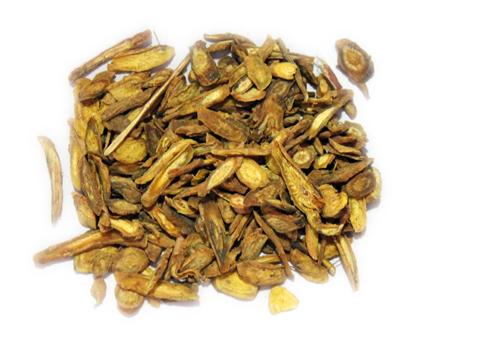
Harvest 2-3 years after planting. Generally, dig in late autumn after the stems and leaves wither, or after the spring thaw and before sprouting. Because the roots grow deep, dig deeply to prevent breaking the roots. After the roots are dug out, shake off the soil, cut off the stems and leaves, sun-dry until half dry, scrape off the outer skin, then quickly sun-dry or oven-dry. They can also be sliced and then sun-dried, but they must not be washed with water, nor sliced while fresh, otherwise the cut surfaces will turn green.
When drying in the sun, avoid exposure to strong light, because excessive exposure will make them turn red. At the same time, also prevent them from being soaked by rain, because after being rained on, the roots of Scutellaria baicalensis first turn green and then black, both of which affect quality. The finished product is considered top grade when it is solid, without holes, and bright yellow inside. Generally, 3-4 kg of fresh roots can be processed into 1 kg of dried goods. The yield of dried goods is 200-300 kg per mu, and can reach more than 380 kg at the high end.