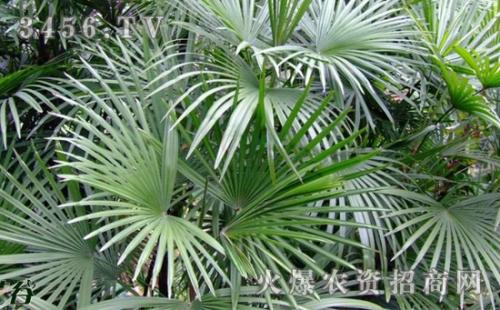
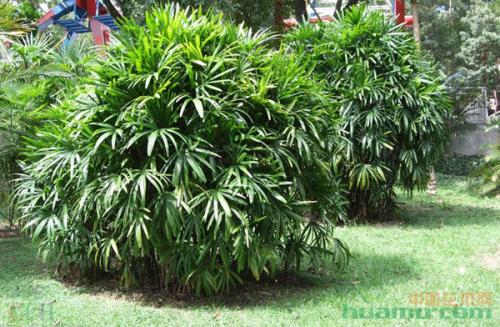
Broadleaf lady palm (scientific name: Rhapis excelsa (Thunb.) Henry ex Rehd.), also known as Guanyin bamboo, jintou bamboo, palm bamboo, and dwarf lady palm, is an evergreen foliage plant of the genus Rhapis in the palm family Arecaceae. It has leaf nodes, wrapped in leaf sheaths with brown reticulate fibers. It is a clumping shrub, 2-3m tall, with erect cylindrical stems that are jointed, 1.5-3cm in diameter. The stems are slender like fingers, unbranched, with leaf nodes; the upper part is covered by leaf sheaths, but these break down into slightly loose, horsetail-like, pale black, rough and hard reticulate fibers.
Propagation Methods
Use a loose, well-draining soil as the growing medium, generally a mix of leaf mold and river sand in equal parts. Before sowing, the seeds can be treated by soaking in warm water (soak in 30-35℃ warm water for two days), and sown once the seeds begin to sprout. Because germination is generally uneven, the soil covering after sowing should be slightly deeper. Generally, germination occurs 1-2 months after sowing, and the germination rate can reach about 80%. When the cotyledons of the seedlings reach 8-10 cm in length, they can be transplanted. It is worth noting that when transplanting, 3-5 plants must be planted as one clump to favor survival and growth.
Division propagation can be carried out in spring together with repotting and soil replacement. Early spring, March to April, is the time for repotting and soil replacement. Generally, small plants are repotted once a year, and large plants once every 2-3 years. The commonly used potting soil is a mix of 2 parts garden soil, 1 part barnyard manure soil, and 0.5 part each of leaf mold and rice husk ash.
Remove the original clump from the old pot, shake off the old soil, but keep some of the old soil ball on the old roots. Use mulberry shears to cut apart the root clump of the lady palm, and at the same time cut away the poorly growing blackened and rotten roots. The cuts should be smooth. Each clump should have at least 5-6 stems, or as many as 10-20 stems (depending on the size of the pot and the number of clumps). Then plant them into the prepared pots. Place broken pot pieces over the drainage holes at the bottom of the pot to facilitate drainage. Add the growing medium, coarse first and then fine, until it is eight-tenths full. While adding the medium, use a small bamboo strip to poke the soil tightly around the roots. Do not plant too deep; keep the original root crown level with the growing medium. After watering thoroughly, place the potted plant in half shade for about half a month, and it will have established itself.
Cultivation Techniques
In the hot summer season, besides normal watering and care, frequently spraying water on the leaves and splashing water on the ground can increase the relative air humidity and reduce dust accumulated on the branches and leaves, helping the plant grow well. During the plum rain and summer shower seasons, prevent water from accumulating in the pot. Summer and autumn are the growing seasons for broadleaf lady palm, so fertilizer and water management should be appropriately increased, and the soil should be kept moist, but waterlogging and drought should be avoided. Apply decomposed cake fertilizer water or human waste about once every 20 days to promote plant growth.
Broadleaf lady palm prefers a warm, shady, humid, and well-ventilated environment. It is not cold-tolerant and fears scorching sun. In the Shanghai area, it is grown as a greenhouse potted plant. It requires moist, well-draining loam rich in humus, and slightly acidic soil is most suitable. Broadleaf lady palm is relatively shade-tolerant and can be enjoyed for a long time in a bright room; it can also be placed continuously for 3-4 months in a darker room. Broadleaf lady palm is relatively cold-tolerant; a low temperature of 0℃ has little effect on its survival, but it fears cold wind and frost, so indoor potted plants can overwinter safely.
To grow broadleaf lady palm well, attention should be paid to winter cold protection, summer shading, rational fertilization, and proper pruning. Broadleaf lady palm grows vigorously. In winter, as long as it is moved indoors and kept above 0℃, it can overwinter safely; if the temperature is above 10℃, it can maintain green leaf color. Because winter temperatures are low, the plant enters dormancy and basically stops growing, so watering should be controlled, the potting soil should be kept on the dry side, and fertilization should be stopped. Wet potting soil and low temperature conditions will cause broadleaf lady palm root rot or massive leaf loss. In spring, as temperatures rise, it is generally moved outdoors for care after Qingming; in summer, it should be placed under a shade shed or in tree shade. In a half-shade and humid environment, new shoots can grow continuously and old leaves remain emerald green; scorching sun and dry hot wind are the main causes of leaf scorch and drying in broadleaf lady palm.
When scorched and withered leaves are found, prune them promptly. Small potted broadleaf lady palms are repotted and given fresh soil once a year, and large plants once every 2-3 years, generally carried out in spring when they are moved out of the shed. The growing medium commonly used is a mix of 2 parts garden soil, 1 part barnyard manure soil, and 0.5 part each of leaf mold and rice husk ash. This growing medium is relatively heavy, retains moisture easily, and is rich in nutrients, making it suitable for the growth of broadleaf lady palm.
During the growing period from May to September, broadleaf lady palm should be watered more to keep the soil moist. It is better to keep it wet than dry, but it must not become waterlogged, otherwise root rot easily occurs. During high-temperature periods, water should also be frequently sprayed on the leaves and ground to increase air humidity, and watering should be appropriately reduced in autumn and winter. During the growing period, broadleaf lady palm should be given liquid fertilizer 1-2 times a month, which can promote a deep, verdant leaf color. Fertilization should be stopped in winter.
The principle of fertilizing broadleaf lady palm is frequent and light application, that is, small amounts applied many times, and combining nitrogen, phosphorus, and potassium, with organic fertilizer as the main component and trace-element fertilizer as a supplement. It is required to apply fertilizer to the roots once every 10-15 days. For a medium to large potted plant, apply 25-30 grams of nitrogen-phosphorus-potassium compound fertilizer per pot each time, 50-60 grams of decomposed peanut bran, mixed with about 2 kg of fermented manure water, and pour it onto the potting soil. In addition, spray a mixed solution of 0.1% magnesium sulfate, 0.1% ferrous sulfate, 0.1% zinc sulfate, 0.3% urea, and 0.5% monopotassium phosphate on the leaves once every 7-10 days, evenly wetting all leaves, especially spraying the growing points, until water droplets begin to drip down.