A Detailed Guide to Succulent Planting Methods and Techniques
Succulent is a concept in floriculture and horticulture, sometimes also called succulent plants. But the meaning of succulent plants in horticulture is narrower than that of succulent plants in botany. In botany, succulent plants are also called succulents or succulent plants; this term was first proposed by the Swiss botanist Jean Bauhin in 1619, meaning that this type of plant has thick, fleshy stems, leaves or roots.
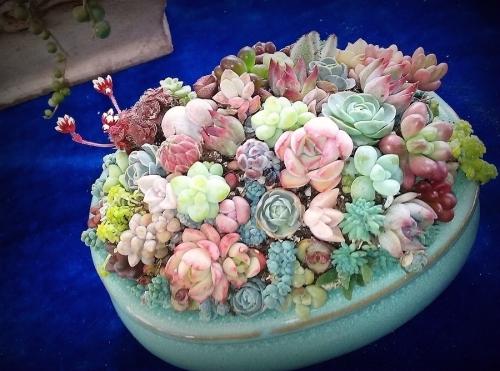
Succulent planting methods:
1. The growing medium should be loose, breathable, well-draining soil, but with a certain water-holding capacity, neutral or slightly acidic. For highland cacti (Aztekium, Obregonia, and Strombocactus) and Ariocarpus, a little more rice-hull ash and small-grained weathered rock can be added. Tall columnar species can be mixed with large-grained quartz sand to stabilize the plant. Transplanting and planting should generally be carried out during the recovery period just after the plant's dormancy has ended. Roots should be trimmed before planting. After root trimming, let them dry for a few days, then plant them in moist growing medium; after planting, provide appropriate shade and do not rush to water, and do not fertilize within one month.
2. Repotting: regularly changing the pot and soil is a necessary major task. Because the root system of succulents is confined to the limited space of a flowerpot, the roots cannot stretch freely, and then as they grow and multiply over the years, the roots will certainly fill wherever they can reach, which is very unfavorable for root drainage and ventilation. Over time, the roots are prone to rot, causing the plant to die. Moreover, the soil contained in the flowerpot is limited, and after the roots continuously absorb nutrients and after repeated watering and flushing, the nutrients are depleted. In addition, in the process of continuously absorbing nutrients, the root system also continuously excretes acidic metabolites, making the soil acidic. These are very unfavorable for the growth of succulents.
3. Pest prevention is more important than pest killing. Succulent plants are prone to root mealybugs, and mealybugs often begin by sucking sap from the roots; by the time insects are found on the leaves, the infestation is often already severe. Therefore, prevention is more important than treatment. Before the arrival of high summer temperatures, it is best to uniformly do 1 root-drenching treatment with a medicinal solution. If root mealybugs have already been found, then it is necessary to do 2-3 consecutive root-drenching treatments to kill the insects, with one week between each, to ensure they are all killed and do not recur. There are many insecticides, including Jiebi Zhi and Muwangte; be sure to read the dilution ratio of the medicinal solution clearly. If it is too weak, it will not kill the insects; if it is too concentrated, it will kill the plants as well.
The leaf arrangements of succulent plants include alternate, opposite, decussate, whorled, two-ranked overlapping, and clustered.