A Detailed Guide to Trichosanthes Planting Techniques and Management Methods
Trichosanthes (Trichosanthes kirilowii Maxim.), also known as Mongolian snakegourd, sugar snakegourd, and snakegourd. Trichosanthes kirilowii Maxim. is a perennial climbing herbaceous plant. It prefers growing in deep mountains and steep ranges, among rocky crevices overgrown with thorns. Its fruit, fruit peel, kernels (seeds), and root tuber are all fine traditional Chinese medicinal materials.
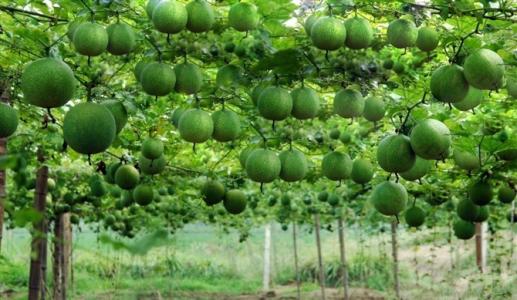
(1) Morphological Characteristics
Perennial climbing vine, with vines 5 m to 6 m long. The root tuber is thick and fleshy, cylindrical, slightly twisted, with a light grayish-yellow outer skin and a white, fleshy cross-section. The stem is much branched, with tendrils slender and long, 2 to 3-branched; leaves are simple and alternate, with long petioles, variable in shape, usually heart-shaped, palmately 3 to 5 shallowly to deeply lobed. It is dioecious; male flowers are 3 to 5 in racemes, with linear sepals; the corolla is white, with obdeltoid lobes fringed at the apex, and 3 stamens. Female flowers are solitary in leaf axils, with a 3-lobed style and an ovate ovary. The fruit is nearly spherical, orange-yellow when ripe. Seeds are flat, ovate-elliptic, light brown. The flowering period is July to August, and the fruiting period is September to October, as shown in Figure 4-19.
(2) Growth Habits
Trichosanthes prefers a warm and humid environment, is relatively cold-tolerant, not drought-tolerant, and avoids waterlogging.
The seeds germinate easily; the suitable germination temperature is 25 C to 30 C, the germination rate is 60% to 80%, and the seed lifespan is 2 years.
(3) Cultivation Techniques
1. Varieties and Types Trichosanthes is a cross-pollinated plant and, after long-term cultivation, has formed many diverse variety types; at present, Ren Trichosanthes is relatively good in production.
In addition, the fruits of several plants in the same genus are also used as snakegourd. Such as Trichosanthes rosthornii (T.rosthornl.), Trichosanthes crenulata (T.crenulata), southern Trichosanthes (T.damia
oshanensis), and Trichosanthes sinopunctata (T.sinopunctata), etc. The root of Japanese Trichosanthes (T.Japonica) is also used as Trichosanthes root.
2. Site Selection and Land Preparation Trichosanthes is a deep-rooted plant, and its roots can penetrate 1 m to 2 m into the soil. Therefore, when cultivating it, choose a sunny plot with deep, loose, and fertile soil; loam or sandy loam is best. It can also be planted
in front of and behind houses, beside trees, along ditches, and other such places. Saline-alkali land and low-lying areas prone to waterlogging are not suitable for cultivation. Before land preparation, apply 5,000 kg of farmyard manure per 1,000 sq m as a base fertilizer, add
30 kg of superphosphate, and plow it into the soil. 15 to 20 days before sowing, broadcast 75% wettable dazomet powder for soil disinfection. Level the plot; generally, no beds are needed, but drainage ditches should be opened around the plot.
3. Propagation Methods Both seed and root division propagation can be used, but in production, root division propagation is mainly used; seed propagation is often used when harvesting Trichosanthes root and breeding new varieties.
(1) Seed propagation: When the fruit is ripe, select orange-yellow, robust, plump, short-stalked mature fruits, split them in half from the fruit base, take out the pulp, rinse out the seeds, and dry and store them. In the following spring, March to April, select plump seeds free of pests and diseases, soak them in
warm water at 40 C to 50 C for 24 hours, take them out and cool them slightly, mix them evenly with 3 times their volume of wet sand, and place them at 20 C to 30
C for germination. When most seeds have cracked, sow them in holes at a spacing of 1.5 m to 2 m, with a hole depth of 5 cm to 6 cm, sowing 5 to 6 seeds per hole, covering with 3 cm to 4 cm of soil, and watering to keep the soil moist; seedlings emerge in 15 to 20 days.
(2) Root division propagation: In the north, carry it out in March to April; in the south, from October to late December. Dig up 3- to 5-year-old robust Trichosanthes roots free of pests and diseases, 3 cm to 5 cm in diameter, with a fresh white cross-section, cut them into small sections 6 cm to 10 cm long, and sow them in holes at a plant spacing of 30 cm and a row spacing of 1.5 m to 2 m, with a hole depth of 10 cm to 12 cm. Place one section of seed root in each hole, cover with 4 cm to 5 cm of soil, press firmly by hand, then mound soil
10 cm to 15 cm high to form a small mound to help preserve moisture. About 20 days after planting, when sprouting begins, remove the moisture-preserving soil on top. Every
1,000 sq m requires 50 kg to 60 kg of seed roots. When using this method, note that more roots from female plants should be selected, with an appropriate proportion of roots from male plants to facilitate pollination. In addition, old roots with yellow fibers in the cross-section are not easy to survive and sprout, so they are not suitable as seed roots.
4. Field Management
(1) Cultivation and weeding: Carry out cultivation and weeding once each in spring and winter every year. During the growing period, weed promptly according to weed growth.
(2) Topdressing and irrigation: Carry this out together with cultivation and weeding, mainly applying human and livestock manure water as topdressing, and adding superphosphate in winter. Water promptly during drought.
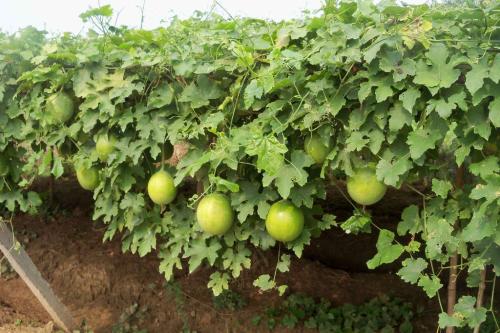
(3) Trellising: When the stems and vines grow to more than 30 cm, bamboo poles and the like can be used as supports to build a trellis, with the trellis about 1.5 m high. They can also be trained toward nearby trees, ditch slopes, or intercropped tall crops to facilitate climbing.
(4) Pruning and removing side shoots: While building the trellis and training the vines, remove excess stems and vines, leaving only 2 to 3 strong vines per plant. When the main vine grows to 4 m to 5 m, pinch off the terminal bud to encourage more side branches. The stems and vines on the trellis should be arranged promptly so that they are evenly distributed.
(5) Artificial pollination: The natural fruit-setting rate of Trichosanthes is relatively low. Artificial pollination is simple and can greatly increase yield. The method is: use a writing brush to collect pollen from male flowers into a petri dish, then dip the writing brush in the pollen and apply it to the stigmas of the female flowers one by one.
5. Pest and Disease Control
(1) Yellow squash beetle: It damages the leaves, and the larvae can also bore into the main root. Control method: spray with 1,000-fold dilution of 90% trichlorfon; during the larval stage, irrigate the roots with 1,000-fold dilution of rotenone or 30-fold nicotine water.
(2) Clearwing moth: It begins to appear in July, is more common in the north, and its larvae damage the aboveground parts. Control method: spray with 1,000-fold dilution of 80% dichlorvos emulsion at the early stage of occurrence.
In addition, there are also damage from root-knot nematode disease, root rot, and aphids.
(4) Harvesting and Processing
Trichosanthes bears fruit 2 to 3 years after planting. The fruits mature successively around October, and when the peel has a white bloom and turns light yellow, they can be picked in batches. Hang the harvested Trichosanthes in a ventilated place to dry, and whole snakegourd is obtained. Split the fruit open from the fruit base, remove the pulp and seeds, and dry them in the sun to obtain snakegourd peel. Add plant ash to the pulp and seeds, rub repeatedly by hand, wash the pulp clean in water, take out the seeds and dry them in the sun to obtain snakegourd seeds. With proper management, they can be harvested continuously for many years. After the 3rd year, dig up the root tuber, remove mud, sand, the reed head, and the rough skin, cut into short sections or split lengthwise, and dry in the sun to obtain Trichosanthes root.