Detailed Guide to Growing and Caring for Bird of Paradise
Bird of paradise (Strelitzia reginae Aiton) is a perennial herbaceous plant of the family Strelitziaceae, stemless. The leaves are oblong-lanceolate, 25-45cm long and 10cm wide. The leaf tips are acute; the petioles are slender. Several flowers are borne on the peduncle, subtended by a spathe; the spathe is green with purple-red edges, the sepals are orange-yellow, and the petals are dark blue; the stamens are equal in length to the petals; the anthers are narrowly linear, the style protrudes, and there are 3 stigmas. The flowering period is in winter.
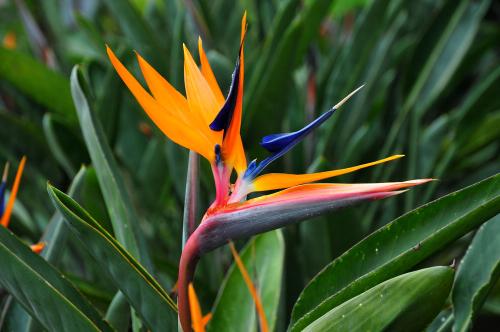
How to grow bird of paradise:
1. Seed pretreatment: remove the colored fuzz on the seeds (it comes off easily with a thumbnail), soak the seeds in warm water for 1-2 days, changing the water twice a day to encourage germination.
2. Sowing: spread the moist medium in a container. Press the seeds into the container about 0.7cm deep, cover moderately, and place in a warm spot at 24-30°C. Keep moist and avoid drying out completely. The container must be covered with plastic film to help maintain humidity.
3. Care after the seeds sprout: maintain sufficient light, avoid overwatering and strong light. Increase ventilation, water in the morning as much as possible, and let the plants dry by evening. Transplant the seedlings at the two-leaf stage; move the seedlings into 5cm peat plug trays, and when the roots grow out through the holes, move them into 10cm trays. You can also sow the seeds directly into plug trays, and when the root system fills the tray, transplant into a larger container.
4. Transplanting/potting: when the seedlings are 30-40cm tall and have about 8 leaves, they can be planted out. During transplanting, the fleshy roots must be protected from damage. The planting depth should be such that the rhizome is buried 2-3cm below the soil surface. Shallow planting easily damages new shoots; planting too deep affects bud sprouting and flower bud differentiation. After planting, water thoroughly, and then for about two weeks, keep misting the leaves every day to help the plants recover and grow. For container growing, use a mix of garden soil, peat and sand; it must have good drainage, and sterilized mixed soil is best. Soilless media can also be used.
5. Light regulation: bird of paradise needs no less than 4 hours of direct light every day, and ideally bright light all day. Take some protective measures when the sun is strong. In winter, which is the main flowering period, plenty of sunshine helps increase flower production. Light regulation emphasizes the management principle of "not shady in winter, not scorched in summer." Under shade, the foliage looks more attractive, but the number of flowers will be relatively smaller.
6. Temperature control: temperature management is of great significance to flower production in bird of paradise. Generally, bird of paradise growth is inhibited above 40°C, suffers frost damage below 0°C, and grows well within the range of 18-30°C. It is best to ensure a nighttime temperature (13-18°C) and a daytime temperature (31-35°C). Within the suitable temperature range, a flower bud can form in the leaf axil of every leaf of bird of paradise. Therefore, controlling the cultivation temperature well is the key to increasing bird of paradise yields.
7. Fertilizer and water management: ensure a sufficient and regular water supply. Except from September to February, when the plants need to stay dry, the soil should be kept constantly moist at other times. Using a well-drained medium is the key to cultivation management. Bird of paradise dislikes waterlogging at the growing site, because its fleshy roots can tolerate drought but are afraid of flooding.
Bird of paradise needs fertile, slightly acidic soil and heavy fertilization. It can be planted in sandy soil rich in humus, or in a mixture of coarse sand, leaf mold, peat and garden soil in equal parts. If the soil is rather poor, put rotted manure or slow-release fertilizer into the planting hole when planting. After planting, apply fertilizer once every 7-10 days, using 0.05kg of compound fertilizer per square meter; after reaching flowering age, during the 2 months before the flowering season, apply 0.02% potassium dihydrogen phosphate to the soil once a month, or apply half that amount as a foliar feed.