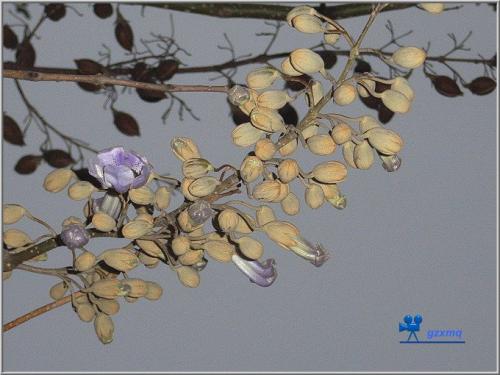
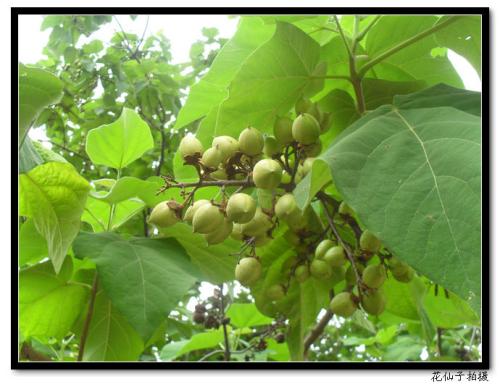
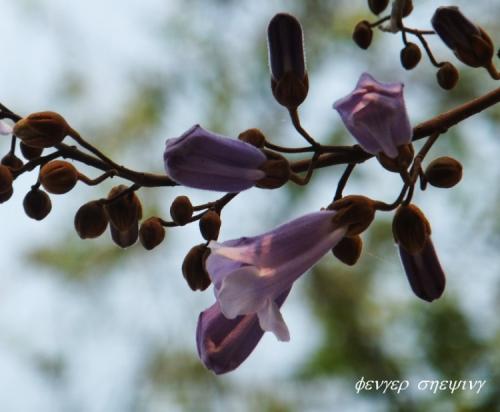
Paulownia tomentosa (scientific name: Paulownia tomentosa) is a plant of the Scrophulariaceae family and the Paulownia genus. Because its flowers are purple, it is also known as purple-flowered paulowniaglandular hairscalyx is shallowly bell-shaped, densely covered with stellate tomentum, 5-lobed to the middle, the corolla is funnel-shaped and bell-shaped, light purple outside with hairs, white inside with purple stripes; the capsule is ovoid, sharply pointed at the tip, with a leathery exocarp; the flowering period is April-May; the fruiting period is August-September. It grows in areas at elevations from 500 m to 1,800 m.
Cultivation techniques:
Paulownia has relatively high heat requirements and a relatively strong ability to adapt to atmospheric drought, but there are certain differences depending on the species. It also has relatively high requirements for soil fertility, soil layer thickness, and looseness. It grows poorly on waterlogged and heavy clay soils. When the groundwater level is less than 2 m, growth is also poor. The ideal soil pH is 6-7.5. Paulownia grows rapidly and can become timber in 7-8 years. In northern regions
Paulownia is a light-loving, fast-growing tree species native to China. It flowers before leafing out in spring. The flowers are large, indistinctly labiate, and slightly fragrant. When in full bloom, the whole tree is very spectacular. After the flowers fall, large leaves grow, and the leaves are dense and large, and the shade is very effective at blocking light. It is a good tree species for landscaping and street trees. However, Paulownia is not very cold-tolerant and is generally distributed south of the Haihe River Basin and south of the Yellow River Basinold course of the Yellow River Paulownia grows very rapidly. A Paulownia more than ten years old has a diameter twice that of a poplar of the same age, but after growing for a long time, the trunk may become hollow. Because of its rapid growth, the wood is light and soft and easy to process, but it is also acid-resistant and rot-resistant, moisture-proof and heat-insulating.
Paulownia propagation methods include root cuttings, sowing, and leaving roots, with root cutting propagation being the most common. The nursery site should be selected as sandy loam and loam with convenient irrigation and drainage, good soil aeration, and a groundwater level below 1.5-2.0 m. Continuous cropping land is not suitable. The length of the nursery stock should preferably be 15-20 cm, and the thickness should preferably be 1.5-4.0 cm. The plant-row spacing is 1.0 x 1.0 m or 1.0 x 1.2 m. During the growth and development of the nursery stock, strengthen water and fertilizer management and the prevention and control of pests and diseases.
Generally, afforestation is carried out along with land preparation, using hole-shaped land preparation, 1 m deep, and 1 m long and 1 m wide. Reasonable afforestation methods and afforestation density should be determined according to the purpose of afforestation and the level of management. Along roadsides, canalsides, and riversides, planting can be done in rows, with a plant spacing of 3-5 m; in areas with better conditions, shrubs such as Amorpha fruticosa can also be planted between plants. Near homes and villages, planting can be done in belts or blocks, with an initial afforestation density of 4 x 4 m. When implementing grain crop-Paulownia intercropping, for the intercropping type mainly based on Paulownia, the initial afforestation density is 5 x 5 m, 26 trees per mu; for the intercropping type mainly based on grain, the afforestation density is 5 x 40 m, 3 trees per mu; for the intercropping type with equal emphasis on Paulownia and grain, the afforestation density is 5 x 10 m, 13 trees per mu. Afforestation is generally carried out from after leaf fall in autumn to before sprouting in the second year's spring. In some areas, autumn planting with leaves can also achieve relatively good results. The standards for one-year-old strong seedlings are generally considered to be: height above 5 m and ground diameter 7-8 cm as special-grade seedlings; height 4-5 m and ground diameter 6-7 cm as first-grade seedlings; height 3-4 m and ground diameter 5-6 cm as second-grade seedlings; height 2-3 m and ground diameter 4-5 cm as third-grade seedlings. During afforestation, strong seedlings of second grade or above should be selected. Paulownia nursery stock breeding is relatively easy, with many methods, among which buried-root propagation has the advantages of simple technology, uniform emergence, fast emergence, high survival rate, good nursery stock quality, and low propagation cost, and is the most widely used method in production.