Detailed Explanation of Honey Pomelo Planting Techniques and Management Methods
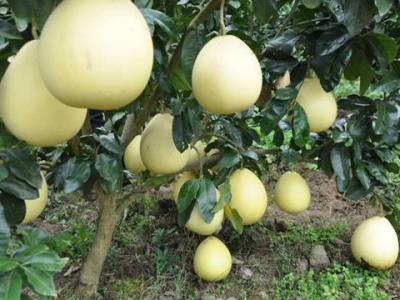
Honey pomelo, also known as Xiangpao, is a premium variety of pomelo. It is mostly grown in the south, and the pomelos produced in Pinghe County, Fujian Province and Shaoguan, Guangdong are the most famous. The fruit is as small as a mandarin or tangerine and as large as a melon, with a thick yellow rind; when eaten, it must be peeled to eat the pulp, and it is mostly harvested in October-November when the fruit ripens. Its thick rind makes it easy to store, and it generally can be kept for three months without losing its fragrance, so it is called a "natural fruit can."
Planting Methods
1 Planting
A new pomelo orchard should be selected with convenient transportation, sufficient water sources, no quarantine pests or diseases, and deep, fertile red soil or sandy loam. When establishing the orchard, mountain land should be chosen with a slope below 25°, and for plains, the groundwater level and flood prevention and drainage capacity should be comprehensively considered. When planting, choose a single variety planted in contiguous blocks to avoid confusion with ordinary honey pomelo.
Planting density: for flatland planting, the row spacing is 4 m x 4 m, generally about 40 plants per mu; for hillside planting, contour planting may be used, with a row spacing of 4 m x 3 m, about 55 plants per mu. Before planting, dig planting holes 0.8-1.0 m in length, width, and depth; after digging, sun-dry the soil to let it weather, and complete backfilling within 1 month before planting. Each hole may be broadcast with 0.5-1.0 kg of lime to adjust soil acidity and alkalinity and kill underground pests and diseases; place green manure such as weeds at the bottom layer, and above that place composted and thoroughly decomposed bran fertilizer, farmyard manure, and phosphate fertilizer, etc. Each hole may be given 2.5 kg of bran fertilizer, 25 kg of farmyard manure, and 1 kg of phosphate fertilizer. When backfilling, break up the soil, put the topsoil first, then cover with subsoil, making one layer of fertilizer and one layer of soil, and no fertilizer should be within 30 cm of the ground surface. Backfill into a round fruit mound about 25 cm above the original ground surface and about 80 cm in diameter, ready for planting.
2 Fertilizer and Water Management
2.1 Young Tree Management
Young honey pomelo trees should be supplemented with water in time during drought to keep the soil moist and promote root growth. Young honey pomelo trees generally can flush 4-5 times a year; fertilization adopts the method of "two fertilizers per flush," applying frequently and lightly. Apply fertilizer once 10 d before the new flush sprouts and once after the new flush unfolds its leaves, mainly with quick-acting fertilizer. Each time, 50-150 g of urea or compound fertilizer plus low-concentration decomposed manure water may be used for drenching, or it may be buried in furrows.
2.2 Fruiting Tree Management
Increasing the application of organic fertilizer to fruiting trees is one of the fundamental measures to improve pomelo fruit quality. Fertilization should be mainly farmyard manure, supplemented by inorganic fertilizer, and the needed trace elements should be supplemented in time.
Fruiting honey pomelo trees have relatively vigorous growth and a relatively short fruit growth period, so throughout the year the key applications are winter fertilizer, pre-flowering fertilizer, fruit-stabilizing fertilizer, and fruit-swelling fertilizer. For high-yield-period fruiting honey pomelo trees (100 kg per plant), on the basis of applying sufficient organic fertilizer, apply per plant over the whole year 1.2-1.5 kg of pure nitrogen, 0.6-0.8 kg of pure phosphorus, 1.0-1.2 kg of pure potassium, 0.8-1 kg of pure calcium, as well as 0.23-0.3 kg of pure magnesium and 0.1 kg of boron.
2.2.1 Winter Fertilizer
In winter, expand the holes and bury base fertilizer deeply, accounting for about 50% of the annual fertilizer application, mainly organic fertilizer, such as bean bran, chicken manure, pig manure, biogas residue, etc., plus calcium fertilizer and phosphate fertilizer, while properly supplementing other trace elements needed for its growth and development according to tree vigor.
2.2.2 Pre-flowering Fertilizer
Apply in early to mid-February at the early bud stage, mainly with nitrogen fertilizer and foliar topdressing. For fruiting trees over five years old, generally apply per plant 0.50-0.75 kg of urea, 0.5 kg of potassium sulfate, 1.0-1.5 kg of compound fertilizer, and 15-25 kg of decomposed human, livestock, and poultry manure. If drought occurs after application, irrigate in time.
2.2.3 Fruit-stabilizing Fertilizer and Fruit-swelling Fertilizer
Apply in two applications from early to mid-April to mid-to-late June, mainly organic fertilizer, combined with nitrogen, phosphorus, and potassium, accounting for about 40% of the annual fertilizer application; each plant each time uses 50-100 kg of dilute manure water (or fully decomposed chicken manure, pig manure, etc.), 1.5-2.0 kg of compound fertilizer, and 0.5-1.0 kg each of potassium fertilizer and phosphate fertilizer. Apply 1.5-2.0 kg of calcium fertilizer before late May. Later, decomposed peanut bran water or manure water may be applied as a drench to improve pomelo fruit quality.
The fertilization method is to open paired furrows or radial furrows outside the drip line of the tree canopy and apply the fertilizer. When the soil is dry, it is best to apply water fertilizer; in the rainy season or when the soil is moist, dry application may be used.
3 Training and Pruning
3.1 Young Tree Management
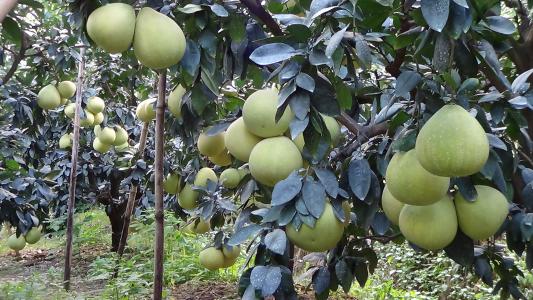
On the basis of setting the trunk at 60 cm, promote more branching by heading back branches and pinching new shoots; keep 2-3 evenly distributed new shoots as main branches; at the second flush, cultivate 3 secondary main branches on each main branch; at the third flush, cultivate lateral branch groups on the secondary main branches, with each shoot 15-20 cm long. Young trees can produce 3-4 flushes a year. For main branches with uneven density or unreasonable branching angles, use branch bending to adjust them, so that the tree body is reasonably distributed, gradually forming an early-bearing, high-yielding canopy that is dense inside and sparse outside with good ventilation and light penetration.
In production, young trees should have buds removed and shoots controlled, with shoots released uniformly, adopting the method of "remove early ones and keep uniform ones, remove scattered ones and keep whole ones, remove weak ones and keep strong ones," so that when about 70% of the base branches in the whole orchard sprout new buds, shoots are released, cultivating a canopy that is early-bearing, high-yielding, and stable-yielding.
3.2 Fruiting Tree Management
Fruiting trees should be reasonably trained and pruned, adopting the "leader tree form" and the pruning method of "three keep, four cut": "three keep": keep good main branches (for adult trees, keep 4-12 main branches according to planting density and tree space), keep branches that expand the canopy, and keep more short fruiting mother branches (mother branches generally retained within 50 cm); "four cut": cut the top and cut less the bottom (prune the upper part of the canopy and prune less the lower part of the canopy), cut vertical and cut less slanted (prune vertical branches and prune fewer slanted branches), cut strong and cut less weak (remove strong branches and water sprouts and prune fewer weak branches), cut dense and cut less sparse (remove dense inner fruiting branches and prune fewer sparse branches). During pruning, adapt measures to the tree, prune as lightly as possible, keep the inner canopy from becoming shaded and overlapping, achieve fruit bearing mainly on close-range and medium branches, and retract the small peripheral and drooping fruiting branches. When pruning, pay attention to the cultivation of fruiting mother branches.
4 Flower and Fruit Management
To promote flower bud differentiation, for trees bearing fruit for the first time, properly control water around October according to tree vigor, bend upright branches into a slanted state, and root pruning may also be used, or ringing may be carried out in October, with the ringing width controlled at 0.1-0.2 cm, preferably reaching the xylem. For fruiting mother branches, at the flower bud stage first thin the inflorescences and then thin the buds, "remove the head and pinch the tail and keep the middle, thin weak ones and keep 2 strong flowers"; remove early summer shoots; after physiological fruit drop in early May, thin fruit 2-3 times, keeping fruit evenly distributed and removing diseased, pest-damaged, and deformed fruit.
5 Integrated Pest and Disease Control
Timely prevention and control of pests and diseases is an important factor in increasing yield and fruit quality, and integrated control methods should be adopted.
5.1 Ecological Control
Timely clear weeds and miscellaneous trees in the orchard to reduce the intermediate hosts of pests and diseases as much as possible; timely remove some fallen fruit, rotten fruit, and pest- and disease-damaged fruit to reduce sources of pests and diseases.
5.2 Chemical Control
The main diseases of honey pomelo include anthracnose, canker, and black spot. According to the occurrence patterns of the pathogens at different stages, sprays such as thiophanate-methyl 800-1000 times solution, mancozeb 600-800 times solution, Tanteling 800-1000 times solution, and Keshade 600-800 times solution may be used alternately. The main insect pests include rust mites, red spiders, leaf miners, and scale insects. For integrated control, options include Miebisheng 1000-1500 times solution, Jiqi Chongmanke 1500-2000 times solution, and Wanling water 1000-1500 times solution. During pest and disease control, different pesticides should be used alternately to avoid resistance and improve control effectiveness.