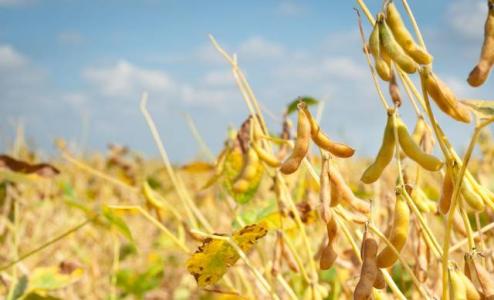
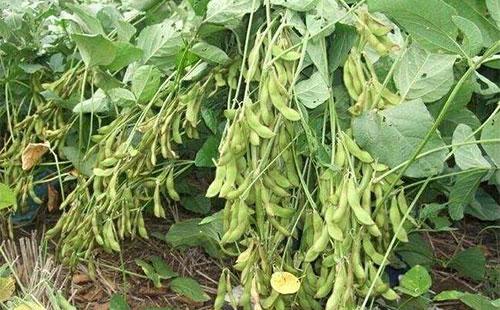
Soybean (scientific name: Glycine max (Linn.) Merr.), commonly known as yellow bean. It is an annual herb of the class Dicotyledoneae, family Fabaceae (Leguminosae), and genus Glycine, with a height of 30-90 cm. The stem is thick and upright, densely covered with long brown stiff hairs. The leaves usually have 3 leaflets; the stipules are veined and covered with yellow soft hairs; the petiole is 2-20 cm long; the leaflets are broadly ovate and papery. The raceme is short with few flowers, or long with many flowers; the common peduncle usually bears 5-8 sessile, closely crowded flowers; the bracts are lanceolate and covered with rough appressed hairs; the bracteoles are lanceolate and covered with appressed bristles; the calyx is lanceolate, and the flowers are purple, pale purple, or white, with a petal stalk at the base, and the wings are comb-like. The pod is plump, slightly curved, drooping, yellow-green, and densely covered with brownish-yellow long hairs; the seeds number 2-5, are oval or nearly spherical, with a smooth seed coat, and vary in light green, yellow, brown, and black. The flowering period is June-July, and the fruiting period is July-September.
Cultivation Techniques
Deep Fertilization
Fertilization method: under normal circumstances, keep the fertilizer and seed separate, applying it 4-5 cm below and to the side of the seed; the amount of chemical fertilizer can be adjusted. When applying more than 20 kg of diammonium phosphate per 667 sq m, it can be applied in layers: the upper seed fertilizer layer at a depth of 5-7 cm, accounting for 1/3 of the application amount; the base fertilizer layer at a depth of 10-16 cm, accounting for 2/3 of the application amount. Alternatively, after the previous crop is harvested, evenly broadcast the fermented organic fertilizer on the soil surface, then use a rake to work the fertilizer into the soil. After the manure and soil are fully mixed, carry out deep plowing; after plowing, harrow, level, and refine the soil to form ridges, or soybean can also be planted flat.
Fine Sowing
Reasonable crop rotation: it is best to choose a proper rotation field, and avoid continuous cropping or alternating cropping on the same field.
Careful land preparation: carry out summer-autumn plowing according to the previous crop, at a depth of 22-25 cm. During operation, do not bring up large clods of soil, do not produce open strips or furrow blocks, and ensure the soil is tightly closed, with no repeats or omissions.
Soil moisture: after land preparation, the soil moisture content (dry soil weight %) should be about 22% at sowing, to ensure normal seed water absorption and sprouting.
Sowing at the right time: for summer-sown soybean, after the wheat harvest, as long as the soil moisture is suitable, it can be sown. The best sowing period is June 10 to 25, and at the latest no later than early July.
Field Management
Hoeing and intertillage:
(1) Before the first compound leaf, hoe the field once, making sure to hoe away weeds in the seedling rows without injuring the seedlings, and loosen the surface soil.
(2) When the seedlings are about 10 cm tall, carry out the second intertillage, making sure not to injure the seedlings, not to press the seedlings, and not to leave weeds.
(3) About 10 days after the second intertillage, carry out the third, making sure to loosen deeply and bring up more soil.
Pre-emergence weed control: the most commonly used broad-spectrum herbicides in production are Pursuit and Command; these two herbicides are effective against many grass weeds and broadleaf weeds in soybean fields. Dosage: 5% Pursuit aqueous solution, 1.5-2 kg per hectare; 48% Command emulsifiable concentrate, 2-2.5 kg per hectare. Pursuit, chlorimuron-ethyl, and Command can all remain in the soil for a relatively long time, so special attention must be paid to phytotoxicity to subsequent crops.
Post-emergence weed control:
(1) Types of herbicides Herbicides suitable for the early emergence stage: currently the most widely used in production is Pursuit. Apply when weeds have just emerged, generally no later than the soybean 2-compound-leaf stage. The dosage of Pursuit applied at the early emergence stage is: 5% Pursuit aqueous solution at 1-1.5 kg per hectare, preferably not exceeding 1.5 kg. It should be applied on days with relatively high humidity before or after rainfall, avoiding hot, dry noon and windy weather.
(2) Dosage 12% sethoxydim emulsifiable concentrate, 1-1.5 kg per hectare; 15% quizalofop-p-ethyl, 0.75-1 kg per hectare; 5% quizalofop-p-ethyl emulsifiable concentrate, 24% lactofen emulsifiable concentrate, 0.33-0.75 kg per hectare. Application period: herbicides suitable for the late emergence stage are generally applied at the soybean 2-3 compound-leaf stage. In years with good spring soil moisture, application can be appropriately earlier, and the lower limit of the dosage is generally used. In dry springs, application can be appropriately later, and the upper limit of the dosage is generally used.
Summer Sowing Techniques
Pre-sowing irrigation: for plots with poor
soil moisture, where irrigation conditions are available, irrigate once before sowing to facilitate seed germination after sowing. Combine irrigation with closed-field weed control.
Sowing period: because the growing season for summer-sown soybean is relatively short, sowing early at the right time is very important. Sowing at the right time gives a high seedling survival rate, neat and robust emergence, good growth and development, and thick stems.
Reasonable close planting: reasonable close planting means, under the specific local and current conditions, correctly handling the relationship between individuals and the population, so that the population develops to the greatest extent and individuals also develop fully; so that light energy and soil fertility per unit area are fully utilized; and under the same cultivation conditions, the best economic benefit can be obtained. It can be sown on field ridges, which can increase the sowing area, and the soybean taste is also better.
Autumn Sowing Techniques
Land preparation: after plowing the paddy field, divide it into beds, with bed width 2-3 m, row spacing 3 m, and hole spacing 0.33 m. Sow 2-3 seeds per hole, with a density of about 30,000 plants per mu.
Sowing at the right time: generally sow before August 10, with a sowing rate of 8-10 kg per mu.
Reasonable fertilization: use 25 kg of calcium magnesium phosphate fertilizer mixed with 500 kg of farmyard manure per mu as covering seed fertilizer; at the early flowering stage, according to seedling condition, apply 3-5 kg of urea per mu as topdressing; at the pod-setting stage, use 2% superphosphate clear liquid at 40-50 kg per mu, and 0.05% ammonium molybdate diluted solution at 30-40 kg per mu, mixing the two and spraying on the leaf surface; or spray 0.1% borax solution on the leaf surface to improve seed plumpness.
Field management: when high temperature occurs at sowing, first make the beds and then irrigate. If moisture is insufficient after sowing, irrigate with running water in the evening. At the 3-leaf stage, thin and finalize the seedlings in time; the usual final seedling density is 30,000-40,000 plants per mu, and after finalizing the seedlings, apply 6-8 kg of urea per mu in time as topdressing. Carry out timely intertillage and weeding, generally 2-3 times, and also hill up the soil.
Nutrition:
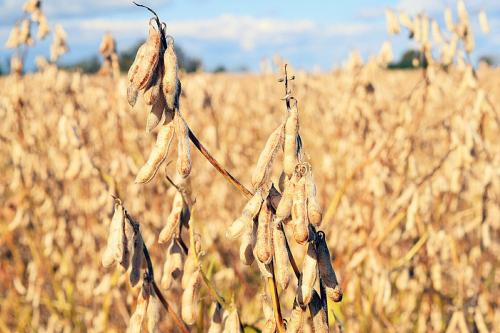
Soybean does not refer only to yellow soybean; it also includes black soybean and green soybean. Its nutrition is comprehensive and rich in content.
Among these, the protein content is 2 times higher than that of pork and 2.5 times that of eggs. The protein content is not only high, but also of good quality. The amino acid composition of soybean protein is similar to that of animal protein, and the amino acids are relatively close to the ratio needed by the human body, so it is easily digested and absorbed. If soybean is eaten together with meat foods and egg foods, its nutrition can compare with that of eggs and milk, and may even exceed the nutrition of eggs and milk.
Soybean fat also has very high nutritional value. This fat contains many unsaturated fatty acids and is easily digested and absorbed by the human body. Moreover, soybean fat can prevent the absorption of cholesterol, so soybean is an ideal nutritional product for patients with arteriosclerosis.
The dietary fiber in
okara plays a decisive role in promoting good digestion and the excretion of solid waste. Appropriately supplementing cellulose can make food in the intestinal tract larger and softer, promote intestinal peristalsis, thereby speeding up defecation and preventing constipation and reducing the risk of colon cancer. At the same time, dietary fiber has obvious functions in lowering
plasma cholesterol, regulating gastrointestinal function, and
insulin levels.