Detailed Explanation of Orostachys fimbriatus Planting Methods and Technical Points
Orostachys fimbriatus (scientific name: Orostachys fimbriatus (Turcz.) Berger): a biennial herbaceous plant of the genus Orostachys in the Crassulaceae family. Leaves alternate, spiny, linear to lanceolate; raceme compact, dense, can form a pyramid shape 20 cm wide; pedicels up to 1 cm long, sepals oblong, petals red, lanceolate-elliptic, anthers purple; nearly square, follicles oblong, beak slender, seeds numerous, small, ovate; flowers in August-September, fruits in September-October.
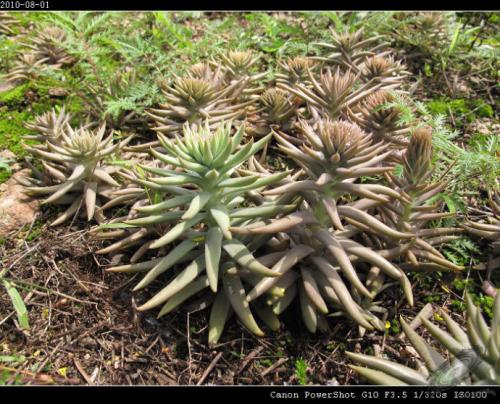
Growth Habits of Orostachys fimbriatus
It grows on stony hillsides and rocks, as well as on the roofs of tile-roofed or thatched houses. It is widely distributed on sunny slopes in deep mountains, in rock crevices, and also grows in the cracks of old roof tiles; it is drought-tolerant and cold-tolerant. It grows on roofs, wall tops and rocks.Planting Methods of Orostachys fimbriatus
Orostachys fimbriatus is easy to cultivate; production bases or roof gardens should use well-drained soil rich in humus. In daily cultivation, attention should be paid to ventilation in summer, and watering should be controlled during high temperatures. For pot cultivation, use loose, breathable sandy soil, or mix one part river sand with one part nutrient soil rich in organic matter, and plant in a shallow pot with a slightly larger diameter, which can produce more adventitious buds.
Light: Orostachys fimbriatus likes light and fears shade; choose a sunny place for cultivation, preferably placed on a balcony, roof or in a courtyard. With sufficient light, the leaves are plump, the leaves are short with dense nodes, and the plant shape is compact; the leaves change from emerald green to red, and under high temperature and strong light, they become iron-red or dark purple. Orostachys fimbriatus placed in semi-shade or on the inner side of a balcony can also grow, but the stem nodes and leaves become longer, and the growth is weak. The plant shape is loose, not compact, and the leaves are powdery green. When the flowering stem is growing, the position should be changed frequently to prevent it from growing toward the light, which would cause the plant to bend and affect its ornamental value.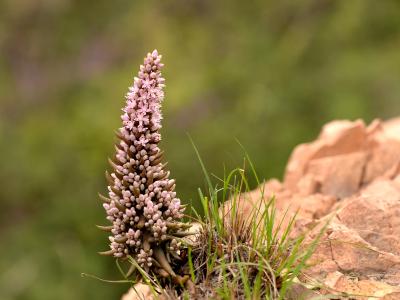
Fertilization: During the growing period, it does not need too many nutrients, and generally no fertilization is needed. During the new leaf germination and growth period, apply once a month a thin, well-rotted organic fertilizer or a low-nitrogen, high-phosphorus-potassium compound fertilizer; stop fertilizing during high temperatures; when flower buds are developing and the flowering stem is extending, water once with a 0.1% potassium dihydrogen phosphate aqueous solution, which can make Orostachys fimbriatus grow luxuriantly and bloom abundantly.
Temperature: Orostachys fimbriatus is heat-tolerant and cold-tolerant, and can endure temperatures from -20 to 40°C. However, during high summer temperatures, the plant grows slowly, and newly planted plants should be properly shaded to avoid heat. On continuous rainy days, avoid rain in time, or place it in a well-ventilated place where rain cannot reach, and control watering, so as to avoid plant rot caused by stuffiness, humidity, and water accumulation in the soil. In winter, when the nighttime temperature is not lower than 5°C and the daytime temperature is above 15°C, the plant can continue to grow. The rosette-shaped fleshy leaves are not cold-tolerant; when the temperature is below 0°C in winter, they will suffer frost damage, shrink and fall off; while the shortened stem formed by dense scale-like leaves growing from its center can withstand severe cold of around -20°C. It can overwinter in the open field.