A Detailed Explanation of Cornus Planting Methods and Technical Key Points
Cornus, also known as "Yuejiao" or "Aizi," is an evergreen aromatic plant with functions of insecticidal disinfection and dispelling cold and wind. Woody cornus includes Wu cornus (Evodia rutaecarpa), Cornus officinalis, and edible cornus, all of which are famous traditional Chinese medicines. Wearing cornus is one of the Han Chinese seasonal customs. On the Double Ninth Festival on the ninth day of the ninth month, people climb mountains and wear cloth bags with cornus inserted on their arms (called "cornus bags" in ancient times). Cornus is a small deciduous tree that bears small yellow flowers and oval red fruits with a sour taste, which can be used as medicine.
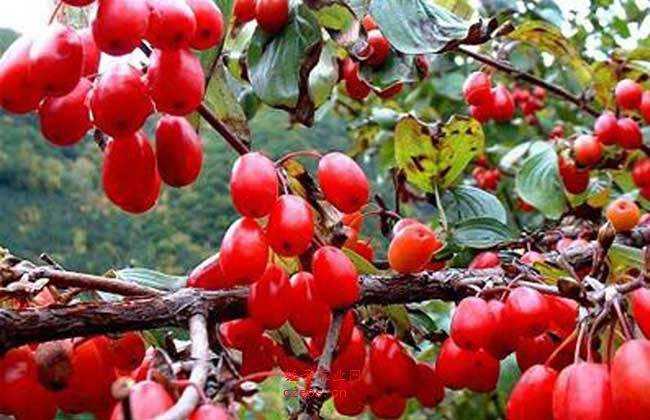
Planting methods:
1. Site selection
For cornus seedling beds, choose gently sloping or flat land that is sheltered from the wind, faces the sun, has good light, and deep soil layers. The soil should be loose, fertile, moist, well-drained sandy loam near a water source with convenient irrigation, and the soil pH should be neutral or slightly acidic. Continuous cropping is not suitable. For planting forest land, soil that is neutral to slightly acidic, with granular structure, good permeability, good drainage, rich in humus and various mineral nutrients, and relatively fertile is suitable. Slopes between 200-1200 m in altitude that are sheltered from the wind and face the sun, with a gradient not exceeding 20°-30°, are appropriate. High mountains, shady slopes, insufficient light, heavy clay soil, and poor drainage areas are not suitable for cultivating Cornus officinalis.
2. Land preparation
After the seedling bed is selected, a deep plowing should be carried out before winter, with a depth of 30-40 cm. Before sowing, 2500-3000 kg of farmyard manure and 50 kg of fully fermented cake fertilizer can be applied per mu, then beds are made, with a bed width of 1.2 m, a ditch width of 30 cm, and a height of 25 cm, and the bed surface is shaped like a tile back. For seedling beds prone to underground pests such as mole crickets and grubs, 1.5 kg of phoxim powder can be spread per mu during land preparation to control underground pests, and 0.5 kg of 50% carbendazim can be used to disinfect the soil to control damping-off disease in the nursery.
Cornus planting sites can be prepared by full land preparation, strip preparation, or block preparation according to specific conditions, and then planting holes are dug, with a hole size of 50 cm × 50 cm × 50 cm, digging 30-50 holes per mu.
3. Sowing and seedling raising
Cornus sowing and seedling raising is generally carried out around the Spring Equinox, sowing the germinated seeds into the seedling bed. Open furrows at a row spacing of 25 cm, with a furrow depth of 5 cm, evenly scatter the seeds into the furrows, and cover with 3-4 cm of farmyard manure. Each mu of seedling land requires 40-60 kg of seeds. After sowing, pay attention to maintaining soil moisture; germination and emergence usually occur in 40-50 days. After emergence, keep the soil moist. When the seedlings produce 3-4 pairs of true leaves, thin and weed 2-3 times, keeping a plant spacing of 7 cm. Apply topdressing twice in June-July, and combine with cultivating to apply 4 kg of urea per mu in the evening or after rain. When the seedlings are 10-20 cm tall, pay attention to drought prevention and shading in case of drought and strong light. Before winter, water once with freezing water and apply farmyard manure around the roots to ensure the seedlings overwinter safely. If water and fertilizer management is timely, annual seedlings can reach more than 70 cm in height. Transplant and plant around the "Spring Equinox" of the following year.
4. Grafting propagation
Cornus officinalis is grafted within the species, with close genetic relationship and strong compatibility; the survival rate can reach more than 70%, and the seedlings grow well. Methods include bud grafting and scion grafting, with bud grafting being dominant in production.
The "T"-shaped shield bud insertion method is usually adopted. It is carried out from July to September, and the rootstock uses seedlings of excellent varieties. The scion uses branches from robust, large-fruited, thick-fleshed, pest-free mother trees of mature age that have already flowered and fruited. The method is: make a horizontal cut about 0.5 cm above the scion bud, deep into the xylem, then cut the bud upward from about 1 cm below the bud (slightly with xylem), attach it to the grafting site of the rootstock, choose a smooth surface, preferably the north side, make a horizontal cut, then make a vertical cut downward from the incision to form a "T" shape, deep to the xylem, gently peel open the bark, insert the bud bark into the "T"-shaped incision, and finally wrap with film from bottom to top, exposing the bud eye, tie a slip knot, and immediately untie it when sprouting begins the following year. After that, strengthen management, carry out timely cultivating, weeding, and topdressing to promote seedling growth. When the seedlings are more than 30 cm tall, they can be lifted from the nursery for transplanting.
5. Transplanting and planting
It is necessary both to make full use of limited land and to ensure the normal growth of Cornus officinalis. It is suitable to plant 30-50 plants per mu. If intercropping with other shrubs or trees, only about 20 plants can be planted. The overall layout is best arranged in a square. Cultivation land with good conditions should be sparser, and cultivation land with poor conditions can be denser. The planting season is during the dormancy period of Cornus officinalis. At this time, temperature and moisture are both in a gradually rising stage, which is the most suitable planting period. It is generally carried out from December to January of the following year. Transplanting after January significantly reduces the survival rate. Seedling lifting should be done on cloudy days, with soil attached to the roots; before planting, trim the root system and dip it in mud slurry to protect the seedlings from damage. The root system must not be exposed to the sun or wind. In the prepared planting holes, apply 2 kg of barnyard manure per hole, mix well with soil, and apply. If the seedling root system is too large, trim the planting hole to avoid root bending. When soil is buried to the original soil mark at the root collar of the seedling, gently lift the seedling once to let the root system spread out, straighten it, fill soil, and firm it, then water with settling water to favor survival.
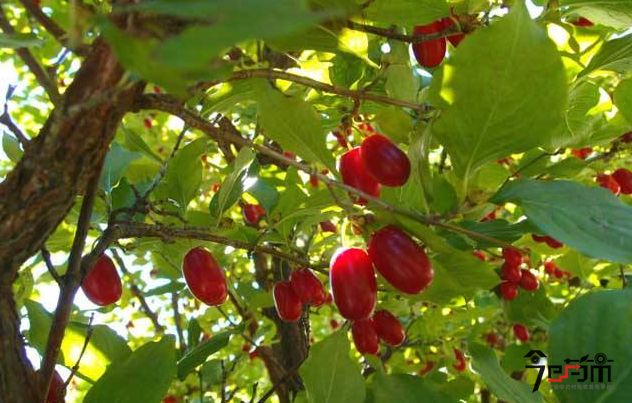
Disease control of cornus
Angular leaf spot. Damage symptoms: It mainly damages leaves, causing early leaf withering, forming a large amount of leaf fall, early tree decline, and delayed fruiting of young trees. The disease occurs in both new and old orchards. According to surveys in mountainous areas, the rate of affected plants in severely diseased orchards is as high as more than 90%, and the leaf damage rate is about 77%, with wide distribution and great damage. The lesions form polygonal shapes due to restriction by leaf veins. When rainfall is abundant, the damage is severe; after leaf fall, fruit drop follows. Trees with poor soil, drought and barren conditions, and poor nutrition are susceptible to the disease.