Detailed Explanation of London Plane Planting Methods and Technical Points
The London plane tree grows 20-30m tall, with a tall, upright trunk and a broad bell-shaped crown. The bark is grayish-brown or grayish-white and peels off in thin flakes during the growing season. Young branches and young leaves are densely covered with brown stellate hairs. The leaves are palmate with 5-7 lobes, deeply cleft to the middle, the lobes longer than wide, the leaf base broadly wedge-shaped or truncate, the leaf margin toothed, with palmate veins and rounded stipules. The inflorescence is a head, yellow-green. The numerous nuts are gathered into a spherical syncarp, 3-6 balls forming a string, with a persistent style long and bristle-like, and the fruit stalk long and drooping. The London plane is also called French plane, sycamore, etc. The flowering period is April-May; the fruit ripens in September-October.
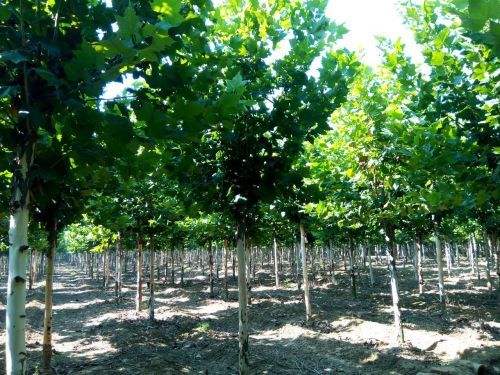
Cultivation techniques:
1. Planting:
Planting before bud break in early spring makes it easier to survive. The planting soil should be deep and fertile, with an organic matter content of 1% to 3%, and good air and water permeability. Place decomposed organic fertilizer at the bottom of the pit, then add 20 cm of matured soil and mix thoroughly to avoid burning the roots. If the weather is dry, fill the planting pit with water, and plant after the water has drained away. London plane is usually planted with a soil ball. After deep planting, the London plane does not easily develop roots, so shallow planting is preferable, usually with the original root collar line level with the ground or 1 cm to 2 cm above it.
2. Water and fertilizer management:
Water 5 to 7 days after planting. After the London plane survives, it does not need frequent watering. Generally, the first watering is done after the soil thaws and before bud break. In May, if the weather is dry, a second watering may be given to benefit the growth and development of the London plane. In the rainy season, water according to the weather conditions. The London plane is drought-tolerant and afraid of waterlogging, so drainage should be noted on rainy days. Because the root system of the London plane has a high respiration demand, prevent root rot and death caused by excessive soil moisture and lack of oxygen. Fertilize in spring and autumn, outside the crown, using the ring fertilization method or the hole-punching method, applying decomposed organic fertilizer once, then watering.
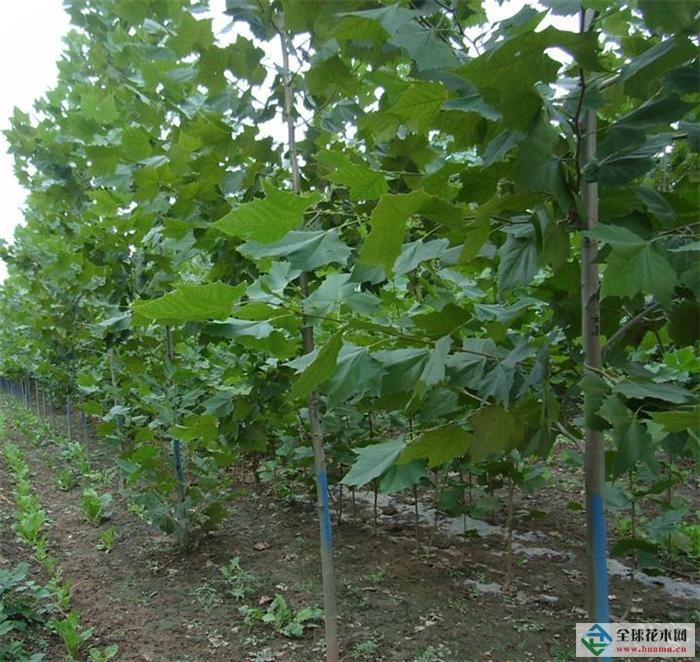
Cultivation and pest and disease control. The London plane does not need special pruning. Before transplanting, trunk-height pruning may be carried out, and at the same time overly dense branches, diseased and pest-infested branches, damaged branches and dead branches should be cut off. During its growth process, because it grows slowly, it is generally not pruned. During maintenance, timely cultivation and weeding are needed to reduce weeds, which is beneficial to tree growth, and at the same time improves soil aeration conditions, promotes root growth and the sprouting of new roots. The London plane has few pests and diseases. In years with high summer temperatures and drought, seedlings of the current year or newly transplanted seedlings are prone to scorching at the stem base, allowing pathogens to invade, and rot disease is likely to occur after rain. In summer, shade nets may be set up or Bordeaux mixture used for control. The main pest is white grubs. London plane cultivation is simple and management is extensive, making it an excellent landscaping tree species. Management after transplanting the London plane is very important, but at the time of transplanting, the soil porosity and the ratio of root size to the amount of branches and leaves retained can also affect the survival of the transplanted London plane.
Value in use:
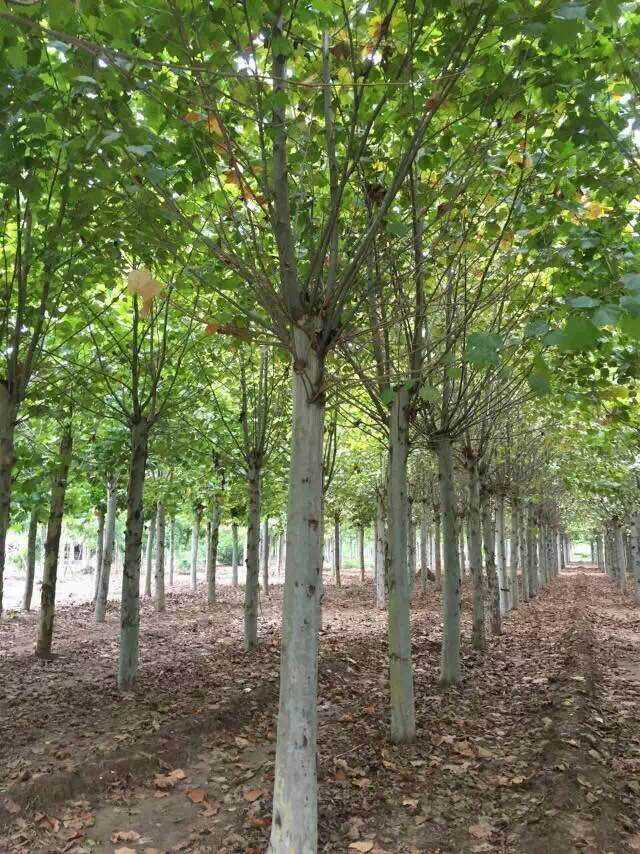
The tree form is majestic and dignified, with large leaves and dense shade, smooth bark, and strong adaptability. It is widely cultivated in various places and is an excellent, world-famous shade tree and street tree. It has strong adaptability and also tolerates pruning and shaping, making it an excellent street tree species. It is widely used in urban greening. In gardens, it is planted alone on lawns or open ground, or planted in rows on both sides of walkways, where it is especially majestic and spectacular. Because it is also relatively resistant to a variety of toxic gases and can absorb harmful gases, it is quite suitable for greening neighborhoods and factories and mines. The fruit can be used as medicine. Garden tree and street tree. The wood can be used to make furniture.