A Complete Guide to Oleander Planting Methods and Care Tips
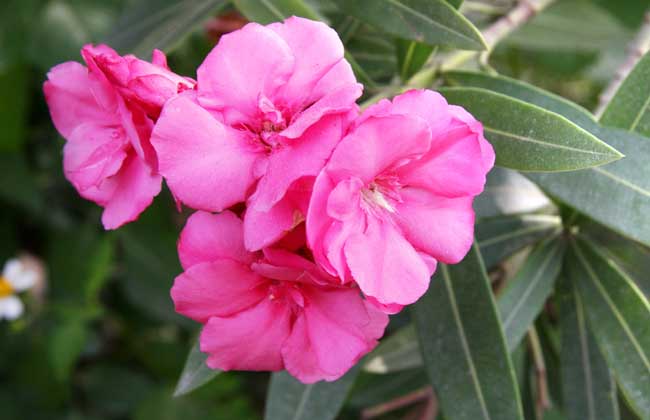
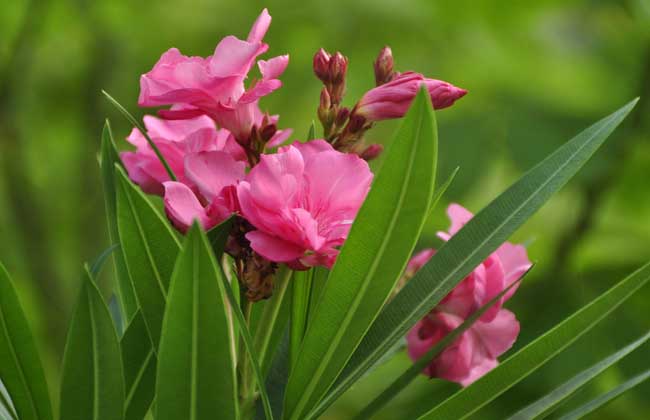
Oleander, also known as "willow-leaf peach" and "half-year red", belongs to the Apocynaceae family. It is an evergreen shrub, and can sometimes grow into a small tree. It can reach a height of more than five meters. The leaves are leathery, borne in whorls of three, lanceolate, 16 to 26 cm long and 1 to 3 cm wide. The flowers are peach-red or white, blooming successively from June to October. Because its leaves resemble bamboo leaves and its flowers resemble peach blossoms, it is named "oleander". Oleander is evergreen all year round, graceful in form, and has a long flowering period, so residents like to plant it in their courtyards.
Oleander likes sunlight and warm, humid, hot climates; in high-temperature seasons it blooms most profusely. It is not tolerant of waterlogging or cold; where it is planted in the ground north of the Yangtze River, it must be wrapped in straw in winter to protect it from freezing; potted plants must be moved to a warm place to overwinter after winter begins. Oleander has a well-developed root system and is very drought-tolerant. It does not demand much from site conditions and can grow in all kinds of soil. It has few pests and diseases, and cultivation and management can be extensive. When transplanting, it should be heavily pruned so that the base has strong sprouting ability and sends out new branches. The branch tips of oleander generally have three branches, and each branch each year produces three new branches again, forming a three-forked, nine-topped shape, so every few years it can be heavily pruned and lowered. For potted plants in the north, the pot must be changed once every three years; when changing the pot, the old branches should be cut off to promote the sprouting of new branches and renew the crown. When grown in the open ground, the trunk must be wrapped with rice straw in winter to protect it from freezing.
How to grow oleander
1. Watering: Although oleander likes water, it fears waterlogging. On consecutive rainy days, the water accumulated in the pot should be poured out promptly to prevent root rot. If watered too much, the leaves will turn yellow and fall off one after another, affecting flowering the following year. In spring and autumn, watering should follow the principle of watering when dry and stopping when wet, keeping the potting soil moist as appropriate. Summer is exactly the period of vigorous growth and flowering for oleander, so it needs more water; it is best to water once each morning and evening, and pay attention to frequently spraying and washing the branches and leaves to keep the leaf surface fresh and emerald green. Move it indoors in mid-October; after moving indoors, watering must be controlled, and too much water must be avoided, otherwise it is prone to root rot and leaf drop, affecting growth the following year.
2. Light: Oleander likes sunlight, so during the growing period it needs to be kept in a place with sufficient sunlight for care; otherwise it will have few flowers and pale color.
3. Temperature: Oleander should be planted in a wind-sheltered, sunny place. In winter, move it indoors to prevent freezing; a room temperature no lower than 0°C is sufficient. If the temperature is too high, it consumes nutrients, which is unfavorable for growth and flowering the following year. Where outdoor temperatures are high in winter, soil can be mounded up around it to protect it from the cold.
4. Fertilizing: Oleander likes fertilizer. From the time it is moved outdoors until the flowers fade (Frost's Descent), a dilute liquid fertilizer can be applied about once every 20 days. After the Beginning of Autumn, oleander grows rapidly; at this time, a fertilizer solution can be applied about once every 15 days until just before it is moved indoors.
5. Pruning: Oleander is generally pruned four times: first, after Grain Rain in spring; second, during July and August; third, during October; and fourth, winter pruning. If it is to bloom indoors, it must be moved to a sunny place indoors at about 15°C. Prune immediately after flowering, otherwise there will be few and small flowers, or even no flowers at all. Through pruning, the branches are evenly distributed, the flowers are large and vivid, and the tree shape is beautiful.
6. Diseases: Brown spot is an important disease on oleander. In the early stage of the disease, spray 50% benomyl wettable powder at 1000 times dilution, or 25% carbendazim wettable powder at 600 times dilution, or 36% thiophanate-methyl suspension concentrate at 500 times dilution. For the control of black spot, management should be strengthened to increase tree vigor, and when necessary spray 75% chlorothalonil at 700 times dilution.