How to Grow Bleeding Heart (Dicentra spectabilis): Detailed Planting Methods and Care Tips
Bleeding heart (Latin scientific name: Dicentra spectabilis (L.) Lem.) is a perennial herbaceous plant in the poppy family, genus Dicentra (bleeding hearts), with a plant height of 30-60 cm. The aboveground stem is erect, cylindrical, and tinged with purplish red; the rhizome is fleshy; the leaflets are usually entire, green on the surface and white-powdered on the underside, with prominent veins on both sides; the petiole is about 10 cm long and resembles that of Angelica sinensis (dong quai).
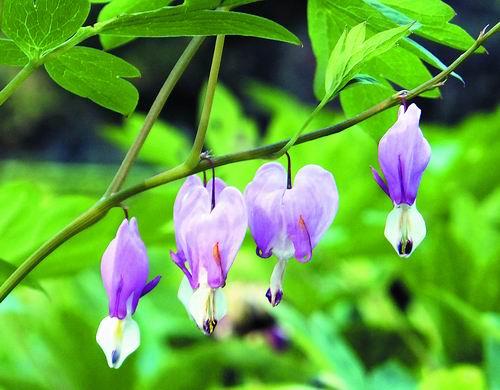
How to grow bleeding heart:
Water and fertilizer:
Bleeding heart has fleshy roots and is somewhat drought-tolerant but afraid of waterlogging. Therefore, water it in appropriate amounts according to factors such as the weather, the moisture level of the potting soil, and the plant's growth condition. Stick to the principle of "do not water when dry, water as soon as it dries, water thoroughly when you water, and never let water accumulate." During the growing season in spring, autumn, and early summer, water once a day or every other day on sunny days, and once every 3 to 5 days on cloudy days, keeping the potting soil at about half moisture, which benefits its growth; too wet easily causes root rot, while too dry leads to poor growth and yellow leaves. During the dormant periods in midsummer and winter, the potting soil should be relatively drier, just slightly moist.
Bleeding heart likes fertilizer. When potting, planting out, or repotting and changing the soil, it is advisable to add some bone meal, decomposed organic fertilizer, or a nitrogen-phosphorus-potassium compound fertilizer to the growing medium. During the growing season, apply a dilute nitrogen-phosphorus-potassium liquid fertilizer once every 10 to 15 days to promote lush leaves and abundant flowers. Stop fertilizing once the flower buds show color, and do not fertilize during the dormant period.
Light and temperature:
Bleeding heart is native to Hebei and Northeast China. It likes a semi-shaded environment with ample diffused light and is fairly cold-tolerant, but it fears the intense heat of midsummer and strong direct sunlight. Therefore, it is best placed under large trees in the courtyard, under a grape trellis, on the shaded side of tall buildings, or on an east- or north-facing balcony. During the summer dormant period, place it in a well-ventilated shady spot away from direct sunlight, and frequently sprinkle water on the nearby ground to raise air humidity and lower the temperature.
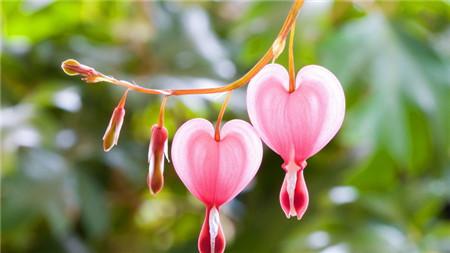
Summer and drainage:
Bleeding heart cannot tolerate prolonged rain and excessive moisture or intense summer heat. Prolonged hot, humid weather will cause the leaves to scorch and the roots to rot. During the hottest part of midsummer, potted bleeding heart can be moved under a seedling shed for shade, or the pots can be buried together in the soil to prevent overheating and lower the temperature, while keeping drainage and ventilation good. On rainless days, spray the branches, leaves, and surrounding area daily to increase air humidity and ensure water supply during the flower bud differentiation period. In the rainy season, pay attention to drainage; on cloudy and rainy days, tip the flower pot on its side to prevent water from accumulating in the pot.
Pruning and overwintering:
To improve ventilation and light penetration for bleeding heart and concentrate nutrients, shaping and pruning should also be done after the leaves fall in autumn and winter. Cut out overly dense branches, such as parallel branches, crossing branches, inward-growing branches, and diseased or pest-infested branches, so the plant keeps a beautiful form. In late autumn and early winter, potted bleeding heart can be buried in the soil with the branches exposed above ground, and then covered with straw or mounded soil for winter protection. Some people also place the flower pots directly in a cellar to overwinter; in early spring of the following year, remove the covering, move them out of the cellar, place them in a ventilated, sunny spot, and strengthen fertilizer and water management to let them bloom naturally. Others place them in a greenhouse or plastic tunnel to force early blooming according to holiday needs.
Medicinal value: The whole plant is used as medicine and has effects such as pain relief, antispasmodic, diuretic, menstrual regulation, blood-dispersing, blood-harmonizing, wind-dispelling, and sore-toxin-clearing properties. It is cultivated in gardens for ornamental purposes.