A Detailed Guide to Mahogany Planting Methods and Key Technical Points
Mahogany (scientific name: Swietenia mahagoni (L.) Jacq.): an evergreen large tree, reaching over 25 m in height, with a diameter of up to 4 m, the base expanding into buttress roots; bark pale red, scaly; branches widely spreading, smooth, gray. Leaves 35 cm long, with 4-6 pairs of leaflets, dark green above, pale green beneath. Panicles axillary, 6-15 cm long, hairless, stalked, with sparse and short branches; petals white, hairless, 3-4 mm long, widely spreading. Capsules large, ovoid, woody; seeds numerous, 18 mm long, 7 cm long including the wing. Flowering from May to June, fruiting from October to November.
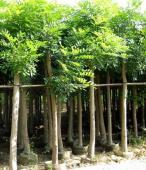
Seedling-raising techniques
1. Mother tree selection: Select healthy 10-15 year old trees that are tall, straight, well-rounded, free of pests and diseases, and vigorous as mother trees for seed collection.
2. Seed collection: When the fruit changes from grayish green to brownish red, it indicates that the fruit has entered maturity. It can be picked when the capsule is about to split. After picking, place it in a cool place for 1-4 d until it splits, or break open the pericarp, take out the seeds, and remove the membranous seed wings. The germination rate of fresh seeds can reach 95.
3. Nursery site preparation: The nursery site should be sandy loam with good drainage (that is, 1/4 fine sand and 3/4 loam) to avoid seed rot caused by water accumulation in the seedbed. Sow the seeds directly on the seedbed at a sowing rate of about 80 seeds/sq. After broadcasting on the seedbed, cover with about 0.5 cm of fine sandy soil and shade. After sowing, germination generally begins in 10-20 d, and the germination period can last about 1 month. After the seedlings grow 1-2 true leaves, they can be directly transplanted into nutritional bags.
4. Seedling management. When the transplanted seedlings recover and regain vigor, apply thin fertilizer. After sowing, water once every morning or afternoon to keep the seedbed moist. Seedlings should be shaded with a shade net to prevent the seedlings from being scorched by sunlight.
5. Nursery-out standard: 1-1.5 year old seedlings with a height of 1-2 m can be released from the nursery for afforestation. For courtyard greening, 2-3 year old large seedlings are preferable.
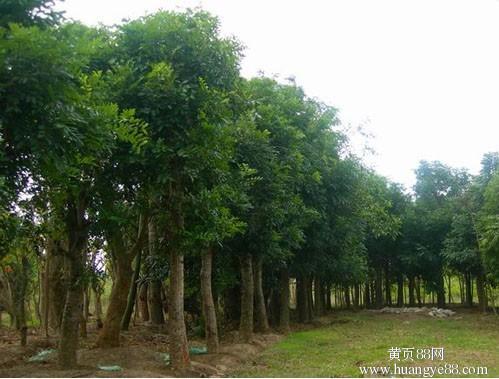
Afforestation and tending techniques
1. Forest land selection: The suitable temperature for planting large-leaf mahogany is 10 - 369v, the optimum growth temperature is 25-3090, and the annual rainfall is 750-4 500 mm; the seedlings are relatively cold-tolerant and can withstand a low temperature of 1°C. Mature trees can withstand extreme low temperatures of about 1-2°C, with only the leaves and immature fruits falling off, and they quickly regrow leaves after the temperature rises; they can adapt to different soil types, but well-drained sandy loam is best.
2. Reasonable planting: Prepare the land in hole-shaped spots along horizontal belts. The planting hole specification is 50 cm x 50 cm x 40 cm. Return topsoil to the hole, and at the same time appropriately use well-rotted manure as base fertilizer. The afforestation density is 4 m x 4 m. During the young forest period, leguminous herbaceous plants can be intercropped to improve light energy utilization and promote seedling growth. When establishing mixed forests, some fast-growing tree species should be selected so that they can provide shade for large-leaf mahogany saplings during the young forest period, but pruning should be carried out later, otherwise it will affect the growth of large-leaf mahogany.
3. Weeding: In the same year after afforestation, completely cut down weeds and loosen the soil around the holes once. In the following 3-4 years, cut grass 2-3 times a year and loosen the soil 1-2 times. At the same time, combined with fertilization, apply 50-100 g of compound fertilizer or 300-500 g of organic fertilizer per plant once every spring.
3. Weeding: In the same year after afforestation, completely cut down weeds and loosen the soil around the holes once. In the following 3-4 years, cut grass 2-3 times a year and loosen the soil 1-2 times. At the same time, combined with fertilization, apply 50-100 g of compound fertilizer or 300-500 g of organic fertilizer per plant once every spring.
Disease control
Diseases: The main diseases of large-leaf mahogany are damping-off, root rot, and stem rot.
1. Damping-off. It mainly infects the roots and stem base during the seedling stage, causing the seedlings to suddenly wither and die. On infected plants and the surrounding surface soil, light brown sporangia 0.5-1 mm in diameter can be seen, along with a layer of white mycelium. Before sowing in the seedbed, disinfect the seedbed and soil with a 500-1 000 times dilution of nitrobenzene for 3 hours.
2. Root rot. When the seedlings appear pale red or pale purple, it indicates infection by root rot pathogens. Before sowing, the seedbed can be disinfected with a 3-6 IJ captan solution, or the seeds can be soaked and disinfected with thiram.
3. Stem rot. This is a seedling-stage disease. The stem base of infected seedlings turns black and rots, causing the seedlings to wither. At present, there is still no good control method.
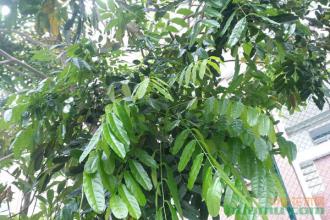
Pest control
Pests: The main pests of large-leaf mahogany are the mahogany leaf miner, quinine gall midge, mahogany shoot borer, and weevils.
1. Mahogany leaf miner. This insect is small and burrows into leaf tissues, causing the leaf surface to turn yellow and wither. A low-toxicity organic insecticide can be sprayed on the leaf surface for control.
2. Quinine gall midge. The damaged parts of large-leaf mahogany turn black. Spraying contact insecticides can effectively control the damage caused by this pest.
3. Mahogany shoot borer. It causes trunk curvature and reduces timber quality. Plants found to be damaged should be immediately removed from the forest land and burned.
4. Weevils. They can cause sap to flow out and become gummy. Spray low-toxicity organic insecticides at the base of the trunk, or hand-collect and kill them.