Key Techniques and Management Methods for Chestnut Cultivation
Chestnut (scientific name: Castanea mollissima BL.), also known as: li (common name), banli (Shilei Hebi), kuili (Hebei and other provinces), maoli (Henan), fengli (Guangdong), has long enjoyed the reputation of the "king of dried fruits," and abroad it is also called the "ginseng fruit." The taxonomic position of the chestnut is Angiospermae, Dicotyledoneae, Archichlamydeae, Fagales, Fagaceae, Castanea.

Cultivation and management techniques:
(1) Selection of chestnut orchard site:
A chestnut orchard should be established on sandy loam with a relatively low groundwater table and good drainage. Avoid planting on saline-alkaline soil, in low-lying, wet, easily waterlogged sites, or in windy places. When opening up a chestnut orchard on hilly or sloping land, choose gentle terrain with relatively deep soil in areas near mountains, and thereafter gradually expand development to areas with poorer conditions.
(2) Variety selection:
For variety selection, locally bred superior varieties should be the main planted varieties, such as Paoche No. 2, Chenguo No. 1, etc., with appropriate introduction of varieties such as Shifeng, Jinfeng, Haifeng, Qingmao Ruanci, and Chushu Hong. According to different culinary requirements, roasted-chestnut varieties should predominate, with appropriate development of superior culinary chestnut varieties, taking into account both foreign trade export and domestic market demand. At the same time, achieve a rational combination of early-, mid-, and late-maturing varieties.
(3) Rational arrangement of pollinizer trees:
Chestnut trees mainly rely on wind to spread pollen, but because chestnut trees exhibit dichogamy of male and female flowers and self-fruiting, a single variety often produces empty burs due to poor pollination. Therefore, a newly established chestnut orchard must include 10% pollinizer trees. Practice has shown that in Xinyang City, using Chushu Hong as a pollinizer tree is better.
(4) Rational close planting:
Rational close planting is a basic measure for increasing yield per unit area. In plain chestnut orchards, 30-40 trees per mu is suitable, and in mountain chestnut orchards, 40-60 trees per mu is suitable. In planned close-planted chestnut orchards, 60-111 trees per mu can be planted, with gradual later thinning by alternate rows and alternate trees.
(5) Rational fertilization:
Rational fertilization is an important foundation for high yield in chestnut orchards. Base fertilizer should mainly be farmyard manure, to improve the soil, enhance the soil's fertilizer- and water-holding capacity, and provide relatively complete nutrient elements. The application time is best in autumn after fruit harvest, when the temperature is relatively high and the fertilizer decomposes easily; at the same time, this period is when new roots are growing, which favors absorption, thereby promoting accumulation of tree nutrients and having a good effect on female flower differentiation the following year. Topdressing should mainly be quick-acting nitrogen fertilizer, combined with phosphorus and potassium fertilizers. The topdressing time is early spring and summer. In spring application, generally newly planted fruit trees are topdressed with 0.3-0.5 kg urea per tree, and large trees in full fruit period are topdressed with 2 kg urea per tree. After topdressing, combine with watering to fully exert fertilizer efficiency. Summer topdressing is carried out from late July to mid-August. At this time, applying quick-acting nitrogen fertilizer and phosphorus fertilizer can promote fruit enlargement, full flesh, and improve fruit quality. Foliar topdressing can be carried out multiple times a year, with emphasis on doing two applications well. The first is in early spring when the leaves at the base of branches just unfold and change from yellow to green, spraying 0.3%-0.5% urea plus 0.3%-0.5% borax, whose role is to promote basic leaf function, improve photosynthesis, and promote female flower formation; the second is at 1 month and half a month before harvest, with an interval of 10-15 days, spraying 0.1% potassium dihydrogen phosphate twice, mainly to improve photosynthetic efficiency, promote transfer of nutrients from leaves and other organs into the fruit, and significantly increase single-kernel weight.
(6) Irrigation:
Chestnut relatively prefers water. Generally, irrigate once before germination and once during the rapid fruit growth period, which is beneficial to normal growth and development of the fruit trees and improvement of fruit quality.
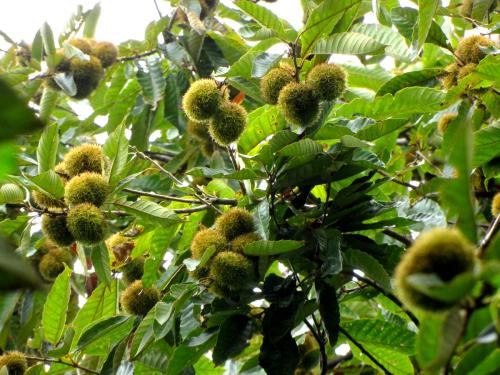
(7) Training and pruning:
Chestnut tree pruning is divided into winter pruning and summer pruning. Winter pruning is carried out from leaf fall to before bud break the following spring, and it can promote the growth vigor of chestnut trees and female flower formation. The main methods include heading back, thinning branches, renewal pruning, delayed pruning, branch bending, and notching. Summer pruning mainly refers to bud removal, pinching, male flower removal, and branch thinning during the growing season, whose role is to promote branching, increase female flowers, and improve fruit set rate and single-kernel weight. 1. Heading back: cutting off part of a one-year-old branch. Heading back can promote branching, strengthen tree vigor, make the canopy compact, reduce male flowers, and adjust nutrient distribution. For vigorous trees and vigorous branches, delayed pruning can be used, heading back after bud break. 2. Renewal pruning: this is heading back of perennial branches. It is mostly used for perennial branches that are weak in growth, whose fruiting parts have moved outward, and whose inner canopy is severely bare. 3. Branch thinning: removing competing branches, shade-casting branches, and slender branches in the inner canopy from the base. 4. Hat pruning: winter heading back near the whorl scars of new shoots that have been pinched different numbers of times. Leaving 2-4 small buds on the new shoot whorl scar and heading back is called live-hat pruning; if handled properly, the small buds on the hat and the large buds below the whorl scar can sprout fruiting branches. Heading back without leaving buds on the new shoot whorl scar is called dead-hat pruning, causing the large buds below the whorl scar to sprout fruiting branches. In general, for branches that are not strong, use dead-hat pruning, and for branches that are strong and vigorous, use live-hat pruning. 5. Delayed pruning: delayed pruning means not pruning. Its main role is to disperse nutrients and moderate tree vigor. Vigorous trees are mostly treated with delayed pruning. 6. Branch bending and notching: for vigorous auxiliary branches in the canopy that have not been pinched, during the period from spring sap flow to bud opening, bend them flat and make notches above each bud at the positions where sprouting is desired, so that they sprout vigorous branches; at winter pruning, then cut the delayed and flattened branches back to the positions where vigorous branches sprouted. 7. Pinching: when a new shoot grows to 30 cm, remove the tip of the new shoot. It is mainly used on vigorous branches, with the purpose of promoting branching and earlier fruiting. Pinch 2-3 times each year. For newly fruiting trees, the new shoots of fruiting branches are long and vigorous; after the pre-fruit shoot grows out, leave 3-5 buds and pinch. After pinching the pre-fruit shoot, about 3 robust branches can form, increasing the proportion of fruiting branches produced, and at the same time slowing the outward movement of fruiting parts. 8. Male flower removal: leave only a few male inflorescences on the branch and remove the rest. Its role is mainly to regulate nutrition, promote female flower formation, and improve fruit-setting ability.
(8) Flower and fruit thinning and pollination:
Flower thinning can be done directly by hand by removing later small flowers and inferior flowers, retaining as much as possible the earlier large flowers and good flowers; generally 1-3 female flowers per fruiting branch is suitable. Fruit thinning is best done with fruit-thinning shears, leaving 1 single bur per node. When thinning flowers and fruits, grasp the principle of leaving more on the outer canopy and fewer in the inner canopy. For artificial supplementary pollination, choose varieties with excellent quality, large kernels, early ripening, and easily peeled astringent skin as pollinizer trees. When the male inflorescences on a branch, or the anthers of most flower clusters on the male inflorescence, have just changed from green to yellow, spread the collected male inflorescences on glass or clean white paper before 5 a.m., place them in a dry, windless place, turn them twice a day, and put the fallen pollen and anthers into a clean brown bottle for later use. When the multi-lobed stigmas of the 3 female flowers in a single bur are fully extended, recurved, and yellow, use a writing brush or a pencil with an eraser tip to dip pollen and dab it on the recurved stigmas. If the tree is tall and dabbing is inconvenient, the gauze bag shaking method or dusting method can be used, prepared by mixing 1 part pollen with 5 parts taro powder as filler.

(9) Harvest and storage:
1. Harvest: There are two chestnut harvest methods, namely the picking method and the beating method. The picking method is to wait until the chestnuts are fully ripe and fall naturally, then manually pick up the chestnut fruits. To make picking chestnuts easier, clear the ground weeds before the chestnut burs split. When harvesting, first shake the tree, then pick up all the fallen chestnut fruits and chestnut burs cleanly. Be sure to persist in picking once in the morning and once in the evening every day, and store them as they are picked. The advantage of the picking method is that the chestnut fruits are plump and full, with high yield, good quality, and strong storability. The beating method is to lightly beat down ripe chestnut burs in scattered batches with a bamboo pole, then pick up the chestnut burs and chestnut fruits cleanly. When using this harvest method, generally beat once every 2-3 days. When beating burs, strike small branches from the outer canopy inward to shake down the chestnut burs, so as to avoid damaging branches and leaves. It is strictly forbidden to beat down all chestnut burs of different maturity at one time. Chestnut burs harvested by beating should undergo "sweating" treatment as soon as possible, because the temperature is relatively high at that time, the chestnut fruits have high water content and high respiration intensity, and generate a large amount of heat; if not handled promptly, the chestnut fruits are prone to mold and rot. The treatment method is to choose a shaded, cool, and ventilated place, spread the chestnut burs thinly, with a thickness of 20-30 cm as suitable, sprinkle water and turn them every day, and after 2-3 days of cooling and "sweating" treatment, carry out manual threshing.
2. Storage: Chestnut fruits have three fears: first, fear of heat; second, fear of drying; third, fear of freezing. Under normal temperature conditions, chestnut fruit rot mainly occurs in the one month after harvest, which is called the dangerous period. From 2-3 months after harvest, there is less rot, which belongs to the safe period. Therefore, doing a good job of temporary storage before transport or storage before entering the kiln is the key to preventing chestnut fruit rot. A relatively simple and feasible temporary storage method is to choose a cool and humid place and build a storage shed of corresponding size according to the amount of chestnut fruits. The shed roof uses bamboo (wood) poles as beams, covered with reed mats, and the surroundings are enclosed with branches or corn and sorghum stalks to prevent sunlight and air-drying. The ground inside the shed should be leveled, with about 10 cm of river sand spread as bedding, then mix at a ratio of 1 part chestnut fruits to 3-5 parts sand, pile the chestnut fruits on top, with a pile height of 30-40 cm, and cover the surroundings of the pile with 10 cm of wet sand. At first, turn once every 3-5 days, and after half a month, turn once every 5-7 days; each turning must remove rotten and deteriorated chestnut fruits. To prevent air-drying, also pay attention to sprinkling water to maintain moisture.