Detailed Explanation of Cymbidium sinense Planting Methods and Technical Points
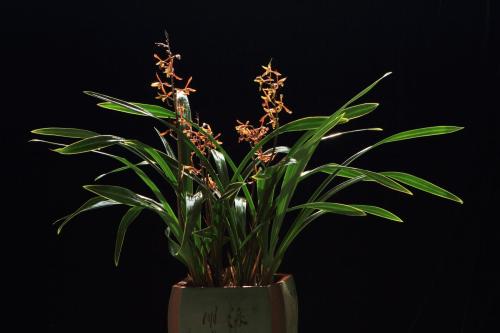
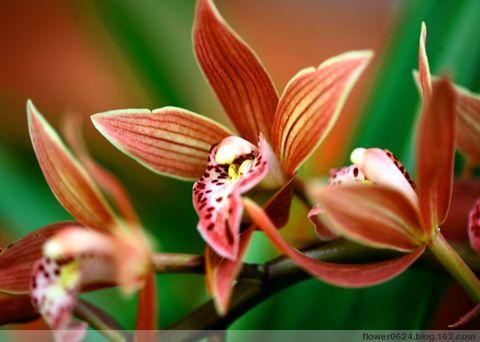
Cymbidium sinense (scientific name: Cymbidium sinense (Jackson ex Andr.) Willd.): also known as Baosui Orchid, it is a terrestrial plant of the genus Cymbidium in the family Orchidaceae. The pseudobulb is ovoid, enclosed within the leaf bases. The leaves are strap-shaped, nearly thinly leathery, dark green. The flower scape emerges from the base of the pseudobulb, upright, relatively stout, generally slightly longer than the leaves; flower color varies considerably, most often dark purple or purplish-brown with a lighter-colored lip, and there are also yellow-green, peach-pink or white forms, generally with a relatively strong fragrance; the sepals are narrowly oblong or narrowly elliptic; the petals are nearly narrowly ovate; the lip is nearly ovate-oblong; the column is slightly curved forward, with narrow wings on both sides; there are 4 pollinia, in 2 pairs, broadly ovate. The capsule is narrowly elliptic.
Cultivation Techniques
1. Cultivation substrate
Traditional Chinese potted orchids mostly use the humus soil from beneath the forests of their place of origin, which the locals call "orchid mud." This soil is rich in humus, loose and non-sticky, and often slightly acidic, making it an excellent potting soil for cultivating orchids. When cultivating orchids in the north, generally 5 parts leaf mold soil and 1 part sandy soil are mixed together. Some also use a mixture of 4 parts humus soil, 2 parts peat soil, 2 parts furnace slag and 2 parts river sand.
2. Dividing seedlings and disinfection
When dividing the pots, first grasp the base of the orchid seedling with the five fingers of the left hand, turn the pot upside down, and gently tap around the pot to separate the pot from the potting soil, then carefully pat and shake the soil ball to remove the soil. Carefully clean the orchid roots, cut off rotten roots, broken roots, dead leaves and dried pseudobulbs, then rinse clean with water, and place the orchid roots in a 1000-fold dilution of Topsin or an 800-fold dilution of potassium permanganate for disinfection. Kill the pathogens near the wounds.
3. Potting
After selecting the pot, before planting, first cover the drainage hole at the bottom of the pot with a large piece of broken tile, and lay on window screen, then spread coarse mountain mud particles, and then place the orchid plant (the root system of the orchid plant should be distributed evenly and spread out, not touching the pot wall), then fill the pot with humus soil and bury up to the leaf base of the pseudobulb. And on the surface of the mud cover another layer of white stones or Selaginella uncinata, which is both attractive and can keep the surface soil moist. Then use the bottom-seepage method to make the soil thoroughly wet, then take it out, rinse the mud off the leaf surfaces with a watering can, place it in a shaded place to recover, and after one week transfer to normal management.
4. Management
Cymbidium sinense is a semi-shade plant, requiring environmental conditions of "warmth, moisture, diffused light, and ventilation." Whether it grows well depends entirely on care and management. The cultivation site requires good ventilation and shade facilities. The water requirements of Cymbidium sinense mainly depend on the temperature, light intensity and plant growth. Gao Lian of the Ming Dynasty said in the appendix to the "Orchid Manual," in the "Four Precepts for Cultivating Orchids": "In spring do not take it out, in summer do not expose it to the sun, in autumn do not let it dry, in winter do not keep it wet." These twelve characters are indeed the experience of cultivating orchids. For watering Cymbidium sinense, rainwater or snow water is best; if tap water must be used to water the orchid, it must be exposed to the sun for one day before use. Use a watering can for watering, and do not spray water into the flower buds, so as to avoid causing rot. In summer, absolutely avoid being drenched by showers; a film must be used to block the rain. As for watering time, in summer and autumn it should be around sunset, and it is best for the leaf surfaces to dry before nightfall. In winter and spring, watering around sunrise is best, and misting is also needed to increase air humidity to benefit the growth of Cymbidium sinense.
5. Fertilization
Fertilization of Cymbidium sinense "should be light and avoid being concentrated"; it generally starts in late spring and stops in late autumn. When fertilizing, a temperature of 18°C to 25°C is suitable, and fertilization is not suitable on cloudy and rainy days. As for the types of fertilizer, either organic or inorganic fertilizer is acceptable. During the growing season, fertilize once a week; in autumn and winter, Cymbidium sinense grows slowly, so fertilize less, once every 20 days, and after fertilizing spray a small amount of clear water to prevent the fertilizer liquid from soiling the leaves. Fertilization must be carried out on clear evenings; fertilizing on cloudy days risks root rot.
Cultivation methods and precautions for Cymbidium sinense
(1) It likes shade and avoids strong light. According to many field investigations, Cymbidium sinense mostly grows in sunny dense forests. According to experiments by the Chinese Orchid Research Center of South China Normal University and the Department of Botany of the National University of Singapore: the light compensation point of photosynthesis in Cymbidium sinense is about half of the morning light in spring, and the light saturation point is about 10%-15% of the midday light intensity in summer. This fully confirms that Cymbidium sinense is a typical shade plant. If sunlight is too strong, it is very likely to cause sunscald damage. Therefore, in winter and spring there should be a shading density of 60%-70%; in summer and autumn there should be a shading density of 85%-90%.
(2) It likes warmth and avoids severe cold. The suitable growth temperature for Cymbidium sinense is 25-28°C, and the suitable temperature during the dormant period is 12-15°C during the day and 8-12°C at night. It is not tolerant of low temperatures below 3°C; even a brief low temperature below 2°C will cause frost damage.
(3) It likes moisture and avoids dryness. Cymbidium sinense originated in the forest wilds of the south where rainfall is abundant, and it likes moisture and avoids dryness. During the growing period it needs a relative air humidity of 75%-80%, and in winter it needs a relative air humidity above 50%. When the substrate surface is somewhat dry, it needs to be watered as soon as possible; do not let it stay dry for too long.
(4) It likes fertilizer and avoids turbidity. According to measurements by relevant departments: the leaves and pseudobulbs of Cymbidium sinense both contain large amounts of phosphorus, and its old roots also have a very strong ability to absorb phosphorus, so Cymbidium sinense has a relatively low phosphorus requirement; Cymbidium sinense has thick stems and broad leaves, and its demand for nitrogen is relatively large. Cymbidium sinense has broad leaves and needs more potassium nutrition, so that the lignin and cellulose of the stems and leaves can effectively increase and strengthen the supporting force of the stems and leaves, so that they will not be weak and unable to stand. Therefore, the suitable ratio of the three major fertilizer elements for Cymbidium sinense is nitrogen 35% : 20% : 45%. Although Cymbidium sinense likes fertilizer, it must absolutely avoid high fertilizer concentration and frequent fertilization; rather, it requires chemical fertilizer at 0.1%, organic liquid fertilizer at 0.1%-0.2%, applied once every 15-20 days.