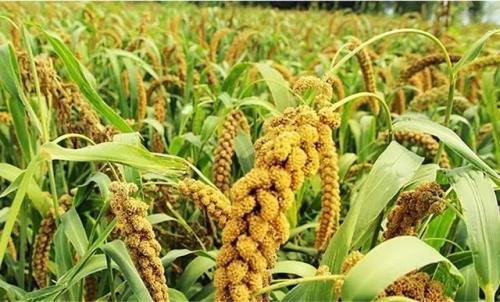
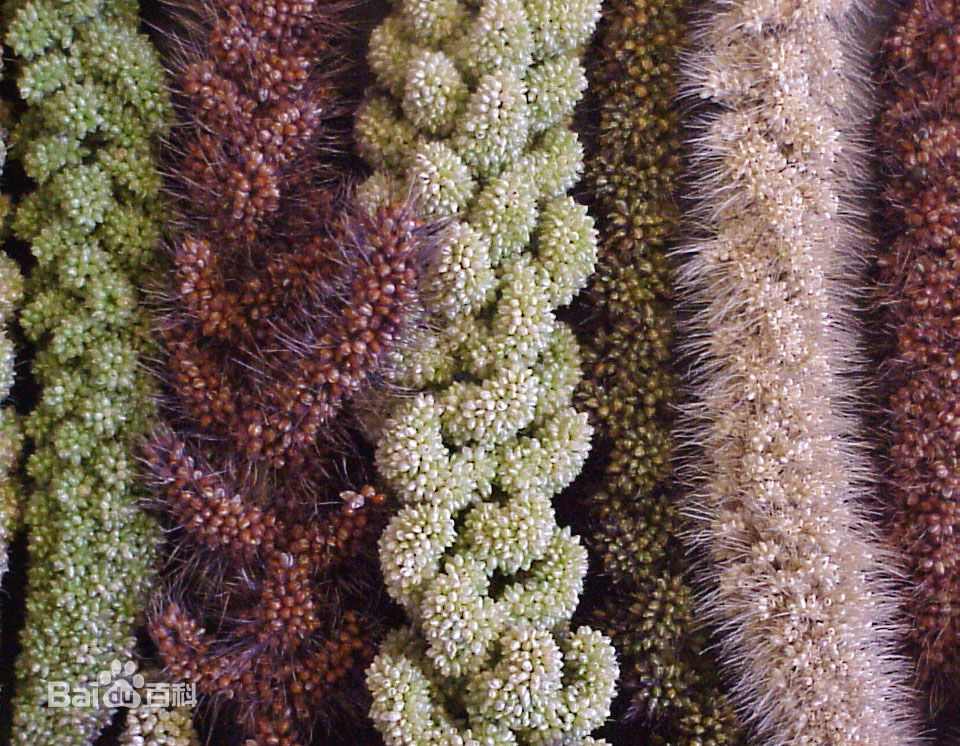
Foxtail millet (scientific name: Setaria italica): a plant belonging to the grass family (Poaceae). In ancient times it was called ji and su, and was also known as liang. It is an annual herb; the culms are stout with few tillers, and the leaves are narrow and lanceolate with a distinct midrib and smaller veins, bearing fine hairs; the inflorescence is a spicate panicle; the panicle is 20-30 cm long; the spikelets are clustered on tertiary branch pedicels, and the spikelets basically have bristles. Each panicle sets several hundred to over a thousand grains, and the caryopsis is very small, about 0.1 cm in diameter. The millet panicle is generally golden-yellow after ripening, with oval grains that are small and mostly yellow. After dehulling it is commonly known as xiaomi (millet). The glumes of su can be white, red, yellow, black, orange, or purple, commonly described as "su has five colors." It is widely cultivated in the temperate and tropical zones of Eurasia. The middle and upper reaches of the Yellow River in China are the main cultivation area, and it is also grown in small amounts in other regions.

Cultivation Techniques
Site Selection and Crop Rotation
To grow foxtail millet, choose land with loose soil, flat terrain, a relatively thick black soil layer, good drainage, and high soil organic matter content, and practice reasonable crop rotation by sowing the millet seed on plots where foxtail millet was not previously grown. After the plot is selected, the soil must be finely prepared and well leveled.
Timely Early Sowing
First, select high-quality seed with strong stress resistance, good yield performance, and good market and nutritional qualities.
Second, carry out seed treatment well: winnow and screen the millet seed and select with salt water to remove shriveled grains, weed seeds, and debris; dry the seed in the shade, then treat it with chemicals to prevent soil-dwelling pests and
downy mildew.
Third, sow early at the right time. Begin sowing when the temperature steadily passes 7°C, mainly to take advantage of soil moisture. Prepare the soil finely, press the grid marks well, and cover with soil evenly. If rain forms a hard crust after sowing, use a roller or other farm tools to break the crust so as to ensure full stands and strong seedlings.
Fourth, improve sowing quality. For plots with good subsoil moisture but poor surface moisture, push aside the dry soil and sow the seed in moist soil; for plots with poor soil moisture, moisten the organic fertilizer 1-2 days before sowing, apply it into the soil, and sow by borrowing soil moisture; if drought occurs when the young shoots are pushing through the soil, press once with a roller to draw up moisture and ensure a full stand. In short, every possible effort should be made to achieve a full stand from a single sowing.
Fifth, practice rational close planting and establish a reasonable population structure. Generally, rational close planting is carried out according to terrain and soil fertility. The principle is that flat land and plots with high fertility should have higher density; slopes and plots with low fertility should have lower density. Generally, for flat land and plots with relatively high fertility, keep 35,000-40,000 plants per mu; for sloped land and plots with poorer fertility, keep 30,000-35,000 plants per mu.
Rational Fertilization
First, base fertilizer, mainly farmyard manure. Apply 5,000-8,000 jin of high-quality farmyard manure per mu, mix it with superphosphate as base fertilizer, and apply it into the soil when plowing or ridging.
Second, seed fertilizer. Generally apply 10 kg of
diammonium phosphate and 5 kg of nitrogen fertilizer per mu as seed fertilizer, which can promote early and rapid growth of millet seedlings and meet the nutrient needs of foxtail millet during its
growth period.
Third, topdressing. When foxtail millet seedlings are 30-50 cm tall, about 6 cm from the seedling row, use a hoe or pick to open a ditch 10 cm deep, evenly broadcast about 35 kg of nitrogen fertilizer per mu, then cover with soil; deep application improves utilization rate.
Strengthen Management
First, press seedlings early to promote root development. When the seedlings have 2-5 leaves, press the young seedlings 1-2 times with a wooden roller to encourage strong roots.
Second, thin and set seedlings early. "Thinning millet by an inch is like applying manure." Begin thinning when the seedlings are 3 cm tall, that is, start thinning as soon as you can handle them; set the seedlings when they are 5-6 cm tall, keep plants at proper spacing and in staggered arrangement, and do not leave dead clusters.
Third, three hoeings and three cultivations, hoeing and cultivating carefully, doing good weeding and soil loosening to promote root development.
Fourth, rational irrigation. "Millet is drought-tolerant, beans are flood-tolerant." Foxtail millet is a relatively drought-tolerant crop and generally does not need irrigation, but during jointing-booting and grain filling, if drought occurs, irrigate promptly and apply booting fertilizer to promote large panicles, increase grain number, and raise seed-setting rate and 1000-grain weight.
Fifth, prevent diseases and control pests. During the growth period, promptly control armyworm, soil locusts, and Asian corn borer; during drought, pay attention to controlling red spider mites; in the later stage with frequent rain and high humidity, promptly control rust disease.
Timely Harvest
Generally, harvesting at the late dough stage or early full-ripening stage is the best time. Harvesting too early injures the sickle and yields a handful of chaff, reducing yield; harvesting too late allows birds to peck or eat the grain and wind to shatter the grain, affecting yield.
Pest and Disease Control
1. Control soil-dwelling pests.
Begin control when the field aphid population reaches 500 per 100 plants. Spray with pyrethroid insecticides, or use 50% pirimicarb wettable powder at 2000-3000 times dilution, or imidacloprid wettable powder at 1500 times dilution, with 40-50 kg of spray solution per mu.
3. Control armyworm.
Apply the pesticide before the 3rd instar; begin application when there are 20 third-instar larvae per square meter. Spray with 90% trichlorfon crystals or 20% fenvalerate emulsifiable concentrate at 2500 times dilution.