Detailed Explanation of Mango Planting Methods and Technical Points
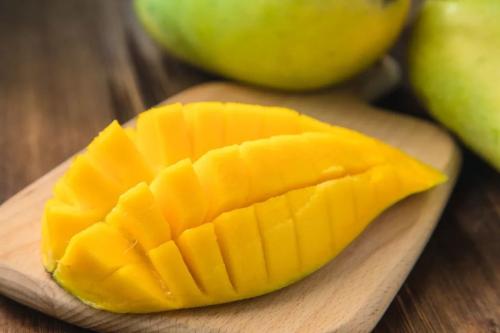
Mango is the common name for mangguo (Mangifera indica L.) as recorded in the Flora of China (Latin scientific name: Mangifera indica L.). Mango is an evergreen large tree of the Anacardiaceae family native to India, with leathery, alternate leaves; the flowers are small, polygamous, yellow or pale yellow, borne in terminal panicles. The drupe is large and flattened, 5-10 cm long and 3-4.5 cm wide, yellow when ripe, sweet in taste, with a hard stone.
Mango sowing is divided into two periods: spring planting in March to April and autumn planting in September to October. Spring planting is better than autumn planting, because by March to April the temperature has clearly risen again and rainfall has increased, so the survival rate after planting is high. However, as China is vast, planting times vary with different regions and different climates.
Mango planting techniques:
1. Choose a suitable planting plot
Mango is suited to growing on sandy loam or loam with a south-facing slope, relatively thick soil layer, convenient drainage and irrigation, and neutral or slightly acidic soil (pH 5.5-7.5). The climatic conditions required when mango flower buds are in the differentiation stage are relatively dry.
2. Grafting to change varieties
In order to speed up the growth of the scion, the method of grafting to change varieties can be adopted so as to fully absorb nutrients from the soil. Grafting can generally be carried out from February to September, with the best period being February to April. If grafting is chosen in summer or autumn, attention must be paid to moisture retention and sun protection; if grafting is chosen in winter, attention must be paid to moisture retention and heat preservation. Before grafting, first saw off the mango tree used as rootstock at a height of 50-60 cm from the ground, split several openings according to the diameter of the sawed position, and then graft the selected scion into the splits. In some cases, after new branches grow from the stump, select 2-4 of the more robust branches for grafting. During grafting, the graft union must be properly wrapped to prevent infection.
3. Planting small seedlings
For mango planting, many orchards sell seedlings with excellent traits, and mango growers can directly select suitable small seedlings for planting according to their needs. Generally, early summer is the best time for this, as there is more rain at that time. Mango grows very fast and the tree is relatively large, so the planting density of mango should be controlled at about 800 plants/hm2. Before planting, first dig planting holes 1 m square, and apply 375 kg/hm2 of fully decomposed organic fertilizer thoroughly mixed with the subsoil into the planting holes, then backfill with topsoil to a thickness of about 25 cm. For the first 2 weeks after mango planting is completed, water once every 3 d.
4. Flower and fruit management
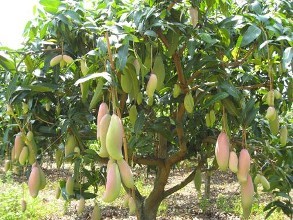
There is an obvious problem of alternate bearing in mango cultivation, so in order to increase yield when growing mango, measures to promote flowering and protect fruit must be well carried out. First, thin flowers by promptly removing early flowers; second, in order to improve the number and quality of flowers, select suitable plant growth hormones for regulation, such as spraying ethephon, which has a certain effect of increasing flowers. Third, apply flower-promoting fertilizer and flower-strengthening fertilizer well.
The fruit-setting rate of mango is generally relatively high in normal years. In order to improve its individual size and fruit quality, manual fruit thinning is needed to ensure that only 1-2 fruits are retained per panicle, which can effectively increase the unit price of the fruit; if a disaster occurs, then fruit protection is needed, and fruit-protecting fertilizer and fruit-strengthening fertilizer should be applied well to increase mango yield. Bagging can improve the smoothness of the mango skin and ensure bright color, so when the average single fruit weight of mango reaches about 200 g, choose special double-layer black paper bags for mango for bagging treatment.
5. Pruning management after harvest
In order to ensure the yield of mango in the second year, after the mango harvest, the tree body should be pruned to overcome alternate bearing and cultivate a tree shape with high and stable yield. In principle, branches sprouting from the upper part should be heavily pruned to control the plant height of mango and improve light penetration, while the middle and lower parts should be lightly pruned to retain as many branches as possible and promote new shoots to sprout as soon as possible; branches in the inner canopy of the crown should be heavily pruned to improve light penetration between tree bodies, while the surface layer should be lightly pruned to increase the number of fruiting branches.
6. Scientific management of fertilizer and water
Relevant data show that for every 1 t of mango, the amounts of nitrogen, phosphorus, potassium, calcium and manganese that need to be absorbed are 6.9, 0.8, 6.6, 5.9 and 3.1 kg respectively. From this it can be seen that mango needs a large amount of fertilizer during the fruiting stage. Generally, different fertilizers play different roles in the growth of mango. For example, nitrogen fertilizer can accelerate the vegetative growth of the mango tree, improve photosynthetic efficiency, and thereby promote the improvement of mango quality and yield; phosphorus fertilizer can accelerate its flower bud differentiation and fruit development; applying an appropriate amount of potassium fertilizer has a certain effect on the ripening of mango fruit; calcium fertilizer can play a certain role in regulating the internal physiological balance of the mango tree. Combined with the characteristics of mango tree development, its demand for fertilizer is greater in the following stages: after fruit harvest, October-November and January-March of the following year, and April-May. First, fertilization after fruit harvest. The amount of fertilizer applied at this stage accounts for 60-80% of the total for the whole year, and the fertilizer type is mainly organic fertilizer, appropriately combined with quick-acting fertilizer. Second, flower-promoting fertilizer. In October-November, flower-promoting fertilizer should be applied in time to provide conditions for flower development. Third, flower-strengthening fertilizer. January-March is the period of mango flower bud development, and fertilization during this period has a good effect on improving the fruit-setting rate. Fourth, fruit-strengthening fertilizer. In April-May, fruit growth speeds up, and if nutrients are insufficient at this stage, serious fruit drop and other problems will occur.