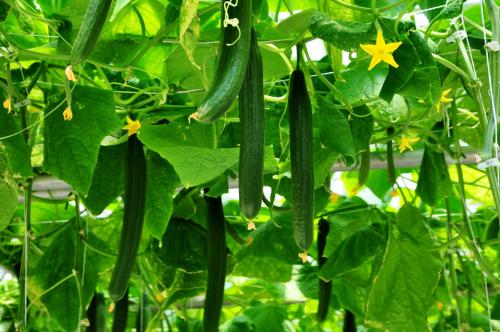
Detailed Explanation of Cucumber Planting Methods and Key Technical Points
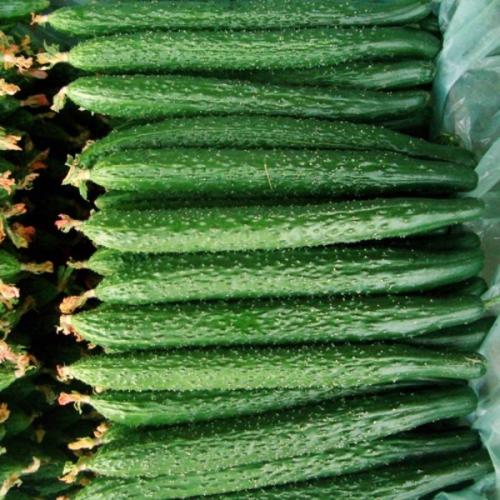
Cucumber, also known as huanggua or qinggua, belongs to the Cucurbitaceae family. The stems and branches elongate, have angular grooves, and are covered with white stiff hairs. The tendrils are slender. The petioles are slightly rough, with stiff hairs; the leaves are broadly ovate-cordate, membranous, with triangular, toothed lobes. It is monoecious. Male flowers: often several clustered in the leaf axils; pedicels slender, pubescent; corolla yellow-white, corolla lobes oblong-lanceolate. Female flowers: solitary or rarely clustered; pedicels stout, pubescent; ovary rough. The fruit is oblong or cylindrical, yellow-green when ripe, with a rough surface. Seeds are small, narrowly ovate, white, without margins, nearly acute at both ends. The flowering and fruiting period is summer.
Growth Habits
Soil: Cucumber likes moisture but cannot tolerate waterlogging, and likes fertilizer but cannot tolerate excessive fertilizer. It is advisable to choose fertile soil rich in organic matter. It generally prefers soil with a pH between 5.5-7.2, but pH 6.5 is best.
Planting Methods
-
Soil Selection and Land Preparation Choose slightly clayey sandy loam with a pH between 6.0-7.5, rich in organic matter, with good drainage and irrigation, and good water and fertilizer retention. Avoid continuous cropping with cucurbit crops; the previous crop is best as paddy rice. For land preparation, use deep furrows and high beds. The bed width is 1.8 m-2.0 m (including furrows), bed height 30 cm, oriented north-south, with double-row planting and a plant spacing of 30 cm.
-
Sowing and Seedling Raising Sow in early spring from January to March, and for summer-autumn planting from June to August. For spring sowing, use seed soaking and germination followed by seedling raising, or direct sowing under plastic film mulch. For summer and autumn, either soaked-seed direct sowing or dry-seed direct sowing is acceptable. Seed soaking and germination are commonly used in cucumber sowing. Soak the seeds in 50-55℃ warm boiled water for disinfection for 10 minutes, stirring constantly to prevent scalding. Then soak in about 30℃ warm water for 4-6 hours, rub clean, scoop out and drain, and keep moist for germination in a constant-temperature incubator at 28-30℃ or in a warm place. Germination begins after 20 hours. For early spring seedling raising with a small arched shed for insulation, use seedling cups or seedbeds. Transplant when the seedlings are 15-20 days old (2 true leaves). Do this on a clear evening, taking care to protect the root system. Water thoroughly before lifting the seedlings, and lift them in order, transplanting with soil to prevent root damage.
Fertilizer and Water Management and Hilling Applying sufficient base fertilizer is one of the keys to stable and high yield. Cucumber responds well to base fertilizer. During land preparation, deep plow and apply additional decomposed organic fertilizer, at 2,000 kg-3,000 kg per mu, 50 kg of mao fertilizer, and 30 kg of superphosphate as base fertilizer. When the plants have 2-3 true leaves, begin topdressing. Cucumber roots have weak absorption capacity and are sensitive to high-concentration fertilizers. Topdressing should follow the principle of "frequent application and light application," applying fertilizer once every 6-8 days, with 5 kg-6 kg of urea per mu. When tendrils appear, combine cultivating, weeding, and hilling with fertilizer application. After harvesting the first batch of cucumbers, hill and fertilize again, applying 15 kg-20 kg of peanut bran per mu, 30 kg of compound fertilizer, and 10 kg of potassium fertilizer. In summer and autumn, because temperatures are high, growth and development are rapid, and aging is also fast. In addition, rainfall is heavy, and fertilizer and water loss is great. Besides applying sufficient base fertilizer, topdress early. At the 1-2 true leaf stage and after harvesting the first batch of cucumbers, hill and fertilize once each time. Attention should be paid to phosphorus and potassium fertilizers to avoid excessive vegetative growth and premature aging. For spring cucumbers, water should be controlled during the seedling stage. The water requirement is greatest during the flowering and fruiting stage. On sunny days, water generally once a day; during drought, irrigate once every 3-5 days. In rainy weather, do a good job of waterlogging prevention.
Trellising, Vine Guiding, and Pruning Generally, when tendrils appear, insert bamboo to build a trellis and guide the vines, building an "A-frame trellis." Begin guiding the vines after tendrils appear, guiding once every 3-4 days,
so that the plants are evenly distributed. Do this on a clear evening. Whether cucumber needs pruning depends on the variety. Varieties that bear fruit on the main vine generally do not need pruning; for those that bear fruit on the main and side vines or on side vines, pinch the growing tips and prune. Generally, all side vines below the 8th node are removed, side branches above the 9th node are kept for 3 nodes and then the tips are pinched, and the main vine is pinched at about the 30th node.
Key Points for Lowering Vines of Greenhouse Cucumbers
Lowering cucumber vines can make the leaves evenly distributed, maintain a reasonable light position, maintain the optimal leaf area index, and improve photosynthetic efficiency, thereby strengthening growth vigor and prolonging the fruiting period. However, the correct method must be mastered when lowering vines to ensure high quality and high yield of greenhouse cucumbers. The key points are: 1. When the plant growing point approaches the top of the greenhouse and the leafless stems and vines at the bottom of the plant are more than 30 cm above the ground, lower the vines in time. It is best to lower vines on a clear, warm afternoon, as this makes it less likely to damage the stems and vines. Be sure not to lower vines on mornings, forenoons, or after watering when water content is high, so as to avoid damaging the stems and vines and affecting normal plant growth. 2. It is best not to water for 7 days before lowering vines. This helps reduce the water content of the stem and vine tissues, enhances flexibility, and can also reduce sources of disease. 3. First remove diseased and old leaves and take them outside the greenhouse to be burned, so as to avoid disease in fruits and leaves near the ground after vine lowering due to the humid environment. 4. Loosen the hanging ropes wrapped around the stems and vines, and let the stems and vines fall to the ground accordingly. Never pull hard or drag forcefully. The stems and vines should be gradually coiled in order in the same direction on both sides of the cultivation ridge. When coiling the stems and vines, bend them along their natural curvature. Do not bend them forcibly or in the opposite direction, so as to avoid twisting, cracking, or breaking the stems and vines in the opposite direction. When vine lowering begins, the stems and vines are thinner, the interval is short, and the coils are small. After the stems and vines become longer and thicker, the interval between vine lowerings is slightly longer, the coils are larger, and 1/3 to 1/4 of the vine length can be lowered at one time. 5. Keep leafy stems and vines about 13 cm from the ridge surface, and maintain more than 20 functional leaves per plant. 6. Harvesting Spring cucumbers take about 55 days from transplanting to first harvest, and summer-autumn cucumbers 35 days. They can be harvested about 10 days after flowering. It is best to harvest when the skin color changes from dark green to bright green and glossy, and the petals have not fallen off. The first cucumber should be harvested early to avoid affecting the growth of subsequent cucumbers, or even hindering plant growth, causing deformed cucumbers and premature plant aging, thereby affecting yield.