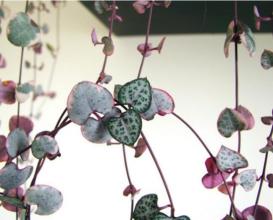
The String of Hearts (Ceropegia woodii) is a succulent plant of the nominate subspecies in the genus Ceropegia, family Apocynaceae. It is a perennial; the plant grows from a tuberous rootstock with nodules and spreads along the ground. The tuber is gray, hard in texture, and wrinkled. From it emerge several purple, thread-like trailing stems. This species produces round tubers at the leaf axils, called "bulbils," which serve to store nutrients and water and to propagate. The leaves are opposite, thick and fleshy, heart-shaped; the leaf surface is dark green with a gray and white net-like pattern, and the leaf underside is purplish red. The flowers emerge from the leaf axils, are rather slender and pitcher-shaped, and are a bright reddish brown. The receptacle is raised and purple. The fruit is horn-shaped.
Propagation Methods
Cuttings: This is the most commonly used propagation method for this species. Generally, a stem section with more than 2 nodes is cut from the plant as a cutting. The cutting is placed in a ventilated spot for about 10 minutes until the exuded sap dries, then inserted into the prepared growing medium and covered with plastic film to increase air humidity and speed up rooting; under suitable temperature conditions, roots form in 2~3 weeks, and when the roots reach 2~3cm, the plant is repotted and transplanted.
Tubers: Similar to cutting propagation, except that the cutting carries a bulbil (tuber). This method roots more easily than cutting propagation and has a higher survival rate, but the production of bulbils requires a certain plant age and sufficient nutrients, so bulbils are rarely produced in home cultivation.
Layering: A relatively good propagation method that does not harm the plant; the layer has an ample nutrient supply and roots easily, with a high survival rate, making it the safest propagation method. For air layering, generally choose a robustly growing stem, lay it flat on the growing medium, prick a small wound at the node with a needle, then secure the node in the medium with a thin wire bent into a "u" shape, cover with a small amount of medium, and keep it moist. In about 3 weeks the node can be seen swelling and growing new roots; when the roots reach 2~3cm in length, cut off this rooted stem section and transplant it.
Cultivation Techniques
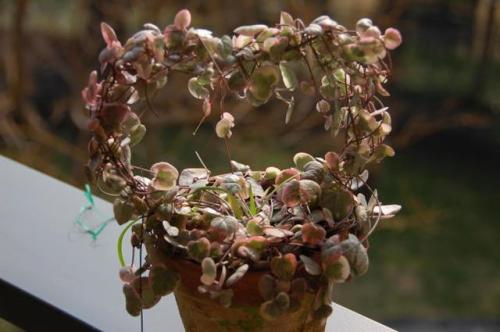
Pot selection: For growing String of Hearts, ceramic pots are recommended; ceramic pots have a certain breathability, clay pots lose water too quickly, and plastic pots retain water too strongly and have poor breathability. For hanging cultivation, a 10-15cm ceramic art pot can generally be chosen; if grown as a green curtain or screen, a long rectangular pot should be chosen or made. When repotting, add some base fertilizer as appropriate depending on the pot size, and repot once every two years.
Soil mix: A well-draining growing medium should be chosen. You can use the succulent-specific soil easily bought at flower markets at 7 parts, coarse sand at 2 parts, and perlite at 1 part. You may also choose to use sphagnum moss or a mixed medium. The mixed medium is prepared from peat soil, perlite, and river sand in a 6:1:3 ratio. Both soil mixes can maintain good drainage and aeration while containing certain nutrients, which is good for management.
Environment: The String of Hearts likes a growing medium with good drainage and good aeration. At suitable temperatures, the plant grows robustly, the internodes are of appropriate length, and the overall plant looks attractive; under high temperature and high humidity, the plant tends to grow leggy, the internodes elongate, the ornamental value is poor, and pests and diseases are easily encouraged; at lower temperatures, plant growth slows, the internodes shorten, and when the temperature drops below 10°C, there is a risk of cold damage to the plant.
In daily management, take care to control the temperature well. Spring and summer are the vigorous growing seasons for this species; in summer, pay attention to cooling, and in winter, protect against the cold. In northern regions, plants must be moved indoors to overwinter. They can also be kept year-round on an indoor balcony, simply opening the windows regularly for ventilation.
Light: This species likes diffused light. In summer, avoid strong light, otherwise it easily causes leaf scorch and affects plant growth. Throughout the year, in spring, autumn, and winter, about two hours of morning light can be given each day; in summer, diffused light is sufficient. However, if the growing environment is shaded for a long time with insufficient light, the internodes tend to grow leggy and the plant loses its ornamental value.
Water and fertilizer: The String of Hearts has a large tuber that can store a great deal of water, so in daily management, watering should follow "water when dry, and water thoroughly," and the medium must never be kept overly wet for long, otherwise the tuber easily rots and the plant dies. The String of Hearts does not like fertilizer; if a mixed medium is chosen as the growing medium, fertilizing 1~2 times a year is enough; if sphagnum moss is chosen, then a light fertilizer application is needed once each quarter. This species dislikes high-phosphorus and high-potassium fertilizers; a high-nitrogen compound fertilizer can be chosen. When phosphorus and potassium fertilizers are excessive, the leaves become deformed or even stop developing, affecting its growth.