Detailed Guide to Narcissus Planting Methods and Care Techniques
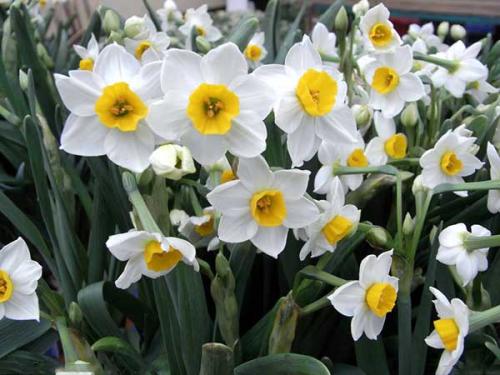
Narcissus is also called Luoshen Xiangfei, Lingbo Xianzi and so on, and its flower posture and colors truly live up to descriptions such as immortal and fragrant concubine. Overall it gives people a feeling of elegance, dignity and grandness. No wonder it is deeply loved by flower lovers.
Cultivation Techniques
The planting time for narcissus is September to October, and it can be done from the Start of Autumn to Frost's Descent. The land for planting bulbs should be chosen in a wind-sheltered, sunny spot, and requires fertile, well-drained loose soil; heavy clay or gravelly land is not suitable. To benefit the development of narcissus roots, the soil should first be deeply plowed, finely broken up and leveled, and sufficient base fertilizer applied. For large-area planting, 75 to 120 kg of superphosphate can be applied per 1000 sq m as base fertilizer, and human or livestock manure and urine can also be applied. Generally, ridges are made 20 cm apart, with furrow depth of 10 to 15 cm, then large and small bulbs are planted separately, with a plant spacing of 10 to 15 cm, and covered above with 5 to 10 cm of fine sandy soil. It is enough to keep the soil moist, and seedlings can emerge after about 30 days. After that, fertilize 1 to 2 times a month, using 30% human manure and urine or cake fertilizer water.
The small bulbs planted are dug up when the soil is turned at the end of May or early June of the following year, and continue to be planted in the ground in autumn, increasing year by year; generally they can bloom in the third year. After the small bulbs are planted, they can also be left to grow in place for 2 to 3 years, then dug out and divided for replanting. However, doing so only results in more small bulbs being produced, while the bulbs do not grow large and the flowering period is delayed, so it is not as good as replanting every year.
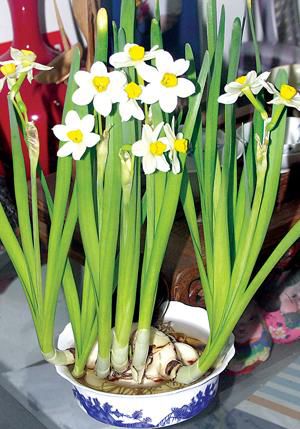
Narcissus is also suitable for pot cultivation. In autumn, plant the mother bulb in a pot; the growing medium should be loose, and can be mixed with 1 part leaf mold, 2 parts garden soil, plus some rice husk ash. If dried chicken or duck manure blocks, soybean cake, rapeseed cake, or crushed eggshell powder are placed at the bottom of the pot and mixed with soil as base fertilizer, so much the better. After planting, place it on a south-facing balcony or windowsill with sufficient light. Be careful to keep the pot soil constantly moist, and apply 20% decomposed human manure and urine or chicken and duck manure fertilizer water 1 to 2 times a month, which can make it produce beautiful flowers in winter.
Narcissus Planting Methods
Narcissus needs 2 to 3 years of cultivation before it blooms. When cultivated in autumn from September to October, the leaves turn yellow in May of the following year, and in June it enters dormancy in the form of bulbs; during dormancy the bulbs continue physiological and biochemical activities. When propagated by side bulbs, the bulbs are dug up after entering dormancy in the second year, and after the storage period, the large bulbs bloom in winter, generally 1 bulb producing 1 stem of flowers; the commercially sold Chongming narcissus is like this.
1. Side bulb propagation: This is the most common and commonly used propagation method. Storage bulbs grow on both sides outside the bulb, connected to the mother bulb only at the base, and easily separate from the mother body on their own. In autumn, separate them from the mother bulb and plant them separately, and new bulbs are produced the following year. Side buds are buds enclosed inside the bulb.
2. Twin-scale propagation: A single bulb contains many side buds, some clearly visible and some hidden. But the basic rule is 1 bud between two scales. Using a bulb basal plate with two scales as propagation material is called twin-scale propagation. The method is to first place the bulb at a low temperature of 4 to 10 degrees C for 4 to 8 weeks, then at normal temperature cut the basal plate into small pieces so that each piece has two scales, and cut off the upper end of the scales leaving 2 cm as propagation material; then use a plastic bag containing vermiculite with 50% water or sand with 6% water, put the propagation material into the bag, seal the bag opening, and place it in a dark place at 20 to 28 degrees C.
3. Tissue culture: Use MS medium, with 30 grams of sucrose and 5 grams of activated charcoal added per liter, use shoot tips as explants, or use stem discs with twin scales 5 x 10 mm as explants, pH 5 to 7; place into 20 x 100 mm glass tubes, with 10 ml of medium per tube, and after disinfection, implant one explant per tube, then culture at 25 degrees C; small protrusions appear 10 days after inoculation, small bulbs form after 20 days, and after 1 month they are transferred to medium containing NAA0.