West China Crabapple Planting Methods and Key Technical Points
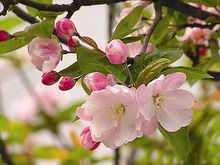
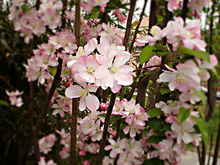
West China Crabapple (scientific name: Malus micromalus) is a plant in the class Magnoliopsida, family Rosaceae, genus Malus (apple). It is a small tree, up to 2.5-5 m tall, with strong upright branches, and is a plant endemic to China. West China Crabapple grows well in the dry zones of northern China and is a relatively popular product in landscaping projects.
Among Chinese fruit names, the cultivars of crabapple are extremely complex and still await unified study. In plant taxonomy, they are temporarily summarized under the single name Malus micromalus Makino, and are no longer listed separately as multiple species, to avoid confusion. The main cultivated cultivars of crabapple include "Baleng Haitang" from Huailai, Hebei; "Pingding Rehuahong" and "Lenghuahong" from Changli; "Guohong" and "Guohuang" from Shaanxi; and "Haitang" and "Qingci Haitang" from Yunnan.
On April 24, 2009, it was selected as the city flower of Baoji, Shaanxi. Baoji was known as Xifu in ancient times, and West China Crabapple (Xifu Haitang) takes its name from this.
Propagation Methods
Crabapple is usually propagated by grafting or division, and can also be propagated by sowing, layering, and root cuttings. Seedlings obtained by grafting can flower earlier and can maintain the original excellent characteristics.
Sowing Method
Although seedlings grow relatively slowly, they often produce variations, so the sowing method is still used when obtaining large quantities of rootstock or for hybrid breeding. Common rootstock types used in northern China include Malus baccata, West China Crabapple, and Malus transitoria; in the south, Malus hupehensis is used. Before sowing, crabapple seeds must undergo 30 days to 100 days of cold stratification. Fully stratified seeds emerge quickly and uniformly, and have a high emergence rate; seeds that are not stratified cannot germinate, or germinate very little. Alternatively, in autumn the fruit can be harvested, the flesh removed, and after slight drying the seeds can be sown directly in a sand bed to let the seeds after-ripen naturally. The covering depth of soil is about 1 cm. Cover with plastic film to preserve moisture; after emergence, remove the plastic film and promptly broadcast a layer of loose fertile soil. Strengthen fertilizer and water management during the seedling stage, and by late autumn of the same year they can be transplanted.
Grafting Method
Use seedlings propagated by sowing as rootstock, and carry out stem grafting or bud grafting. Carry out stem grafting or bud grafting. In spring, when sap flows and buds sprout, carry out stem grafting; in autumn (between July and September), bud grafting can be done. For stem grafting, methods such as cut grafting and cleft grafting can be used. Select well-developed 1-year-old branches as scions, take their middle section (with 2 or more plump buds), and after grafting cover the scion with fine soil. For bud grafting, the "T" method is mostly used. About 10 days after grafting, if the bud is fresh and the petiole falls off at a corner, this is proof that the graft has taken; after a few days, the binding material can be removed. When the seedling height is 80 cm to 100 cm, train the scaffold branches; thereafter only prune overly dense branches, inward-growing branches, and overlapping branches to maintain a rounded crown.
Division Method
Carry this out before budding in early spring or after leaf fall in autumn and winter. Dig out the suckers sprouting from the root zone, divide them into several individual plants, or take 2-3 rooted sprouts as a clump and transplant them. After division and planting, water thoroughly in time, pay attention to preserving soil moisture, provide shade when necessary, and water during drought.
Cultivation Management:
1. Planting time: Crabapple is generally planted in the ground, and the period is preferably before budding in early spring or after leaf fall in early winter.
2. Nursery out-planting management: Keeping the root system of the seedlings intact when leaving the nursery is the key to survival. Generally, large seedlings should be with a soil ball, and small seedlings should retain native soil according to the situation. After planting the seedlings, strengthen tending and management, and constantly keep the soil loose and fertile.
3. Pruning branches and leaves: From after leaf fall to before budding in early spring, carry out one pruning, cutting off dead and weak branches and diseased and pest-infested branches, to keep the crown open and allow ventilation and light penetration. To promote vigorous flowering of the plant, the water sprouts must be shortened to reduce nutrient consumption for sprouting. Fruit-bearing branches and spurs do not need pruning.
4. Water and fertilizer management: To make the potted landscape flower abundantly and bear much fruit, water and fertilizer management should be strengthened. Before flowering, apply 1 to 2 topdressings of mixed phosphorus and nitrogen fertilizer, then every half month apply 1 topdressing of dilute phosphorus and potassium fertilizer. In deep winter, the method of heating to force flowering can also be used: move the potted crabapple landscape to a sunny place in a greenhouse, water it, add liquid fertilizer, and thereafter spray the plant branches and trunk appropriately with water every day, keeping the room temperature at 20°C to 25°C.
5. Disease control: Remove diseased trees, burn diseased branches, and reduce sources of pathogens. In early spring, spray lime sulfur mixture or paint lime agent on the trunk. At the initial onset, cut intersecting vertical and horizontal knife marks of about 0.5 cm on the lesion, reaching deep to the xylem, then spray with fungicide.