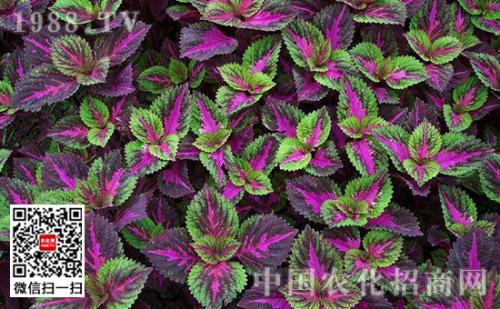
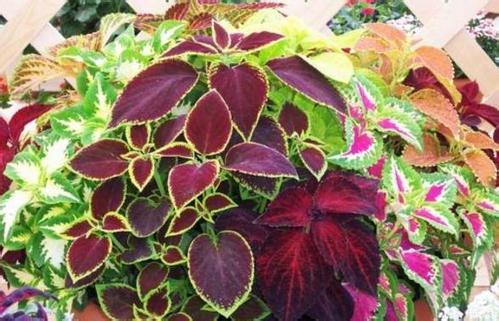
Coleus (scientific name: Plectranthus scutellarioides (L.) R.Br.) is an erect or ascending herbaceous plant in the Lamiaceae family, genus Plectranthus (formerly Coleus). The stems are usually purple, and the leaves are membranous, highly variable, usually ovate, with obtuse to shortly acuminate tips, broadly cuneate to rounded bases, and crenate-serrate or crenate margins; the colors are diverse, including yellow, dark red, purple and green. The verticillasters are many-flowered, with the flowers mostly densely arranged; the pedicels and rachis are covered with fine pubescence; the bracts are broadly ovate, the calyx is campanulate with a two-lipped calyx limb, the middle lobe broadly ovate, the lateral lobes short and small, ovate; the corolla is light purple to purple or blue, the corolla tube abruptly bent downward, the corolla limb two-lipped, and the filaments are united into a sheath below the middle. The style extends beyond the stamens, and the disk is swollen at the front. The nutlets are brown and glossy. It flowers in July.
Propagation Methods
Cuttage propagation has the advantages of saving seeds, shortening the cultivation cycle and preserving varietal characteristics well. When taking cuttings, first cut about 10 cm of young shoots from a mature plant as cuttings; to reduce transpiration, cut the leaves and branches on the cuttings as short as possible. Before inserting the cuttings, water the nursery bed thoroughly once, and wait until most of the water in the bed has drained and the bed soil is muddy before inserting the cuttings. When inserting, push the base of the cutting vertically downward about 2 cm. After insertion, take care not to shake the cuttings, so as to prevent cracks from forming in the soil, which would cause the cuttings to dry out and die.
Coleus takes 5 months from sowing to growing to the marketable stage, so if it is to be marketed during the National Day period, it can be sown in May. For sowing, an artificial substrate of perlite:peat soil at 3:1 is generally used, because the artificial substrate is rich in nutrients and loose in texture, making cultivation and management convenient. When preparing the artificial substrate, it can first be disinfected with a 75% chlorothalonil wettable powder 800-fold solution.
Before sowing, first fill the seedling tray with substrate, then moisten the substrate with a spray head. Coleus seeds are small, and direct sowing makes it very difficult to spread them evenly, so fine soil can be mixed into the seeds before sowing. When sowing, pinch up the seeds mixed with fine soil and scatter the seeds together with the fine soil into the seedling tray. Generally, 2-3 seeds are scattered into each cell. After the seeds are sown, to prevent the seeds from drying out, soil should also be covered. For covering, use a sieve filled with fine soil to sift soil onto the surface of the tray, with a covering thickness of 1-2 mm; after covering is completed, the seedling tray can be placed on the seedling bed to germinate.
Cultivation Techniques
Soil: Potted coleus requires a sandy culture soil rich in humus, loose and fertile, with good drainage and aeration.
Watering: Coleus's water requirement lies in keeping the pot soil and the environment moderately moist at all times; avoid drought and prevent waterlogging, so as to prevent the leaves from dehydrating and losing color and the roots from being infected with soft rot.
Sunlight: When the light is soft and sufficient, coleus leaf color is strikingly brilliant, but avoid direct strong light from a clear blazing sun in midsummer, which makes the leaf surface rough and lose its glossiness. In shaded environmental conditions, the leaf color is also not vivid.
Temperature: Coleus likes a warm and humid climate and fresh-air environmental conditions. The suitable indoor temperature in winter is 20°C to 25°C, and the minimum overwintering temperature must not be lower than 10°C; if the temperature is too low, the leaves turn yellow and fall off, and below 5°C the plant dies.
Fertilizing: Coleus has low fertilizer requirements; during the growing season, apply 1-2 times a month a thin fertilizer mainly based on nitrogen fertilizer.
Pruning: During the seedling stage, coleus should be pinched back several times to promote side branches and make the plant shape full. After flowering, 2-3 nodes of some branches can be retained and the rest cut off to regrow new branches.