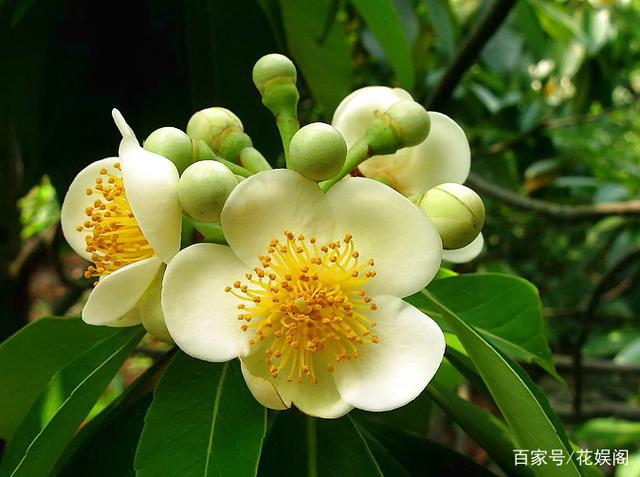
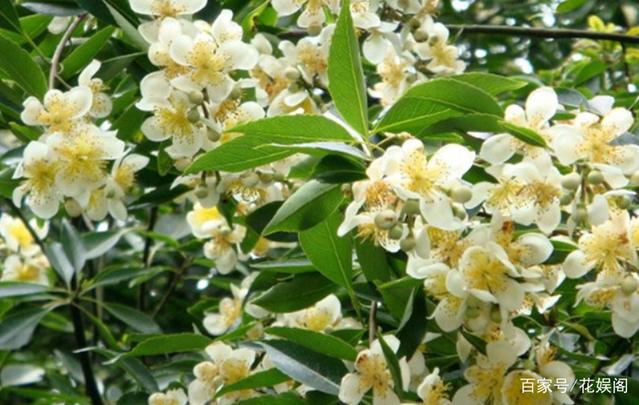
Schima superba (scientific name: Schima superba Gardn. et Champ.) belongs to the family Theaceae, genus Schima, and is a
large tree reaching up to 25 m in height, with young branches usually hairless. It is light-demanding, and slightly shade-tolerant when young. It is distributed in Zhejiang, Fujian, Taiwan, Jiangxi, Hunan, Guangdong, Hainan, Guangxi, Guizhou and other places.
Schima superba is both an excellent landscaping and timber tree species, and a relatively good fire-resistant, fire-retardant and flame-retardant tree species. Schima superba is a precious timber tree species in China, with a straight trunk, tough wood, fine texture, durability, and easy processing; it is a superior material for making spindles and bobbins in the textile industry; it is also an excellent timber for bridges, ships, vehicles, buildings, farm tools, furniture, plywood, etc. Its bark and leaves contain tannins, from which tannin extract can be obtained. Schima superba is a very good firebreak forest species.
Cultivation Techniques:
Nursery Site Selection
The nursery site for raising seedlings should be moderately fertile acidic sandy soil, deep-plowed 20-25 cm to make seedbeds. Sow in mid-March, with a sowing rate of 8-9 kg per mu, evenly broadcast on the bed surface, covered with fine soil to the extent that the seeds are half-buried and half-exposed, and covered with grass about 1 cm thick. Sprouting occurs 20 days after sowing; remove the grass cover. Weed 2-3 times a month; fertilize after weeding, progressing from dilute to concentrated, 1-2 times a month, mainly with nitrogen fertilizer. Thin the seedlings in May, June and July; for the first thinning leave 130 seedlings per sq m, for the second leave 110, and for the third leave 90, while paying attention to the prevention and control of pests and diseases. When the seedlings are over 25 cm tall and the ground diameter is over 0.5 cm, the seedlings can be lifted from the nursery for afforestation the following year.
Layout of Forest Belts
According to the area that needs to be controlled for forest fire prevention and the terrain and other conditions, a closed network with fire-prevention capability is set up. Main firebreak forest belts are mainly laid out on the boundaries around newly established timber forest bases; secondary firebreak forest belts are laid out on the ridges of larger, contiguous forest land to control the spread of fires within the forest. Footpaths are opened on both sides of the belts to facilitate forest patrol and management; field-edge firebreak forest belts are laid out at the junction of forest land and relatively large tracts of farmland, with the aim of preventing mountain forest fires caused by agricultural fire use. The main protection targets of firebreak forest belts are Chinese fir (Cunninghamia lanceolata) and pine coniferous plantations; once a fire occurs in these coniferous plantations, it often forms a crown fire, so the requirements for the width and performance of firebreak forest belts are that they can prevent both surface fires and crown fires. Therefore, the width of main firebreak forest belts should be more than 15 m, secondary firebreak forest belts more than 10 m, and field-edge firebreak forest belts more than 8 m; in case of steep slopes, wind gaps or wind channels, or sections with taller conifers, the firebreak forest belts should be appropriately widened by 3-5 m.
Afforestation Techniques
Afforestation firebreak forest belts generally extend along mountain ridges, mountain slopes, and the edges of fields at the foot of mountains, with long lines and narrow surfaces and complex terrain, so it is inconvenient to clear the site by slash-and-burn; chemical herbicides can be used to kill the weeds and then holes can be dug to establish the firebreak forest belt. Using glyphosate herbicide to kill the weeds on old firebreaks, after 8 months there is no phytotoxicity when establishing a Schima superba firebreak forest belt, and the survival rate of Schima superba can reach more than 95%. Newly established firebreak forest belts can be carried out simultaneously with afforestation, generally with block site preparation, digging holes of 50 cm x 40 cm x 30 cm, with a spacing of 1.5 m x 1.5 m or 1.5 m x 1.2 m, and an initial planting density of about 300 trees per mu. For afforestation seedlings, Grade I seedlings should be selected for planting; the best afforestation season is from Great Cold to the Beginning of Spring, before the seedlings sprout. When planting, do it so that seedlings are lifted, transported and planted promptly, without damaging the roots or bark, with roots spread out, soil firmed, and planted straight. Schima superba has an early fast-growing period; after afforestation, tending and management should be strengthened, with 2-3 hoeings and recultivations each year for the first two years, and thereafter, depending on the growth of the belt, 1-2 tendings each year until canopy closure. Every year or every other year, before the critical fire prevention period, remove dangerous combustibles such as litter under the forest. Establishing Schima superba firebreak forest belts not only requires little investment and brings long-term benefits, but is also a long-term strategic measure that achieves multiple goals in protecting forests.
Maintenance and Management
Main attention should be paid to the roots of the seedlings, which are often harmed by
white grubs; pay attention to their control. Other management is very extensive and will not be described in detail.
Strengthening fertilizer and water management is the key to cultivating strong seedlings; in the early stage of seedling growth, pay attention to keeping the nursery land moist. Fertilization follows the principle of applying thin fertilizer frequently, and according to the different growth stages of the seedlings, apply decomposed human manure and urine or chemical fertilizer. In the seedling stage (mid-April to the end of June), mainly nitrogen fertilizer, in small amounts and many times; in the fast-growing stage (early July to early September), mainly nitrogen and phosphorus fertilizers, applied about once every 15 days; in the lignification stage (mid-September to the end of October), mainly phosphorus and potassium fertilizers, applied about once every 20 days.