Detailed Guide to Moonflower Planting Methods and Key Technical Points
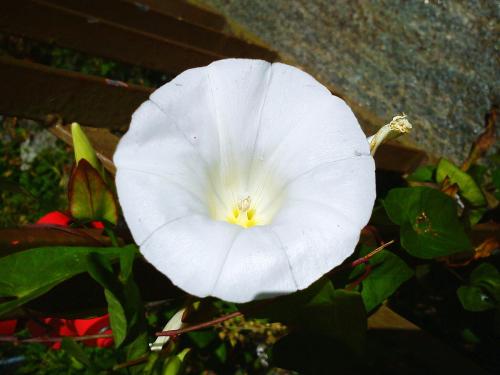
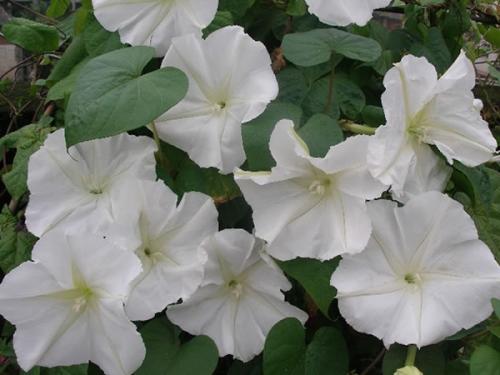
Moonflower (scientific name: Calonyction aculeatum (L.) House) is an annual herbaceous plant of the genus Calonyction in the family Convolvulaceae, with stems reaching up to 10 m long, containing milky sap, cylindrical green stems, ovate leaves with long acuminate or acuminate tips and cordate bases, and large flowers that open at night, fragrant, in racemes, sometimes with zygomorphic rachis; sepals ovate, green, with long awns, the inner sepals with shorter awns or none; corolla large, snow-white, extremely beautiful, with a pale green band in the middle of the petals, style and stamens exserted beyond the corolla; filaments cylindrical, anthers large, sagittate at the base, pale yellow; disk annular, capsule ovate, fruit stalk thick. Seeds large, hairless.
Planting Methods
1. Crop Rotation Selection and Land Preparation
Choose flat land and low-lying land with good drainage and fertile soil, as well as hilly land with irrigation conditions. Avoid continuous cropping or back-to-back cropping with watermelon and other cucurbits. Land preparation: make ridges when the soil is moist, and press promptly to preserve soil moisture. The transplanting ridges are long-mouthed ridges. The ridge width is 9-13 cm, and the 7-8 empty ridges in between should also be ridged to help control weeds;
2. Seed Soaking and Germination
Select the Japanese green-skinned gourd variety, soak the seeds in 40°C warm water for 12-24 hours, remove and wrap them in gauze, spin dry, and crack open the soaked sweet gourd seeds. Use a wooden trough or an ordinary basin, line it with a layer of sterilized sawdust or sand, then line it with a layer of gauze, place the soaked seeds evenly on the gauze, cover with a wrung-out new towel, cover with a lid, and cover with a cotton quilt to germinate, sprinkling water twice a day with a new broom whisk. The germination temperature is generally 25-28°C. Remove the germinated seeds every day, place them in another basin, and keep them in a cool place indoors to control sprout growth;
3. Sowing in the Seedbed
① Seedbed Preparation
Line the bottom of the seedbed with 8-10 cm of horse manure or chopped straw, spread a layer of soil on top, and tread flat. At the same time, disinfect with 70% dexon wettable powder at 0.3-0.6 g/sq m, and cover with a shed. After sowing, cover the seedbed with a small shed.
② Nutrient Soil Preparation
Choose soil that has not been treated with herbicides such as pursuit and chlorimuron, sieve it well, and mix it with sieved decomposed farmyard manure at a ratio of 7:2.
③ Bagging and Sowing
Put the nutrient soil into 10 cm x 15 cm plastic bags, and place 20-30 granules of diammonium phosphate as base fertilizer in the bottom 1/3 of the plastic bag, fill it full and firm it, and cut open the bottom corners of the nutrient bag or punch 2-4 holes with a diameter of 8-10 mm at the bottom to allow water to pass through. The sowing time depends on the local season. Use a wooden stick to make a 3-4 cm deep hole in the middle of the nutrient bag, place the germinated seeds with the sprout eye facing down, cover with soil and water once;
4. Care and Management
Moonflower prefers a slightly moist but somewhat dry soil environment. Summer high temperatures are its vigorous growth stage, when water supply should be ensured. Its demand for fertilizer is relatively high. In addition to applying base fertilizer at planting, a dilute liquid fertilizer can be applied every 2-3 weeks during the vigorous growth stage.
Moonflower prefers an environment with sufficient sunlight, and daily sunlight exposure should not be less than 4 hours. It also likes warmth and is not cold-tolerant, growing better within a temperature range of 18-28°C. Supports should be set up in time to ensure that the seedlings have something to cling to after growing and can climb the trellis smoothly. In actual cultivation, moonflower may be harmed by powdery mildew and attacked by pests such as aphids. If this occurs, measures should be taken promptly to deal with it.