Detailed Explanation of Mung Bean Planting Methods and Key Technical Points
Mung bean (scientific name: Vigna radiata (Linn.) Wilczek.), an annual erect herb, 20-60 cm tall. The stem is covered with brown long stiff hairs. Pinnately compound leaves have 3 leaflets; stipules are peltately attached, ovate; leaflets are ovate, the lateral ones somewhat oblique, entire, apex acuminate, base broadly cuneate or rounded, both surfaces more or less sparsely long-hairy, with three prominent veins at the base; petiole 5-21 cm long; rachis 1.5-4 cm long; petiolules 3-6 mm long. Racemes are axillary; peduncle 2.5-9.5 cm long; pedicels 2-3 mm long; bracteoles linear-lanceolate or oblong; calyx tube hairless; standard petal nearly square, yellow-green outside, sometimes pink inside, apex slightly emarginate, incurved, hairless; wings ovate, yellow; keel falcate, green tinged with pink, with a prominent sac on the right side. Pods are linear-cylindrical, spreading, more or less constricted between seeds; seeds 8-14, pale green or yellowish brown, short cylindrical, hilum white and not sunken. Flowering in early summer, fruiting from June to August.
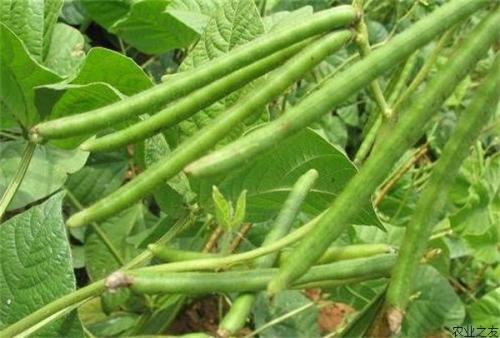
Mung bean planting techniques:
1. Choose early-maturing, high-yielding varieties. Such as Zhonglü No. 4 and No. 6, Minglü No. 3, etc.
2. Apply sufficient base fertilizer. Although mung bean rhizobia have nitrogen-fixing ability, increasing the application of farmyard manure and phosphorus and potassium fertilizers has an obvious yield-increasing effect. Farmyard manure can be applied once before sowing, and after application it should be plowed into the soil. If there is no time to apply base fertilizer, a certain amount of nitrogen and phosphorus fertilizer should be applied in the early growth stage, that is, at branching and early flowering, to enhance the nitrogen-fixing ability of rhizobia and increase flower bud differentiation.
3. Strive for early sowing and rational close planting. In disaster areas, early sowing should be pursued as much as possible; where floodwater recedes relatively late, seeds can first be pre-germinated until the radicle emerges and then sown in water while racing to plant. A suitable sowing rate should also be ensured. Mung bean seeds contain 10% small hard seeds, which are very difficult to germinate after sowing and easily cause missing plants and broken rows, so they should be screened out before sowing. The sowing rate is generally 1.5-2 kg per mu, and the sowing depth is 3-5 cm.
(1) Thinning and final singling. When mung bean seedlings reach the two-leaf-one-heart stage, clustered seedlings should be removed. At the 4-leaf stage, final singling should be carried out, with a plant spacing of 13-16 cm and a row spacing of about 40 cm, leaving 10,000-12,500 plants per mu.
(2) Intertillage and weeding. From emergence to flowering and row closure, mung beans are generally hoed at least four times, with intertillage depth going from shallow to deep and then back to shallow.
(3) Irrigation and drainage. The flowering and pod-setting stage of mung bean is the peak period of fertilizer and water demand. If drought occurs during this period, timely watering is needed to keep the soil moist. But the flowering and pod-setting stage often falls in the rainy season, causing excessive vegetative growth of stems and leaves, resulting in a large number of flower and pod drops, or death from waterlogging. Timely drainage is necessary to ensure normal growth of mung bean.