Detailed Explanation of Gleditsia sinensis Planting Methods and Technical Key Points
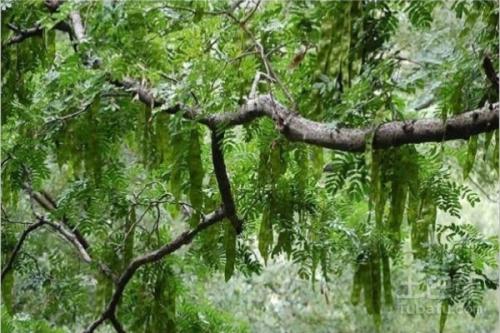
Gleditsia sinensis (scientific name: Gleditsia sinensis Lam.), also known as the Chinese honey locust or soap pod, is a deciduous tree or small tree of the Gleditsia genus in the Fabaceae family, reaching up to 30 m in height; branches gray to dark brown; thorns stout, cylindrical, often branched, mostly conical. Leaves are once pinnately compound, with fine serrations along the margins, short pubescence on the upper surface, slightly pubescent along the midrib beneath; reticulate veins prominent, raised on both surfaces; petiolules pubescent. Flowers polygamous, yellow-white, forming racemes; inflorescences axillary or terminal; male flower petals oblong. Pods strap-shaped, straight or twisted, with slightly thick flesh, bulging on both sides, curved into a crescent shape, without seeds inside; pod neck 1-3.5 cm long; valves leathery, brown or reddish-brown, often covered with a white powdery bloom; seeds numerous, brown, glossy. Flowering period March-May; fruiting period May-December.
Propagation methods:
Select trees with straight trunks, fast growth, good development, aged 30 to 80 years, with plump seeds and free of pests and diseases as mother trees for seed collection, collecting seeds every October. Place the harvested fruits in a sunny spot to dry, then after drying beat them with a wooden stick to remove the fruit skin, then carry out winnowing; after the seeds are dried in the shade, store them in a clean cloth bag. The seed coat of Gleditsia sinensis is relatively thick, so treatment before sowing is necessary to ensure the germination rate. In early November, soak the seeds in water for 48 hours, then remove and mix with wet sand for storage and germination promotion; by mid-March of the following year, when they crack and show white sprouts, they can be sown.
Choose a nursery site with deep, fertile soil and convenient irrigation and drainage; raised beds may be used for the seedbed, applying 2000 kg of decomposed and fermented cow and horse manure per mu as base fertilizer. Sowing uses the drill method, with a row spacing of 20 cm, sowing 15 seeds per meter, and covering with soil immediately after sowing to a thickness of 4 cm. Keep the soil moist. After the seedlings emerge uniformly, loosen the soil with small tools. When they reach 15 cm in height, thin them to a final spacing of 12 cm between plants. During the seedling stage, strengthen water and fertilizer management and pest and disease management. In the same year, the young seedlings can grow to 100 cm tall. After leaf fall in late autumn, transplanting can be carried out at a plant spacing of 0.5 m and a row spacing of 0.8 m. After transplanting, promptly carry out bud removal and pruning to promote straight growth of the seedling trunk, which is conducive to cultivating large seedlings with well-developed root systems and full crowns.
Cultivation techniques:
Water and fertilizer: For Gleditsia sinensis trees grown in the nursery, scientific water and fertilizer management is particularly important. In early April each year, apply urea once; in early June, apply a compound fertilizer containing the three major elements once; in mid-August, apply a phosphorus-potassium compound fertilizer once; in late autumn, in conjunction with watering for freezing protection, apply decomposed and fermented cow and horse manure once, at a rate of 4000 kg per mu.
Pruning: During nursery cultivation of Gleditsia sinensis, pruning management should be strengthened, especially paying attention to the trunk height at which the leader is headed and crown pruning. For seedlings being grown as street trees, the heading height should be no less than 2.8 m; for seedlings for other uses, the heading height can be somewhat lower. Before reaching the heading height, strengthen the training of the main trunk, maintain the apical dominance of the trunk extension shoot, and promptly remove competing branches.