Marigold Planting Methods and Key Technical Points
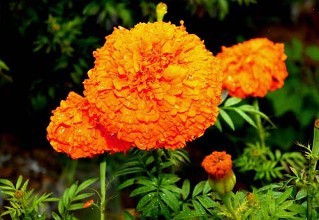
Marigold (Tagetes erecta L) is an annual herbaceous plant of the genus Tagetes in the family Asteraceae, with an upright, stout stem that has fine longitudinal ridges, and branches spreading upward and outward. The leaves are pinnately divided; there are a few glands along the leaf margins. The flower heads are solitary; the involucre is cup-shaped with toothed tips at the apex; the ray florets are yellow or dark orange; the disk florets have yellow corollas. The achenes are linear, narrowed at the base, black or brown, covered with short fine hairs; the pappus has 1-2 long awns and 2-3 short, blunt scales. The flowering period is July to September.

Marigold Planting Techniques
Seedling Raising and Planting
Marigolds are mostly grown from seed, and can also be propagated by cuttings. The former method is mostly used for large-area planting, while the latter is often used for cultivating rare varieties.
Seeds can be sown all year round; usually spring sowing gives autumn flowers, and summer sowing gives autumn and winter flowers. The seeds germinate easily and can self-sow. From late March to early April, prepare the soil and make beds, and after sowing cover with soil to a depth of 0.8 cm. Then water with a fine-rose watering can to keep the soil moist. At a temperature of 20-21°C, the seeds germinate and emerge 1 week after sowing, and in about half a month the plants have 7 leaves, at which point they can be transplanted. The optimum temperature for seedling growth is 15°C. When the seedlings are 10-13 cm tall they can be planted out, with a plant spacing of 30-35 cm. Early-maturing varieties have a short vegetative growth period and bloom in about 40 days, while late-maturing varieties bloom in about 90 days, with a flowering period of 2 months.
During the growing period in May and June, cut off healthy young shoots with 3-4 nodes, 6-10 cm long, and insert them under a shade shed for cutting propagation, using washed river sand or garden soil as the medium. Insert to a depth of 2-3 cm and keep the soil moist. Roots form after 2 weeks, and the plants are ready to leave the nursery and be planted out after 3 weeks, blooming in about 1 month. For large-scale cuttings, use the full-light misting method, with perlite as the medium. Because the misting raises air humidity, the cuttings do not need shading during the day after insertion, and more leaves can be left on the cuttings than in conventional seedling raising. Roots form in about 1 week, after which they are transplanted.
Field Management
If marigolds are planted in sunny, loose and fertile soil, there is no need for much fertilisation after planting. If the soil is poor, during peak growth periods such as bud formation and flowering, spray the leaves 2-3 times with a 0.3% urea solution, with 0.5% monopotassium phosphate added. Because it is relatively drought-tolerant, apart from watering during especially dry summer periods, it generally does not need watering.
Shaping and Pruning
Removing side buds at the seedling stage favours the growth of the terminal bud and elongates the flower stalks, making the plants suitable for flower beds. In summer the plants tend to grow leggy, so prune promptly to control height. After removing the terminal bud the plants are shorter, bloom earlier, and the flowering period is easier to control. Because the flowering period is long, the plants tend to lodge in the later stages of growth and the branches and leaves tend to wither and age, so overcrowded stems and leaves and spent flowers should be thinned out promptly. Tall and medium-stemmed varieties must be supported with stakes and double wires to hold up the stems and prevent them from being blown over by the wind.
Harvesting and Fresh-keeping
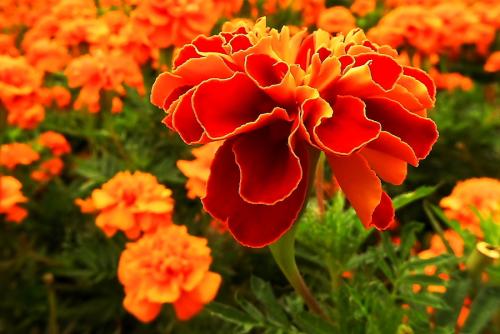
The harvest time depends on the variety; usually, when 4 to 6 petals have loosened and the flower bud has opened, they can be harvested. It is sometimes found that after harvesting, marigold cut flowers droop prematurely before the buds have opened; this is mainly because they were harvested too early at the bud stage, when the calyx was still tightly enclosing the bud. It is best to cut when the sepals form a 90° angle with the petals. When cutting, the stem should have 5 internodes or a somewhat longer length, but there must be at least two buds on the stem. One hour after cutting, insert into water to absorb water, then grade by length, tie into bunches of 10, and wrap in cellophane. Marigold cut flowers have a short fresh-keeping period and do not tolerate long-distance transport. If the harvested marigolds are not to be sold on the market, they should immediately be stored in a low-temperature warehouse, at a storage temperature of 1°C-2°C, and preferably stored wet by inserting them in water. The water quality for wet storage is very important; a low pH value is beneficial for marigold cut flowers. Take care not to insert the leaves into the water as well. The preservative in the holding container is a mixture of silver thiosulfate and aluminium sulfate. Generally, the preservative solution used for all marigold vase holding is called the Cornell formula. To overcome the bent-neck phenomenon in marigolds, cobalt acetate at a mass fraction of 360×10E-6 can be added to the preservative. Adding ethephon-ammonium carbamoyl phosphate can prevent red marigold cut flowers from rotting and wilting early.
Home Pot Cultivation
Pest Control
When the hot summer heat arrives and there is little rain and the air is dry, red spider mites are prone to cause damage. Besides paying attention to choosing well-ventilated plots, it is advisable to spray high-efficiency, low-toxicity pesticides early for control.