Detailed Guide to Poinsettia Planting Methods and Techniques
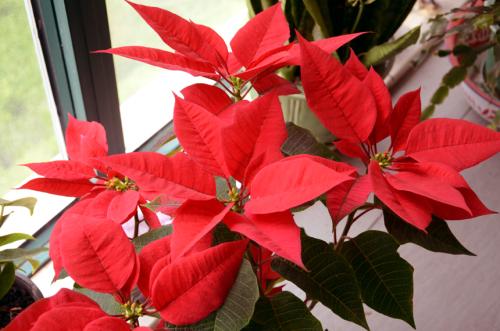
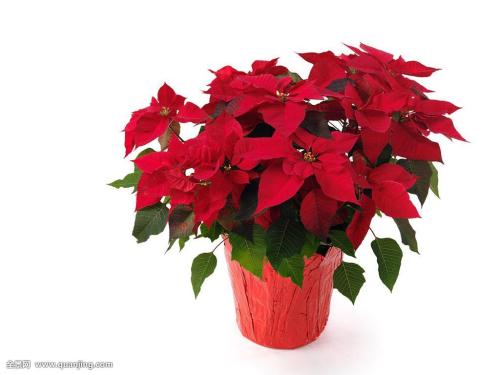
Poinsettia (scientific name: Euphorbia pulcherrima Willd. et Kl.): a shrub. The roots are cylindrical, with extremely many branches. The stems are erect, 1-3 m tall, 1-4 cm in diameter, hairless. The leaves are alternate, ovate-elliptic, long-elliptic, or lanceolate, green, with entire or shallowly lobed or wavy-shallowly-lobed margins; the leaf surface is pubescent or hairless, and the leaf underside is pubescent; the bracts are 5-7, narrowly elliptic, 3-7 cm long and 1-2 cm wide, usually entire, very rarely with shallow wavy splits at the margins, vermilion red. The inflorescences are several, arranged in cymes at the branch tips; the involucre is urn-shaped, pale green, with a toothed 5-lobed margin, the lobes triangular, hairless. The capsule is three-angled and round, smooth and hairless. The seeds are ovate, gray or pale gray, nearly smooth; without a caruncle. The flowering and fruiting period is from October to April of the following year.
Growth Habits of Poinsettia
Poinsettia prefers a warm, humid, and well-ventilated environment, and is not tolerant of low temperatures. Too strong direct sunlight or insufficient light may both affect its growth and cause the symptoms above. During the growth period, maintenance work such as fertilizer management and pinching to set the head should be done well.
Poinsettia Cultivation Methods and Precautions
1. Propagation: Mainly by cuttings. It is best to select older one-year-old branches from February to March and cut off 8-12 cm as cuttings. To avoid the toxic milky sap from flowing out, they should be immediately soaked in clean water, and after drying, inserted into well-drained soil or coarse sand, leaving 2-3 young buds above the soil surface, and kept moist and shaded.
2. Soil: Poinsettia likes loose, well-drained soil. Generally, use 3 parts vegetable garden soil, 3 parts humus soil, 3 parts leaf mold, and 1 part decomposed cake fertilizer, mixed with a small amount of cinder.
3. Temperature and light: In late September each year, it should be moved indoors for growing. In winter, the temperature should preferably be kept at 15-20°C. After mid-December, when it enters the flowering period, attention should be paid to ventilation. Poinsettia likes light and is a short-day plant. It should be given sufficient light all year round, preferably 8 to 9 hours per day.
4. Fertilization: Poinsettia likes fertile sandy soil. It is now autumn, and 0.3% compound fertilizer can be used once a week for 3 to 4 consecutive times to promote bract color change and flower bud differentiation.
5. Watering: This should be flexibly controlled according to the weather, the potting soil, and the plant's growth conditions. Generally, watering should keep the potting soil moist without water accumulating, but watering should be reduced after flowering.
6. Pruning: Mainly prune some old roots and diseased or weak branches. The usual pruning times are late June and mid-August. During cultivation, heavy fertilization and heavy watering should be controlled, especially before the plant's shape is set in autumn. When the branches grow to 20-30 cm, begin shaping and bending, with the aim of making the plant compact, the flower heads neat and evenly distributed, and improving ornamental value.