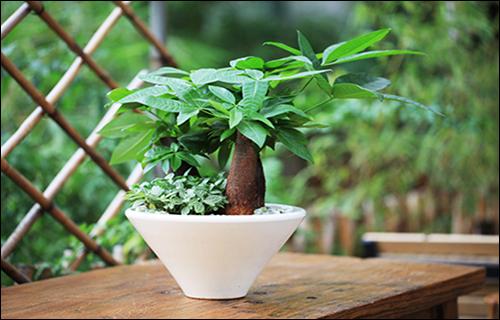
The money tree (Pachira aquatica), a small tree of the Malvaceae family (formerly Bombacaceae), grows 4-5 m tall, with a rather loose crown and chestnut-brown young branches that are hairless. The leaflets have short stalks or are nearly stalkless. The flowers are solitary at the tips of branches and in leaf axils; the pedicels are stout, covered with yellow stellate tomentum, and deciduous; the calyx is cup-shaped and nearly leathery; the petals are pale yellow-green, narrowly lanceolate to linear, with the upper half recurved; the staminal tube is relatively short, and the filaments together with the staminal tube are 13-15 cm long, yellow in the lower part and turning red toward the top, with narrowly linear, curved anthers; the style is longer than the stamens and dark red. The capsule is nearly pear-shaped, with a thick, woody, almost yellowish-brown pericarp, hairless on the outside and densely covered with long cottony hairs on the inside, splitting open, with many seeds per locule. The seeds are large, irregularly ladder-like and wedge-shaped, with a dark brown seed coat bearing white spiral lines, and contain multiple embryos. The flowering period is from May to November, the fruits ripen successively, and the seeds germinate naturally after falling to the ground.
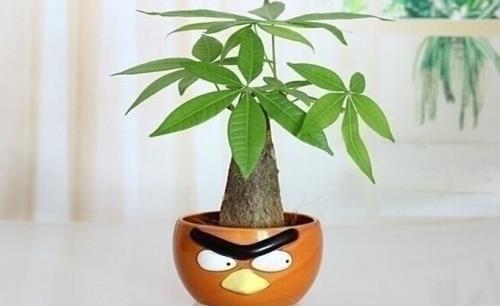
Cultivation Techniques
Land Preparation and Planting
For the seedbed preparation, choose a sandy loam plot with deep, fertile soil, sheltered from the wind and facing the sun, with good drainage and irrigation, as the nursery site; make beds 1 m wide and 10 m long, preferably oriented north-south; deep-plow the bed surface, remove the topsoil, and tamp it firm; lay a 3 cm thick layer of gravel on the lower layer, and on top spread 10 to 15 cm of a substrate sandy soil mixed from fresh river sand and furnace slag in a 2:1 ratio, with moisture such that it forms a ball when squeezed in the hand and crumbles when the hand is released. Spray the bed surface with a 400-fold dilution of 40% formalin, soaking to a depth of 3 to 5 cm, and cover with plastic film for 3 days to disinfect the soil and eliminate pests and diseases in the soil.
The money tree mainly carries out photosynthesis through its green bare trunks, and generally requires relatively strong light before sprouting, so semi-finished money trees are generally not shaded during winter and spring maintenance. In summer and autumn, because the sunlight is intense, failure to shade can easily cause excessively high temperatures inside the greenhouse and localized dehydration and death of the braided trunks on the side facing the sun, so one layer of 50% shade net is generally used. The money tree is a day-neutral plant, and after sprouting, 75% shading is generally suitable. In winter, no shading is used; in spring and autumn, one layer of 50% shade net is used.
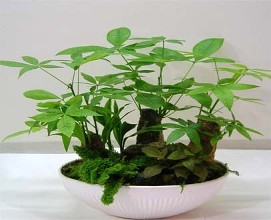
The money tree prefers a high-temperature, moderately humid environment. After the first watering, the greenhouse film should be completely sealed to increase humidity and raise the temperature. Before sprouting, the temperature should be kept at around 25-38°C and the humidity at around 50%-75%, with appropriate ventilation and air exchange every day. In the hot summer sun and the dry autumn, water should often be sprayed on the ground at noon to increase humidity and lower the temperature, controlling the temperature and humidity as much as possible.
If conditions permit, install spray pipes; misting for 5 minutes every 10 minutes gives even better results. After the buds grow to 7 cm, ventilation and air exchange must be increased, and the temperature inside the greenhouse appropriately lowered. Thereafter, the suitable growing temperature for the money tree is between 20°C-35°C. The temperature inside the greenhouse should not be too high; exceeding 35°C is unfavorable for plant growth, though it can still grow well if it exceeds 38°C for a short time, and it can also adapt to temperatures below 10°C. However, the temperature should not be lower than 5°C, otherwise cold damage easily occurs, causing leaf drop in mild cases and death in severe cases.
Humidity should also not be too high, otherwise it will cause the breeding of pathogens; watering should be done so as to keep the potting soil evenly moist. In summer, the money tree grows rapidly and needs sufficient water, so it should be watered 1-2 times a day. For winter maintenance of semi-finished plants, the potting soil must be kept appropriately dry, and watering should follow the principle of watering when dry and stopping when wet. If watered too much or if there is even slight water accumulation, it very easily causes root rot in the money tree, leading to plant death. Therefore, its growth condition should be observed frequently.
The money tree has strong vigor and grows rapidly, so it needs relatively sufficient fertilizer. After potting and sprouting, spray a liquid fertilizer with the three major elements once a week, such as a 500-600-fold dilution of a compound fertilizer with a nitrogen:phosphorus:potassium ratio of 20:20:20, and additionally apply an organic fertilizer or a phosphorus-potassium fertilizer to the soil once a month. During the peak growing season, avoid applying excessive nitrogen fertilizer alone, so as to prevent excessive vegetative growth. Phosphorus and potassium fertilizers should be applied in a balanced way to promote robust plant growth, make the leaves emerald green, and enhance the ornamental effect.
Pruning and Shaping
Potted money trees are mostly grown with their trunks "braided". The specific method is: when the sown seedlings have grown to about 2 m tall, cut off the upper part at about 1.5 m to make them bare trunks, then dig them out of the ground and let them dry naturally for 1-2 days under semi-shaded conditions, so that the trunks become soft and easy to bend. Next, tie the bases of several plants of the same thickness tightly together with rope, braid their trunks into a braid shape, lay them down on the ground, and press them down with a heavy object to fix their shape, so that they can stand upright and grow upward in the future. After braiding, the plants can continue to be planted in the ground and allowed to grow for a period of time, so that the stems grow thick and the braid becomes full and neat; they can also be directly potted and allowed to grow branches and leaves. The "three dragons", "five dragons", "seven dragons" and so on sold on the market are made by braiding 3, 5, or 7 Malabar chestnut (Pachira aquatica) plants into a braid shape and then planting them in pots, greatly increasing their value.