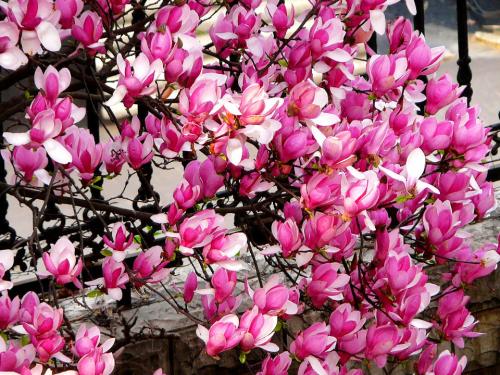
Saucer magnolia (scientific name: Magnolia soulangeana Soul.-Bod.), whose Chinese name is Erqiao yulan, also known as Zhusha yulan, belongs to the order Magnoliales and is a deciduous small tree or shrub. The plant reaches 7-9 m in height and is a yulan magnolia and magnolia hybrid. The leaves are obovate to ovate-oblong, the flowers are large, bell-shaped, white on the inside and pale purple on the outside, fragrant, with sepals resembling petals, but only reaching half their length, and some are small and green. It blooms before the leaves emerge, and its flowering period is similar to that of the yulan magnolia. All varieties of saucer magnolia are more cold-tolerant and drought-tolerant than the yulan magnolia and magnolia, and are difficult to transplant.
Propagation Methods
Grafting Propagation
Grafting usually uses rootstocks such as the purple magnolia and
Yunnan magnolia and other Magnolia genus plants; methods include
cut grafting, cleft grafting, side grafting,
bud grafting, etc. Cleft grafting has a high survival rate and rapid growth. Late-autumn grafting has a more reliable survival rate than early-spring grafting.
Cutting Propagation
Cuttings are the main propagation method for the purple magnolia. The timing of cuttings greatly affects the survival rate; it is generally done in May to June, and cuttings taken from the current year's shoots of young trees have the highest survival rate. Soaking the base in 50 ppm naphthalene acetic acid for 6 hours can increase the rooting rate.
Layering is a traditional propagation method, suitable for preserving and developing famous and superior varieties. Saucer magnolia is best suited to this method; select well-growing plants and take 1-2 year old branches about 0.5 cm thick as layers; if there are branches, they can be layered on the branches. The layering time is February to March. Roots form in the same year after layering; the longer it remains connected to the mother plant, the more developed the root system and the higher the survival rate. It can bloom 2-3 years after planting out.
Asexual Propagation
Using tissue culture methods, with buds of the saucer magnolia as explants, successful cultivation in test tubes has already been achieved.
Field Management
Pinching and Leaf Removal
The time to move out of the shed or room is from
the Spring Equinox to Qingming, choosing overcast or cloudy weather. After moving out, let the potted flowers adapt to the outdoor environment for 2-3 days, then remove the old leaves, leaving only a few tender leaves at the branch tips to encourage new shoots. Afterward, each time a batch of flowers finishes blooming, a small number of old leaves should also be removed to promote new branch growth and flower bud formation. During the growth period, pinch back frequently to control
apical dominance and encourage more lateral branches.
Adequate Nutrients
This is an important part of flowering-period management. Because the saucer magnolia has a long flowering period and many flowers, nutrients must be replenished regularly; in addition to applying sufficient base fertilizer when potting, during the flowering period from May to October, apply an organic liquid fertilizer mainly based on phosphorus and potassium (such as decomposed cake fertilizer water) once every 5-7 days. The fertilization principle is to apply thin fertilizer frequently; a method of starting lighter and then stronger can also be used, and raw fertilizer must not be applied, otherwise it will burn the roots. At the same time, carry out
foliar feeding once every 7-10 days, spraying the leaves with 0.5% plant growth promoter and 0.3%
monopotassium phosphate.
Timely Watering
The saucer magnolia has
fleshy roots, so it needs water but fears waterlogging. From early summer to late autumn, water once a day to keep the soil moist, but during the hot "dog days", water once each in the morning and evening, and also spray water on the leaves and the ground around the flower pot to increase air humidity. When using tap water, be careful to prevent
soil alkalinization; if leaf yellowing is found, apply ferrous sulfate water or water the roots with 0.7%-0.8% vinegar water, or spray the leaves with 0.3%-0.4% vinegar solution; the results are all very good. In rainy seasons, water must not accumulate in the pot, otherwise the roots will rot.
Suitable Light
The saucer magnolia is a
sun-loving flowering plant and needs plenty of sunlight; during the growth period it should be cared for in a
sunny spot with long
sunshine hours and strong light. Daily light must not be less than 6 hours. If kept in a shaded place, it will only grow leaves and not bloom, or bloom very little, with slender branches, pale leaf color, thin leaves, and no luster, which is unfavorable for growth. However, during hot high temperatures it needs moderate shading; from 12:00 to 16:00 each day, avoid scorching sun exposure and also avoid high-temperature radiation from brick walls or cement floors. At this time, not only should water be sprayed on the plants to cool them, but water should also be poured or sprayed on the ground to lower the temperature and dissipate heat and increase air humidity.
Key Care Points
The saucer magnolia has fleshy roots, so it is not tolerant of waterlogging; low-lying areas and areas with
high groundwater levels are not suitable for planting, as water accumulation around the roots easily causes leaf drop, or the roots may
suffocate and die. After the fleshy root system is damaged, the healing period is relatively long, so when transplanting, as much of the soil ball as possible should be kept. It is best grown in acidic, humus-rich, well-drained areas, and slightly
alkaline soil is also acceptable.