Detailed Explanation of Water Bamboo Planting Techniques and Management Methods
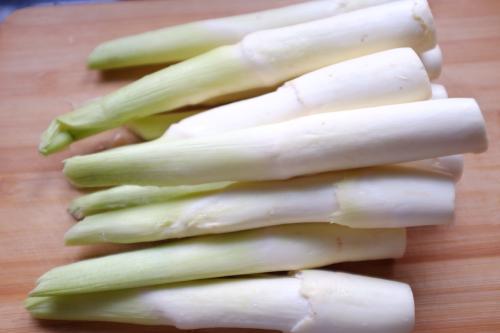
Water bamboo, also known as gaogua, gu sun, gu shou, jiao sun, or gao sun. It is a perennial root herbaceous plant of the genus Zizania in the grass family. It is divided into double-season water bamboo and single-season water bamboo (or divided into one-crop jiao and two-crop jiao); double-season water bamboo (two-crop jiao) has higher yield and better quality. The ancients called water bamboo "gu." Before the Tang Dynasty, water bamboo was cultivated as a grain crop; its seeds were called gu mi or diao hu, and it was one of the "six grains" (tu, shu, ji, liang, mai, gu). Later people discovered that some gu plants, infected by smut fungus, did not produce ears, and the plants showed no signs of disease; the stems kept swelling and gradually formed spindle-shaped fleshy stems, which is the water bamboo eaten today. In this way, people used the smut fungus to prevent water bamboo from flowering and fruiting, and propagated this diseased, deformed plant as a vegetable. It can also be used as medicine. In the world, only China and Vietnam cultivate water bamboo as a vegetable. In Baizhuangzi, Xintai, Shandong, water bamboo is honored as one of the three treasures (the three treasures are water bamboo, spring buds, and wild duck eggs), a tradition passed down since ancient times. It mostly grows in the Yangtze River lake areas and is suitable for growing in freshwater.
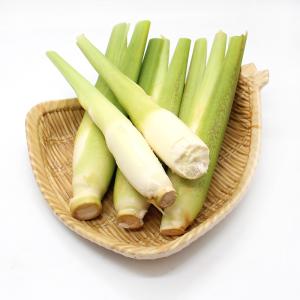
I. Requirements of Water Bamboo Growth and Development for Environmental Conditions
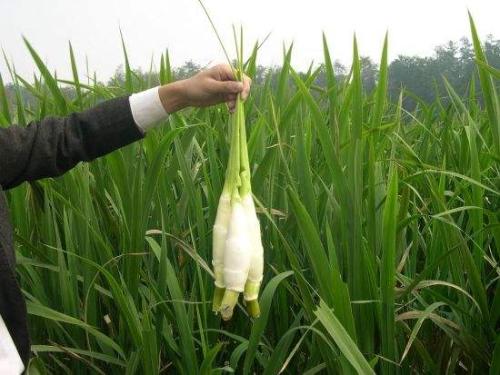
Water bamboo is a perennial aquatic root plant of the grass family. The plant height is 1.6-2 m, with 5-8 leaves, and the leaves are composed of leaf blades and leaf sheaths.
Water bamboo includes autumn-produced single-season water bamboo and autumn-summer double-season water bamboo. The growth cycle of water bamboo can be divided into four stages:
(1) Germination stage: after the beginning of spring, it begins to sprout in March and April; the minimum temperature is above 5 degrees C, and 10-20 degrees C is suitable.
(2) Tillering stage: from late April to the end of August, each plant can produce more than 10-20 tillers, and the suitable temperature is 20-30 degrees C.
(3) Jiao pregnancy stage: for double-season water bamboo, once from early to late June, and again from late August to late September. Single-season water bamboo only becomes pregnant with jiao from late August to early September; the suitable temperature is 15-25 degrees C; below 10 degrees C or above 30 degrees C, it will not become pregnant with jiao.
(4) Growth stagnation and dormancy stage: after jiao pregnancy, when the temperature is below 15 degrees C, tillering and aboveground growth both stagnate; below 5 degrees C, the aboveground part withers.
II. High-Quality and High-Yield Cultivation Techniques
(1) Soil cultivation: choose a field for the seedling bed that is sheltered from wind and faces the sun, convenient for both irrigation and drainage, and with loose and fertile soil. Before planting, prepare the land; it should be water-plowed and water-leveled. Before land preparation, apply green manure or barnyard manure 3500-4000 kg or human waste 3000-4000 kg as base fertilizer, break it up and level it, so that the mud is soft, the fertilizer is sufficient, and the field is level, and tamp the field ridges firmly to strictly prevent water and fertilizer leakage. After exposing it to the sun for several days, irrigate again with shallow water 3 cm deep, in preparation for planting.
(2) Seed selection and planting: carry out clump selection 6-7 days before harvesting autumn jiao; the seed clumps should conform to the characteristics of the original variety, with relatively short plants, growth vigor not excessive, and little height difference among the leaves surrounding the stem, but the last 1-2 young leaves are markedly shortened, such as when the leaf sheath and the jiao white eye are tightly contracted together.
Water bamboo is planted in spring and autumn. Regardless of late-maturing varieties of single-season or double-season water bamboo, in the Yangtze River basin from April to May, when the buds of the mother clump are 33-40 cm high and have 3-4 true leaves, dig up the water bamboo clump and split it along the tillering points with a sharp knife into several small clumps; each clump should carry stolons and 4-6 strong tillers, cut off the leaves, and retain leaf sheaths 16-26 cm long, so as to reduce water evaporation and help improve survival; dig, divide, and plant as you go.
Autumn planting: after the beginning of spring, dig up the old clumps after sprouting, cut each tiller into 8-10, and temporarily plant them in a lotus root field or fertile muddy field for seedling cultivation, always keeping the water depth at 3 cm. By July-August, each hole already has more than 10 tillers, and then plant them again separately.
From July to August, it enters the jiao pregnancy stage; remove the weaker tillers, leave one jiao per 10 sq cm, and from early August pick off yellow leaves 2-3 times, tread the yellow leaves into the soil to serve as fertilizer, and press a piece of mud in the middle of the water bamboo clump, so that the plants spread out toward the four sides of the clump, facilitating ventilation and reducing disease.
(3) Fertilizer and water management: water bamboo has a long growth period, many tillers, and a large fertilizer uptake. Since it is planted once and harvested many times, base fertilizer and topdressing must both be important. There are 4-5 topdressings in total. According to the principle of "promote-control-promote," 7-10 days after planting, it is suitable to apply seedling-promoting fertilizer, applying clear manure water 500-1000 kg per mu to promote seedling growth; half a month later, apply clear manure water 1000-1500 kg per mu or urea 10-15 kg; after that, stop fertilizing to avoid excessive growth; afterward it enters the tillering stage. From late July to early September, the tillers of new water bamboo enter the jiao pregnancy stage. When the jiao shoots begin to enlarge, apply concentrated manure water 3000-4000 kg per mu and urea 20-25 kg to promote enlargement of the jiao shoots; afterward, the 4th-6th fertilizations can be handled as appropriate.
The water level in the water bamboo field should be flexibly controlled according to the growth and development characteristics of water bamboo, and managed according to the principle of "shallow-deep-shallow" (shallow water for planting, deep water for establishment, shallow water for tillering). Before germination, irrigate with shallow water 2-3 cm to promote sprouting; after planting, maintain a water depth of 5-8 cm to promote tillering and root development; by the late tillering stage, deepen it to 10-14 cm to control ineffective tillering. During the high-temperature period from July to August, it is suitable to maintain a water depth of 13-17 cm, and change the water frequently to lower the temperature and reduce diseases and insect pests. During the jiao pregnancy stage until 6-7 days before harvest, irrigate the fetus-nourishing water according to the growth of the main stem water bamboo. Initially maintain about 15 cm, then gradually deepen to 23-27 cm, so that the entire water bamboo is immersed in water, but not exceeding the "jiao white eye." In the late jiao pregnancy stage, gradually irrigate shallow water to 3-7 cm. After harvesting autumn jiao, maintain shallow water 2-3 cm to prevent the root stock from freezing and rotting.
III. Pest and Disease Control
During the jiao pregnancy stage, there are large borers, striped stem borers, and long green planthoppers. During the young larval stage of the pests, apply 50% fenitrothion emulsifiable concentrate 100 g per mu diluted in water 75-100 kg and splash it on, or use 90% trichlorfon and 40% dimethoate at 1000 times, and after stripping off old leaves, pour the solution into the heart of each plant. After the beginning of autumn, aphids, leafhoppers, and thrips occur; use 40% dimethoate emulsion at 1000 times, or 10% leafhopper powder wettable powder 200-300 g diluted in water 50-75 kg and spray. For water bamboo rust, spraying with 1:800 sodium rust solution has good results.