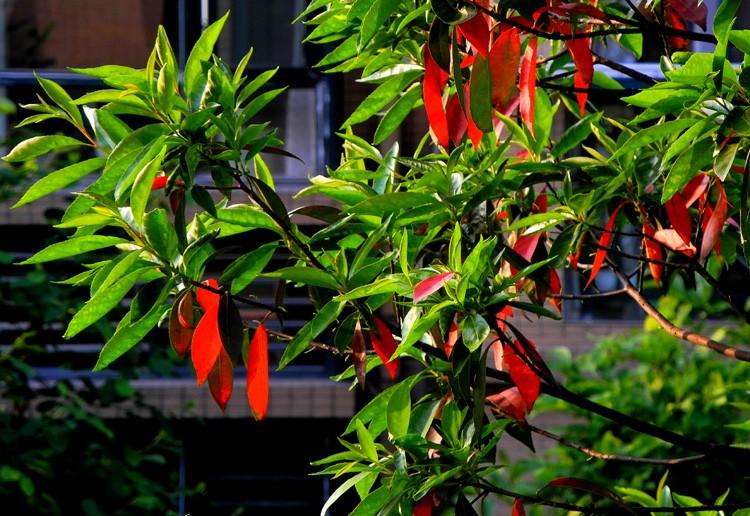
The branches and leaves of Elaeocarpus sylvestris are dense, and some leaves turn red after frost, creating a beautiful mix of red and green. It is suitable for clump planting on lawns, slopes, forest edges, in front of courtyards, and at road junctions, and can also be planted as a background tree for other flowers and trees. It is an excellent tree species for courtyard viewing and greening around homes.
Cultivation techniques:
Elaeocarpus sylvestris is a deep-rooted, shade-tolerant tree species.
A site should be selected with short sunlight hours, convenient drainage and irrigation, and loose, fertile, moist soil as the nursery site. In late autumn and early winter, deep plow the nursery site. Apply
decomposed barnyard manure at 2000 kg per mu,
cake fertilizer or compound fertilizer at 100 kg per mu, and powdered
ferrous sulfate at 15 kg for
soil disinfection. Prepare the land carefully; the seedbed should be 20 cm-25 cm high and 1.2 m wide.
2. Sowing techniques:
The seeds of
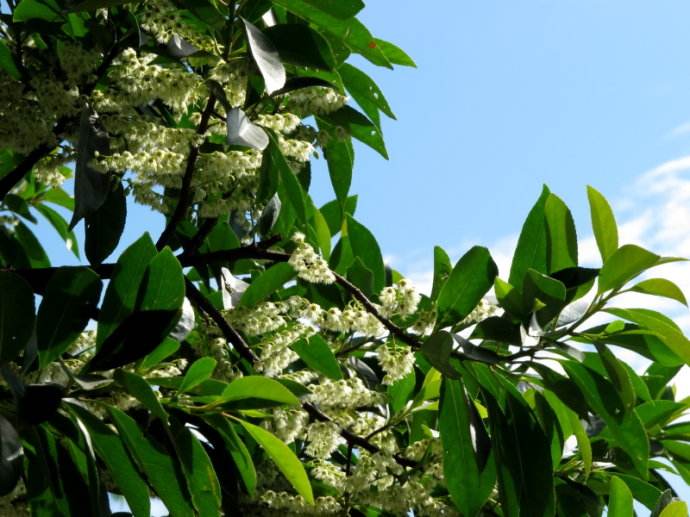
Elaeocarpus sylvestris mature from September to November. After the fruit is collected, remove the peel, dry it in the shade, and store it in sand. Sprinkle an appropriate amount of water and turn it once every 10-15 days to maintain suitable humidity.
The sowing time is from February to May. Use drilling, with row spacing of 25 cm, furrow width of 10-12 cm, and depth of 3 cm, at a sowing rate of 8-10 kg per mu. When sowing, spread an appropriate amount of calcium magnesium phosphate to promote rooting. The covering soil should be thin; scorched mud ash is best for covering the seeds, with a thickness such that the seeds are no longer visible. A thin layer of dry grass can be placed on top to keep the soil loose and moist, which is beneficial for seed germination. The emergence period is about 30-40 days. When 70% of the seedlings have emerged, remove the covering in the evening, and the next evening spray the seedbed with a 0.1% solution of dexon to prevent disease.
3. Field management during the seedling stage:
(1) Fertilization: In the early stage of seedling growth, apply dilute
human feces and urine at a concentration of 3%-5% every half month. After mid-May, apply 1%
superphosphate or 0.2% urea solution by watering.
(2) Weeding: Follow the principle of "weed small, weed early, weed completely." Weed 3 to 4 times; by the end of July the seedlings can close their canopy and form rows, after which weeding can stop.
(3) Water management: During the plum rain season, clear ditches and drain water well; during dry seasons, carry out irrigation well.
(4) Pest and disease control: The main insect pests are the leaf-eating pest
copper green chafer and the underground pests
white grubs and
cutworms. To control the copper green chafer, grasp the adult peak period; they can be shaken off and killed, or killed with an 800-fold dilution of 50% dichlorvos
emulsion. To control underground pests such as white grubs and cutworms that bite and feed, use dichlorvos or
methamidophos emulsifiable concentrate at a
mass fraction of 0.125%-0.167% solution, and pour it into holes made in the bed surface with bamboo sticks.
(5) Thinning: During the vigorous growth period (after mid-June), carry out thinning in stages and batches, and complete final thinning in late July, keeping 30-40 plants per square meter. Stop applying nitrogen fertilizer half a month before the Beginning of Autumn. From mid-September to mid-November, spray alternately once every 10 days with 0.3%-0.5%
potassium dihydrogen phosphate solution and 0.2%
borax solution, 2-3 times in total, to promote lignification of the seedlings. Generally, one-year seedlings can grow to about 50 cm tall.