Detailed Guide to Lantern Flower Planting Methods and Care Techniques
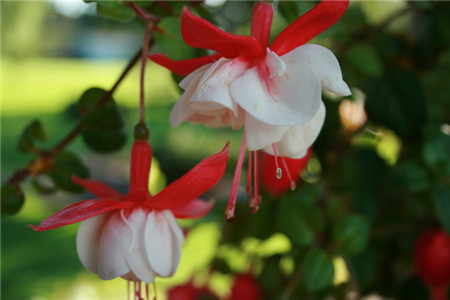
Lantern flower, also known as Fuchsia and Hanging Bell Begonia, is a perennial herbaceous flowering plant. It has many varieties, with the main flower colors being red, purple, and white. The leaves are alternate, often clustered at the tips of small branches; the flowers are arranged in terminal, drooping umbels or racemes; the flowers are pentamerous, with a 5-lobed calyx, a bell-shaped or urn-shaped corolla with a short 5-lobed limb; 10 stamens, a linear style longer than the stamens, and a capitate stigma; a capsule. Although it is delicate and beautiful, it cannot withstand the scorching sun of hot summers.

Temperature and Light
It prefers a cool, moist climatic environment, with an optimal growth temperature of 10°C~25°C. In winter it requires ample sunlight, and in summer it needs a semi-shaded environment. When the summer temperature exceeds 38°C, the lantern flower prefers a sunny environment; if there is insufficient sunlight, the plant is prone to leggy growth, and the number of flowers will be greatly reduced. However, in summer it needs appropriate shading; move the lantern flower plant to a ventilated, cool place to avoid prolonged direct sunlight and prevent the leaves from curling. With slow metabolism, growth enters a stagnant state, and leaf drop and root rot often occur at this time. If effective measures are not taken, it can cause the death of the entire plant. In addition, it should be noted that the medicinal lantern flower is a plant of the genus Enkianthus in the family Ericaceae.;
Water
During the growing period, the potting soil should be kept moist, following the principle of "dry-wet cycle" (water when dry, stop when wet). During the flowering period of the lantern flower, avoid the potting soil being too dry or too wet, otherwise it can easily cause bud drop, flower drop, or leaf drop. During the summer semi-dormant period and in winter, watering should be controlled to prevent leaf loss and root rot.
Fertilizing
The lantern flower likes fertilizer; apply sufficient organic fertilizer before planting. Because the lantern flower grows relatively fast and can also bloom continuously, during the growing period it should be fertilized every 7-10 days or so with cake fertilizer water or a dilute liquid fertilizer. In the early growth stage, nitrogen fertilizer should be controlled, and during the flowering period, additional phosphorus and potassium fertilizer is appropriate.
Soil
The cultivation medium should preferably be a fertile, loose, breathable, well-drained sandy loam.
In spring, repotting and soil changing can be carried out: pour out part of the potting soil, appropriately prune old roots, and choose a suitable flowerpot. In both spring and autumn, the soil should also be loosened appropriately.