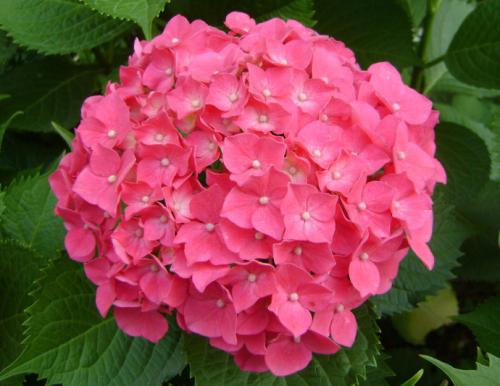
Hydrangea (scientific name: Hydrangea macrophylla), also known as hydrangea or ziyang flower, is a plant of the genus Hydrangea in the family Saxifragaceae. The flowers of hydrangea are pure white and full, large and beautiful, and their color can be red or blue, delighting the eye and refreshing the mind. It is a common potted ornamental flowering shrub. Hydrangea was cultivated relatively early in China, and hydrangeas were planted in Jiangnan gardens built during the Ming and Qing dynasties. Parks built in the early 20th century also could not do without hydrangea plantings. Modern parks and scenic areas plant them in broad masses to form landscapes.

Propagation Methods
Division, layering, cuttings, and tissue culture propagation are commonly used.
Division propagation: This is best done before budding in early spring. Separate rooted branches from the mother plant, pot them directly, do not water too much, and maintain them in partial shade. After new buds sprout, return to normal care.
Layering propagation: Carry this out when the buds begin to swell. Growth can occur after 30 days. Cut from the mother plant in the spring of the following year, transplant with soil, and it can bloom in the same year.
Cutting propagation: Carry this out during the plum rain season. Cut off tender shoot tips about 20 cm long, remove the lower leaves, and use a suitable cutting temperature of 13-18°C. Roots form 15 days after insertion.
Tissue culture propagation: Use dormant buds as explants, routinely disinfect them, then inoculate them on MS medium supplemented with 0.8 mg/L 6-benzylaminopurine and 2 mg/L indoleacetic acid to cultivate adventitious buds. When the shoots reach 2-3 cm in height, transfer them to 1/2 MS medium supplemented with 2.0 mg/L indoleacetic acid to grow into complete small plantlets.
Potted hydrangeas commonly use 15-20 cm pots. For potted plants, after budding in spring, pay attention to watering thoroughly to ensure the leaves do not wilt. During the flowering period from June to July, fertilizer and water should be sufficient, fertilizing once every half month or using "Huiyou" 21-7-7 acid fertilizer. When sunlight is too strong in midsummer, provide appropriate shading to prolong the viewing period of the flowers. After flowering, remove the flower stems to encourage new branches. Flower color is affected by soil pH: acidic soil produces blue flowers, while alkaline soil produces red flowers. Repot once every spring. Prune appropriately to maintain a beautiful plant shape.

Cultivation Techniques
The main diseases are wilt disease, powdery mildew, and leaf spot disease, which can be prevented and controlled by spraying a 600-fold dilution of 65% zineb wettable powder. Pests include aphids and mirid bugs, which can be killed by spraying a 1500-fold dilution of 40% omethoate emulsifiable concentrate.
Hydrangea prefers warmth and humidity, is not tolerant of drought, and also dislikes waterlogging; it prefers a semi-shaded environment, is not cold tolerant, and is suitable for growing in fertile, well-drained acidic soil. Soil pH has a very obvious effect on hydrangea flower color: when the soil is acidic, the flowers are blue; when the soil is alkaline, the flowers are red. Hydrangea is best cultivated in acidic soil (pH 4-4.5 is suitable).
Hydrangea prefers fertilizer. During the growth period, generally apply once every 15 days a diluted, well-rotted cake fertilizer solution. To maintain soil acidity, 1%-3% ferrous sulfate can be added to the fertilizer solution. Regular watering with alum fertilizer water can make the plant branch abundantly and keep the leaves green; adding 1-2 applications of monopotassium phosphate during the bud stage can make the flowers larger and more brilliantly colored; applying cake fertilizer should avoid the dog days to prevent pests and diseases and damage to the root system.
Hydrangea leaves are large and the branches and leaves are lush, so it requires a relatively large amount of water. In the growing seasons of spring, summer, and autumn, water thoroughly to keep the potting soil constantly moist. In summer, when the weather is hot and evaporation is high, in addition to watering thoroughly, also spray water on the leaves every day. The roots of hydrangea are fleshy roots, so watering must not be excessive, and water accumulation in the pot should be avoided, otherwise the roots will rot. After September, as the weather gradually turns cooler, gradually reduce the amount of watering. Move indoors before Frost's Descent, and the room temperature should be maintained at around 4°C. Before bringing indoors, remove the leaves to prevent leaf rot. In winter, the plant should be placed in a sunny indoor spot, and it is suitable to move it outdoors after Grain Rain the following year. Hydrangea management is relatively extensive, with few pests and diseases, making it an ideal potted flower that is relatively easy to manage and cultivate.
Hydrangea, also known as grass hydrangea, blooms from June to July. The flowers are white when they first open, gradually turning pink or blue, in large spherical heads composed of sterile flowers. When the many flowers bloom fully, they look like snow pressing down on the tree, charming and moving. Its branches and leaves spread densely, and its roots are fleshy. It has strong adaptability and can be planted in the ground in family courtyards or a corner of a patio, and is also suitable for pot cultivation to add color to balconies and windows.
Hydrangea prefers semi-shaded and humid environments and is not very cold tolerant. In the intense summer heat, avoid direct sunlight, otherwise the leaves are prone to scorching and yellowing. It is not suitable for excessively dry conditions and prefers to grow in light loam rich in humus, moist, and well drained. Branches and leaves are prone to wilting and withering after frost. When cultivated in the open ground, the aboveground part dies in winter, and in the following year new shoots sprout from the rhizome and bloom again. If potted and overwintered in a greenhouse, it can remain evergreen.
The key points of four-season care and management are as follows.
Spring: For potted plants, prune dead branches and repot with fresh soil. After the plant has adjusted, apply one or two dilute liquid fertilizers mainly based on nitrogen fertilizer, which can promote the sprouting of branches and leaves.
Summer and autumn: Place in partial shade or under a curtain frame to prevent direct sunlight and avoid leaves turning yellow and scorching. Apply one or two additional fertilizer applications before and after flowering to promote green leaves and abundant flowers. After the flowers fade, promptly trim away the flower stems to maintain a beautiful appearance. Keep the potting soil always moist, but prevent water accumulation after rain to avoid rot of the fleshy roots of hydrangea due to excessive moisture.
Winter: After the beginning of winter, plants cultivated in the open ground should be earthed up for warmth so they can overwinter safely; potted plants can be placed in a warm place facing south, sunny, and free from cold wind. Although the leaves fall off in winter, the roots and branches remain alive, and new leaves sprout again the following spring.
Soil Replacement and Pruning
Potted hydrangeas generally need to be repotted and have their soil replaced once each year. Repotting and soil replacement are best done in early March. The new soil is prepared with a ratio of 4 parts leaf mold, 4 parts garden soil, and 2 parts sand,
then add an appropriate amount of well-rotted cake fertilizer as base fertilizer. When replacing, prune the plant's root system, cutting off rotten roots, decayed roots, and overly long fibrous roots. After moving the plant into the new pot, press the soil firmly, then water thoroughly, place it in a shaded place for about 10 days, and then move it outdoors for normal management.
To make a potted hydrangea have a beautiful crown and bloom more, the plant must be pruned. Hydrangea grows vigorously and tolerates pruning. Generally, after the seedlings survive and grow to 10-15 cm in height, pinching can be done to allow the lower axillary buds to sprout. Then select 4 well-sprouted new branches in the middle and upper parts and remove all the lower axillary buds. When the new branches grow to 8-10 cm, carry out a second pinching. Hydrangea generally blooms on two-year-old strong branches. After flowering, the old branches should be cut short, retaining only 2-3 buds, to limit the plant from growing too tall and to encourage new shoots. After autumn, cut off the tops of the new shoots to stop branch growth and help overwintering. Through such pruning, the plant's shape becomes more graceful, greatly enhancing its ornamental value.