Rosa roxburghii Planting Techniques and Cultivation Management Points
Rosa roxburghii is a rare fruit with excellent medicinal value. The fruit of Rosa roxburghii looks like a little hedgehog covered in spines, which is very endearing, and it has high medicinal value.
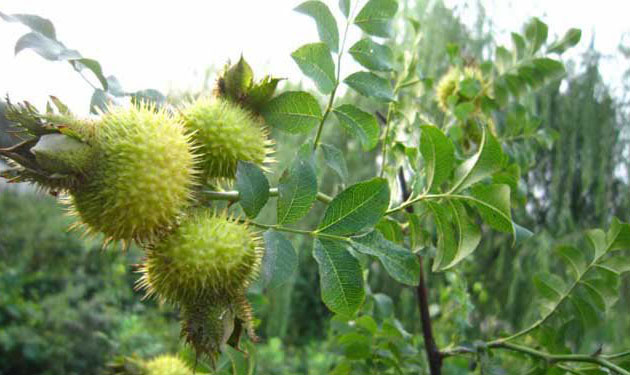
How to cultivate Rosa roxburghii, management methods for Rosa roxburghii cultivation
1. Training and pruning: Keep the tree height at 1.5-2 m and the crown spread at about 1.5 m, with 5-8 main branches per clump, on which fruiting mother branches are distributed in a staggered pattern. In the early stage after planting, let it grow freely to promote fruiting and form a crown, then thin out overly dense, drooping and overly long branches, and adopt a combination of winter and summer pruning to cultivate fruiting mother branches, achieving the goal of three-dimensional fruiting.
2. Fertilizer and water management
① Adjusting pH: Adjust the soil pH so that it is slightly acidic to neutral, pH 5.5-7.0. If the soil is too acidic, add lime water to adjust it; if the soil is too alkaline, apply gypsum or sulfur.
② Increasing organic fertilizer application: Increase the application of organic fertilizers, such as barnyard manure and miscellaneous soil manure. Apply base fertilizer in autumn every year at 22500 kg per hectare. Apply topdressing once before flowering and once at the young fruit stage, with urea at 75-90 kg per hectare.
③ Soil moisture management: Strengthen soil moisture management. Irrigate promptly in drought, drain promptly in waterlogging, and when the soil becomes compacted, carry out timely intertillage and weeding, etc.

3. Disease and pest control: Common diseases and pests of Rosa roxburghii include powdery mildew, aphids, nettle caterpillars, bagworms, citrus spiny whitefly and fruit borers. Powdery mildew occurs in both spring and autumn. In early June, at the initial stage of the disease, spray triadimefon in time, and the control effect can reach 74%-88%. Aphids mainly damage new shoots, and spraying with 80% dichlorvos at 2000 times dilution gives a good control effect. In addition, it is also effective against leafhoppers, nettle caterpillars, tortrix moths, and small leaf beetles. Citrus spiny whitefly parasitizes the underside of leaves. When pest damage occurs from May to August, 2000 times water-soluble amithion can be used for control. Spraying 2.5% deltamethrin at 6000 times dilution twice continuously from early July to August can control fruit borers.
4. Harvesting and drying: Fruits mature successively from August to the end of September. It is best to pick them in batches when the fruit is dark yellow and gives off a fruity aroma. Handle gently during picking to prevent pressure damage, and sell immediately after harvest. Dried fruit processing is simple: just sun-dry or oven-dry the fruit. Dried products can be stored for about 1 year. Before storage, fumigate each ton of dried product with 2 kg of sulfur powder for 2 hours, then pack in hemp bags and store with an outer plastic film bag. After 1 year, vitamin C loss is only 2.85%. If not fumigated with sulfur, vitamin C loss after 1 year can be as high as 80%.
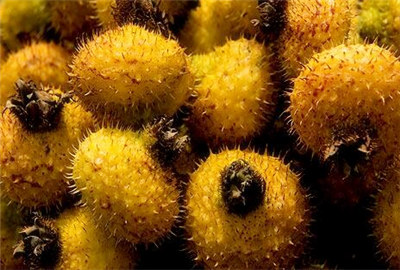
Planting methods for Rosa roxburghii
1. Planting preparation: Before planting, the soil should be deeply plowed, aged, improved, and planting trenches or holes dug. When building an orchard on mountainous land, the soil plow layer is thin, organic matter is low, and fertility is low, so soil improvement is needed. Before planting, generally dig trenches or holes 40 cm deep and 60 cm wide or in diameter, thoroughly mix the topsoil with farmyard manure and backfill, and settle with water or tamp firmly layer by layer.
2. Planting density: For plots with poor site conditions or extensive management, row and plant spacings of 2 m x 1 m or 2 m x 1.5 m can be used. For plots with fertile soil and sufficient rainfall, the row and plant spacing can be appropriately larger, with 2.5 m x 1.5 m or 2.0 m x 1.5 m being more suitable.
3. Planting time: Because Rosa roxburghii prefers moisture and cannot tolerate drought, and its protective tissues are not well developed, it easily loses water through transpiration. Therefore, in the Guizhou area, planting is generally done from late November to early February of the following year during the dormant period after leaf fall. In other areas, it can be determined as appropriate based on actual conditions.