Detailed Explanation of French Marigold Planting Methods and Technical Points
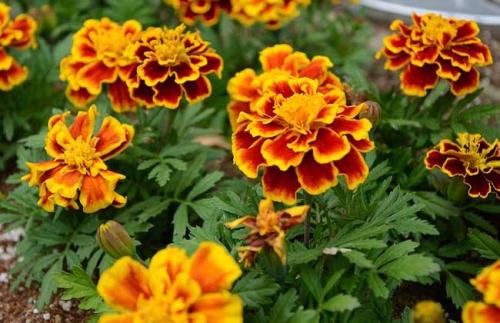
French marigold (Tagetes patula) is an annual herbaceous flower of the genus Tagetes in the Asteraceae family. The plant is relatively short, with a height of 20-40 cm, a compact form, and many branches in a clumping habit, with purple stems. The leaves are opposite, pinnately divided, with lanceolate lobes, and the leaf margins have distinct oil glands. The capitulum is terminal, with the outer ring of florets dark red and the inner part yellow, hence it is also called red-yellow herb. Because of repeated interspecific hybridization, in addition to red and yellow, pure yellow, orange and other varieties have also been bred, as well as single-petaled and double-petaled varieties. The flowering period lasts from "May 1" all the way to "October 1".

Cultivation Management
Calathea insignis is native to the Americas, likes semi-shade and high-temperature, humid environments, is not cold-tolerant, and its optimum growth temperature is 20-30°C; above 35°C or below 7°C, growth is poor. The overwintering temperature must not be too low, otherwise the leaves tend to curl. It requires loose soil rich in humus and with good drainage.
For potted Calathea insignis, use loose, fertile, well-drained, slightly acidic loam rich in humus. Generally, it can be mixed with 3 parts leaf mold, 1 part peat or sawdust, and 1 part sand, with a small amount of soybean cake added as base fertilizer. Avoid using heavy clay garden soil. When potting, first place a 3 cm thick layer of coarse sand at the bottom of the pot as a drainage layer to facilitate drainage.
During the growing season, give sufficient water. Especially in summer and autumn, in addition to keeping the pot soil moist at all times, it is also necessary to frequently spray water on the leaves to cool and moisturize; it requires relatively high air humidity, preferably 70% to 80%; avoid dry air and dry pot soil, but it must not be waterlogged. After late autumn, water should be controlled to help it resist cold and overwinter. In winter, maintain a dry environment; if too wet, the basal leaves will turn yellow and scorched, affecting its ornamental value.
From May to September, during the growing season, it should be placed in shade or semi-shade, maintaining a light transmission rate of 40%-60%, avoiding direct sunlight. Too strong light or dry air can easily cause scorched leaf margins and tips and dull, lusterless leaf patterns; however, light should not be too weak either. If placed in a dark room for a long time, with low temperature and insufficient light, growth will also weaken, which is unfavorable for leaf color formation and causes loss of the unique metallic luster of the leaves. In winter, it can receive direct sunlight through glass.
Fertilization Matters
When Calathea insignis lacks fertilizer, the plant is noticeably shorter, the leaf color is dull, and the golden luster is not vivid. During the growing season, apply a dilute liquid fertilizer once every 20 days. The nitrogen-phosphorus-potassium ratio should be 2:1:1, which can make the leaf color glossy and vivid. Be sure not to use too high a proportion of nitrogen fertilizer. For example, spraying a 0.2% liquid fertilizer directly on the leaves every 10 days is extremely beneficial for sprouting and growth. Stop fertilization in winter and summer.
Calathea insignis likes high temperatures and humidity. Its optimum growth temperature is 18°C-25°C, and it likes humid air. It grows fastest from May to October when the temperature is above 20°C. From October each year to April of the following year, during the low-temperature season, it should be moved into a greenhouse to overwinter in the north. The overwintering temperature in winter should not be lower than 15°C, otherwise the leaf color will darken, the leaves will curl, and the leaf tips will turn yellow. If the frost damage is slight, promptly changing the environmental conditions may still allow new leaves to emerge the following spring. If the frost damage is severe, the leaves will die one after another, and even the whole plant may die. If the indoor temperature difference between day and night is large, plastic film can be used to cover the pot or a glass box can be used to keep it warm and humid. Also, wash the leaf surface with warm water once a month to maintain the leaf color. Every spring, after the temperature steadily rises to 20°C, repot once. When repotting, add new culture soil and prune off residual roots and dead leaves, then replant to promote growth.
Disease Prevention
Calathea insignis has relatively few diseases and pests, but if ventilation is poor and the air is dry, scale insects can still occur. Spray 1500 times dimethoate to control them.
Controlling Calathea insignis Leaf Spot
Leaf spot lesions are yellow-brown. In the early stage of the disease, small yellow granules form near the leaf margins or in the center of the leaf, and gradually expand, deepen in color, and turn yellow-brown. There is a relatively obvious halo around the lesion. As the lesion expands, the leaf gradually dries, shrivels, and finally falls off and dies. The pathogen is the conidium of the imperfect fungus Drechslera. The causes of the disease are high temperature and high humidity, poor air circulation, plants placed too densely, excessive weeds and rotten leaves in the cultivation environment, excessive nitrogen fertilizer application, and spindly plant growth. Tender tissues are susceptible to the disease.
The control method is to strengthen fertilizer and water management, appropriately increase phosphorus and potassium fertilizers, apply less nitrogen fertilizer, promote full plant growth, and enhance its own resistance. Promptly remove diseased and disabled leaves as well as weeds to reduce sources of infection. Plants should not be placed too densely. Appropriate ventilation and light transmission and reducing environmental humidity can reduce disease occurrence. When disease occurs, spray for protection. Chemicals include: 50% carbendazim 600 times to 800 times solution; or 75% chlorothalonil 600 times to 800 times solution; 50% mancozeb 500 times to 600 times solution, once every 7 to 10 days. Various chemicals should be used alternately to prevent the pathogen from developing resistance.