The Latin genus name of the Vanda orchid is Vanda, which comes from Urdu in India and means growing attached to trees; some also believe that the word itself simply means "orchid" in India. Either way, from this genus name it can be inferred that Vanda orchids were first discovered in India.

Cultivation Methods
Vanda orchids prefer a high-temperature environment, but most species can adapt to intermediate-temperature cultivation conditions, and most bloom in spring and summer. However, Vanda coerulea from high-altitude areas
prefers a cooler environment more than other species and should be grown in a cool greenhouse. Vanda orchids have no dormant period, so cultivation should maintain year-round routine and constant care; fluctuations and changes under any environmental conditions may cause the lower leaves to drop, leaving only a stem with no roots or few roots, poor growth, and a few shriveled leaves. The stem at the base of older plants may be bare, with no roots or leaves; at this point, part of it can be removed and the healthy upper section with leaves and roots can be replanted. During the growing period, Vanda orchids should be maintained at 20°C to 30°C all year round; the higher the accumulated temperature, the easier it is to bloom. If this temperature cannot be reached during the growing period and the winter temperature is below 15°C, even if the plant grows well, it will be difficult to bloom due to insufficient accumulated temperature. If the room temperature falls below 5°C, some tropical species will freeze to death.
Compared with other orchids, Vanda orchids need sufficient light, otherwise they will not bloom. In the wild, Vanda orchids have the characteristic of growing toward light; usually in hot summer, they can tolerate daytime temperatures above 30°C, strong light, and moist conditions. In winter, no shading is needed and they grow well. Generally, during the hottest summer period, 30% to 40% shading should be applied. During the seedling stage, 40% to 50% shading should be applied, and ventilation should be increased. In winter, during continuous rainy weather or when indoor light is insufficient, artificial supplementary lighting should be provided in time; otherwise, it may cause nutritional deficiencies in the plant and delay the flowering period.
Growing Medium
Vanda orchid roots are thick and long, and prefer to be exposed to the air. Therefore, when growing in pots, the medium must be highly permeable; use materials such as charcoal, brick pieces, tree fern chunks, coconut shells, pumice, and bark pieces. Use less sphagnum moss, and do not use potting soil or leaf mold. Large Vanda orchids can generally be grown in hanging baskets or wooden slat baskets, while small Vanda orchids can be grown in porous clay pots or porous plastic pots. They can also be grown without medium or containers, suspended directly in the air. If high-quality sphagnum moss with strong water-absorbing capacity is used for potted flower production, the new growing medium should be replaced once every year, preferably in spring when the outdoor temperature exceeds 20°C or after the flowers fade. After repotting, appropriately control water, keep the moss slightly moist, and create a cool, ventilated environment to help it resume growth.
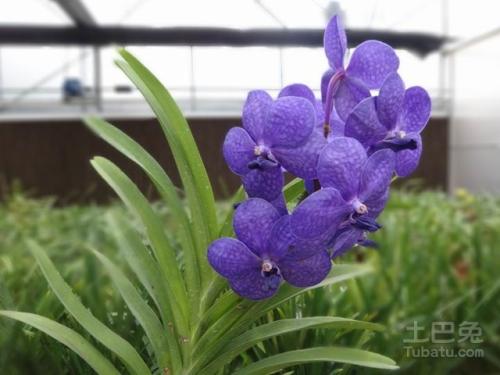
Temperature and Moisture
Vanda orchids prefer high humidity, and many roots are often exposed. During cultivation, it is necessary to ensure that the orchid plant has sufficient water and high air humidity; usually air humidity should be maintained at 70% to 80% or higher. However, when growing in pots, the roots must have good breathability and must never be waterlogged or poorly drained, otherwise it easily causes rot. Whether grown in pots or bare-root, during high temperatures or when the weather is too dry, water should be sprayed more often on the leaves and ground. When heating the greenhouse at night in winter, pay attention to increasing air humidity.
On sunny days in spring and summer, water once in the morning and once in the evening, and spray the plant with water from time to time to increase humidity. In autumn, change to watering in the morning; in winter, choose noon on sunny days for watering. If the room temperature is low, control watering to avoid low-temperature dampness causing the orchid plant to rot. Vanda orchid leaves are mostly folded lengthwise, making it very easy for water to remain on them, especially in winter; when watering, be careful to avoid splashing the leaves, otherwise water remaining for a long time at night may cause leaf rot, and even cause some leaves to drop or die.
Vanda orchids require more nutrients than other epiphytic orchids. Therefore, during the vigorous growth period, a liquid fertilizer diluted 1000 times can be applied once a week; potassium dihydrogen phosphate or "Huabao" orchid-specific water-soluble fertilizer can be used, and both root application and whole-plant spraying are suitable. During the high temperatures of midsummer, apply once a month at a dilution of 3000 to 5000 times. After the flowering period, the faded flower stems should be cut off from the base to help the plant recover from reproductive growth to vegetative growth. If fertilization is insufficient during the growing period, the plant's vigor will decline noticeably, and the stems and leaves will become thin, long, and weak, making them prone to falling over. For potted flower production, the nitrogen-phosphorus-potassium ratio for seedlings is 2:2:1, for medium to large seedlings it is 1:1:1, and for flowering plants it is 1:3:2. In winter, when the temperature is low, stop fertilizing; if the room temperature is high and the Vanda orchid is still growing, fertilization can continue.
Medium
Because Vanda orchid roots are aerial roots, any well-drained medium can be used, such as tree fern fiber, crushed brick pieces, charcoal, and coarse gravel; whether used alone or mixed together, they are all good potting media. In growing Vanda orchids, besides the medium, the pot must also be chosen with care. Among pots of various materials, wooden slat baskets and clay pots are superior, and drilling several more holes in the pot is even more beneficial for good drainage and air circulation. Besides wooden slat baskets and clay pots, Vanda orchids can also grow well on tree fern boards or tree trunks. Vanda orchids should not be repotted frequently; unless they are affected by pests or diseases, they should be repotted at least only once every 3 years.