How to Plant and Care for Guzmania (Bromeliad)
Guzmania, also known as bromeliad, is an indoor ornamental flower for winter and spring, evergreen all year round, with beautiful and varied inflorescences and rich colors. Commonly cultivated varieties include bright red, pink, golden yellow, rose red and so on. Bromeliads have a long flowering period and are suitable for growing at home.
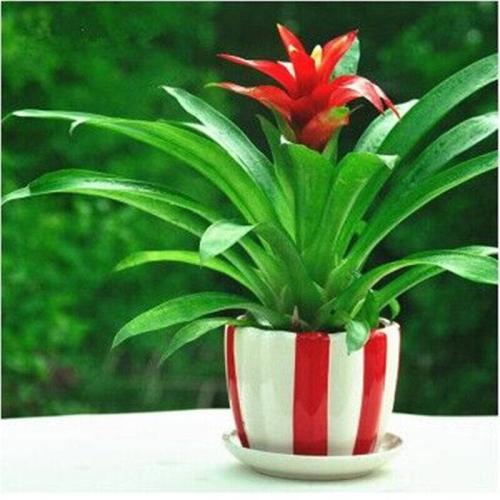
Planting and propagation techniques for Guzmania
1. Soil: Bromeliads are suited to loose, fertile, humus-rich soil. For home cultivation, you can mix 2 parts peat soil with 1 part fine sand to make a potting mix. (Tip: since many flower lovers buy them already potted with soil, there is no need to repot)
2. Light: To keep bromeliad leaves bright in color and to bloom regularly, light is very important. In winter, there must be at least 4 to 5 hours of direct sunlight every day. On cloudy and rainy days, you can use lights to increase illumination. In summer, the pot should be placed in the shade of trees; for indoor cultivation, shade netting can also be set up as needed.
3. Fertilizer: Bromeliads bloom in winter and require sufficient fertilizer. Usually apply a dilute organic liquid fertilizer once every two weeks, such as soaked liquid of soybean cake or sesame paste residue (a concentration of 20% is suitable); soybean soaking liquid or fermented rice washing water can also be used. 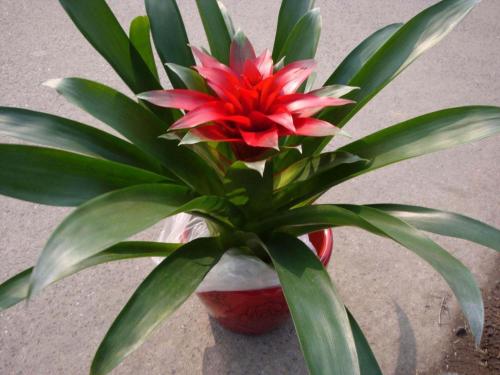
4. Watering: Bromeliads like a humid environment. Keeping the potting soil moist on ordinary days is enough; generally do not water on cloudy and rainy days. For home cultivation, it is best to use water that has been left to stand, and do not water directly with tap water. Bromeliads are flowers that are enjoyed both for their blooms and their foliage. It is best to spray the leaves with clean water once a day to remove dust, make the leaf color brighter, and also help photosynthesis, promoting healthy plant growth.
5. Growing temperature: The most suitable growing temperature for Guzmania is 21-28°C during the day and 18-21°C at night, and its maximum temperature must not exceed 35°C. Of course, in winter when the temperature is lower, the temperature can be appropriately lower as well, but it must not be lower than 10°C, otherwise the plant will be frostbitten and the leaves will turn yellow, so attention must be paid to temperature control.
6. Pest and disease control: In environments with high temperature and humidity and poor ventilation, bromeliads are prone to pests and diseases, such as sooty mold, red spider mites, scale insects and so on. If disease is found, carbendazim can be sprayed promptly; for pests, omethoate can be sprayed. No matter which liquid medicine is sprayed, it must be done outdoors to prevent polluting the indoor environment.