Detailed Explanation of Peony Planting Methods and Technical Points
Peony, also known as the king of flowers, tree peony, Guyu flower, wealth flower, etc., belongs to the family Ranunculaceae and the genus Paeonia. In its place of origin, the peony is mostly distributed on mid- and low-altitude mountains at around 1000 m above sea level, and it is a suitable flower for warm temperate and temperate regions.
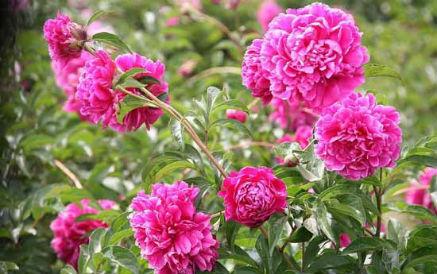
Planting and Management of Peonies
Peonies have a well-developed root system and are relatively suitable for field planting. They are generally transplanted from late September to early October, with a plant spacing of 80 cm x 100 cm. Before planting, the soil should first be prepared and fertilized. The planting depth should be such that the root crown is slightly below the ground surface. Generally, fertilizer is applied 3 times a year: base fertilizer after leaf fall, topdressing after sprouting in early spring, and topdressing again after flowering. Water during drought, but the amount of water should not be too large. After watering and after heavy rain, the soil must be loosened, and waterlogging is strictly prohibited. In early March, select and retain 5-8 strong branches per plant, keep 2 flower buds on each branch, remove the rest, and promptly remove the tillers on the root crown. After the flowers fade, the faded flowers should be cut off in time to prevent nutrient consumption due to seed formation.
Peony Planting Techniques
If you want peonies to bloom early for the Spring Festival, about 2 months before the Spring Festival, that is, at the end of November, select robust, well-filled plants with plump buds from varieties that bloom easily. When digging them up, be careful to damage the roots as little as possible, dry them in the shade for 1-2 days, and after the roots become soft, plant them in tall pots, water thoroughly, and place them in a greenhouse at about 12 degrees C for 2 weeks. After that, increase the temperature so that the greenhouse temperature remains at about 16 degrees C. When the new branches have 3-4 leaves and the flower buds are as large as a thumb, raise the greenhouse temperature to about 18 degrees C. At this time, watering should be controlled to prevent excessive leaf growth. When the flower buds become larger and round like a peach, water thoroughly once to promote the growth of both buds and leaves. When the flower buds have grown to normal size, increase the temperature to 28-30 degrees C, and pay attention to ventilation and spraying water, and they will bloom in a few days.
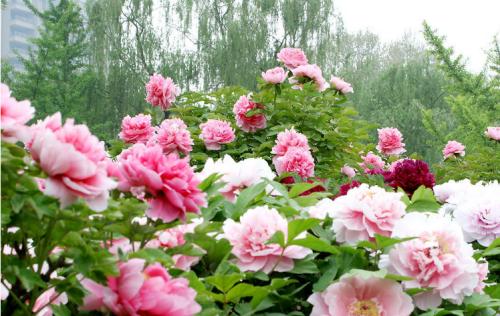
Origin and Habits of Peonies
Native to the western and northern regions of China. It likes light, tolerates cold, and does not tolerate damp heat; it tolerates drought and avoids waterlogging; it likes fertile, well-drained sandy loam.
Propagation Methods of Peonies
Peonies can be propagated by division, grafting, and sowing. The division method is generally commonly used. Division is suitable in late September. First dig out the entire plant from the ground and remove the soil, dry it in the shade for 1-2 days, cut the clump apart with a sharp knife, and apply sulfur powder or plant ash to the wounds to prevent rot. Each clump should retain 3-5 buds and an appropriate root system, and they should be planted separately.
Grafting peonies is also carried out from late September to early October. Root grafting is mostly done using peony rootstock, and planting is done immediately after grafting. The depth should be such that the top of the scion is level with or above the ground. After watering, cover with soil 10-15 cm deep, and remove the covering soil when sprouting in the following spring to facilitate the emergence of young seedlings.
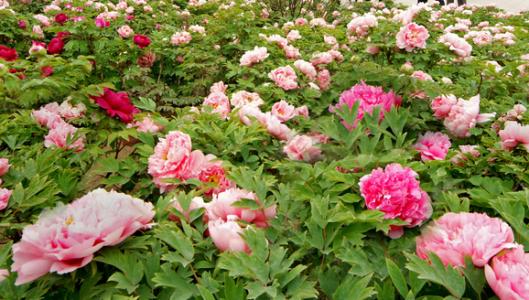
For peony propagation by sowing, the seeds are collected after they mature in August and sown immediately, or they can be buried in wet sand to promote germination and sown after young roots grow. The drill sowing method is commonly used, with a furrow depth of 4-6 cm, covered with 2 cm of soil, and pressed firm. In the year of sowing, only roots grow, and they sprout in the second year, and are transplanted after 2 years. If managed properly, they can bloom in 5 years.