A Detailed Guide to Navel Orange Planting Techniques and Management Methods
Navel orange [qí chéng], original name: sweet orange. Aliases: orange, navel orange, fragrant orange, orange. Latin name: Citrus sinensis (L.) Osbeck, Dicotyledoneae, Sapindales, Rutaceae, evergreen small tree, branchlets hairless, thorny spines short or absent. Leaves elliptical or ovate, entire or with inconspicuous blunt teeth; petiole with narrow wings, apex articulated. The navel orange is a fine citrus variety cultivated competitively around the world.
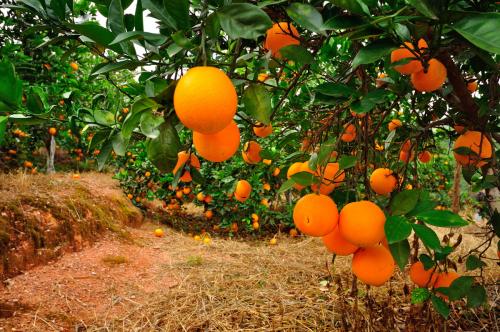
When to plant navel oranges: either early spring or early autumn is fine; do not plant in the hot summer or cold winter, so as to minimize damage to roots, branches, leaves and flowers.
Planting Techniques
(1) Soil fertilization: Soil fertilization should both help the roots absorb fertilizer as quickly as possible and prevent the roots from suffering fertilizer damage. Therefore, fertilization should be suited to the time, the tree and the fertilizer. Persist in shallow application for shallow roots, deep application for deep roots, shallow application in spring and summer, deep application in autumn and winter; shallow application for inorganic nitrogen, deep application for phosphorus and potassium fertilizers and organic fertilizers. Autumn and winter fertilization should be combined with deep plowing to expand the planting holes and improve the soil, and burying green manure; phosphorus fertilizer is easily fixed by the soil, so mixing it with decomposed organic fertilizer or bio-organic compound fertilizer and applying it deeply gives good results.
There are various methods of soil fertilization: young navel orange trees use ring-shaped trench application; mature fruiting navel orange trees use strip trench application; navel orange trees on narrow terraced plots use radial trench application. Since navel orange fruit trees are deep-rooted crops, with roots mainly distributed 40-80 cm deep, the fertilization position should be outside the drip line of the canopy, not near the main roots directly below the trunk.
① Ring-shaped trench fertilization: According to the size of the canopy, with the trunk as the center, open a ring-shaped trench near the outer edge of the canopy; the depth of the trench depends on the depth of root distribution, generally 20-30 cm deep and 30 cm wide. The advantages of ring-shaped fertilization are that it saves fertilizer and is simple and easy to carry out, but the area is small and roots are easily damaged, so it is often used for fertilizing young trees.
② Radial fertilization: According to the size of the canopy, dig 4-6 radial trenches in the tree basin, about 30 cm wide, shallow near the trunk and gradually deeper outward. This method damages few roots; change the fertilization position every other year or every other time to expand the fertilization area.
③ Strip trench fertilization: Open strip trenches between the rows or between the plants of navel orange trees, 30 cm deep and 30 cm wide, and cover with soil after fertilization; alternate trenching between plants and between rows in different years. It is suitable for mature navel orange orchards, especially closed-canopy navel orange orchards.
④ Hole fertilization: Evenly dig 4-8 holes at the outer edge of the canopy, 20-30 cm deep and 30 cm wide, apply fertilizer into the holes, and cover with soil after it seeps down. The hole fertilization method is simple and damages few roots, but the fertilization area is small, so it is suitable for applying liquid fertilizers.
⑤ Whole-orchard fertilization: Evenly broadcast fertilizer over the whole orchard, then turn it into the soil. It is suitable for mature navel orange orchards whose roots fill the whole orchard, but the fertilization depth is shallow and it easily causes roots to grow upward, so it should be used alternately with other methods.
(2) Foliar topdressing: Foliar topdressing is also called leaf surface fertilization. The nitrogen fertilizers used for foliar spraying are mainly urea, ammonium sulfate and ammonium nitrate, etc., and urea is the best; phosphorus fertilizers are mainly ammonium phosphate (a mixture containing monoammonium phosphate and diammonium phosphate), superphosphate, potassium dihydrogen phosphate, dipotassium hydrogen phosphate, etc., among which ammonium phosphate gives the best effect. When superphosphate is used for foliar fertilization, soak it in water for a whole day and night before use, then prepare it at the required concentration; potassium fertilizers are mainly potassium dihydrogen phosphate, potassium sulfate, potassium chloride, potassium nitrate and dipotassium hydrogen phosphate, etc., with potassium dihydrogen phosphate being the best.
When fertilizing, in order to save labor, different fertilizers are usually mixed and applied, simultaneously meeting the comprehensive nutrient element requirements of navel orange growth and development, and sometimes proper mixing of fertilizers can improve fertilizer efficiency.
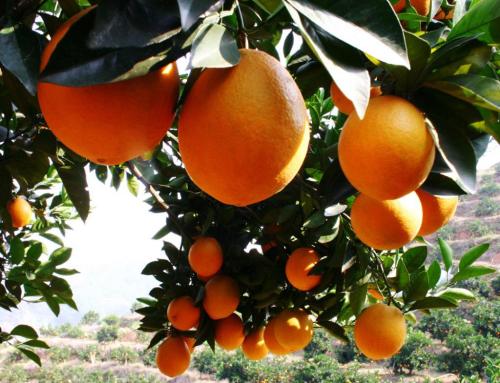
Summer Cultivation Techniques for Newly Fruiting Navel Orange Trees
1. Apply fruit-stabilizing fertilizer according to the tree and strengthen foliar spraying After newly fruiting trees send out flower buds and bloom, they consume a large amount of nutrients. To improve fruit set, apply a fruit-stabilizing fertilizer in time before the second physiological fruit drop (early June), adhering to the principle of "fertilizing according to the tree." Method: Cultivate and loosen the soil in the tree basin, open a ring-shaped shallow trench at the drip line, and drench each tree with 150-250 grams of imported compound fertilizer + 10-5 kg of decomposed manure water, then cover with soil. During the young fruit growth period, spray the leaves with 0.3% potassium dihydrogen phosphate and 10.3% urea once every 15 days.
2. Remove summer shoots and thin fruit reasonably Newly fruiting trees send out a relatively large amount of summer shoots. To reduce the conflict between shoots and fruit and improve the fruit-setting rate, thoroughly remove summer shoots from mid-May to late July, and uniformly release autumn shoots in early August to cultivate the fruiting mother branches for the next year. Thin fruit before the second physiological fruit drop in early June, mainly removing small and weak fruit, deformed fruit, pale-colored fruit and diseased and insect-damaged fruit. If fruit set is excessive, part of the healthy fruit should also be thinned, with a leaf-to-fruit ratio of 50-60:1.
3. Prevent navel yellow fruit drop There are usually three types of navel yellow: physiological navel yellow, pathogenic navel yellow and pest-caused navel yellow. For physiological navel yellow, apply 200-300 ppm gibberellin (920) or 800-fold yellow-inhibiting ester solution to the navel, once every 10-5 days, for 2-3 consecutive applications. For pathogenic and pest-caused navel yellow, add thiophanate (or carbendazim, thiram) and insecticides such as omethoate to the above agents, and smear the navel with the mixed liquid, but the concentrations of fungicides and insecticides used should be 3-5 times higher than usual.
4. Strengthen orchard soil management to prevent fruit cracking Covering the tree basin (with a 10-5 cm thick layer of weeds) and reasonably interplanting leguminous green manure can effectively lower soil temperature, keep the soil moist, and significantly reduce fruit cracking caused by sudden water absorption and expansion after rain following drought. During the young fruit period, spray the leaves with 0.3% potassium dihydrogen phosphate once every 10-5 days.
In early July, apply 250-500 grams of potassium fertilizer per tree once. From early June to late July, use 200-250 points of gibberellin (920) to smear the navel of young fruit; if cracked fruit is found, add 800-fold thiophanate solution. During the fruit expansion period from July to August, spray the canopy with a mixed solution of 1.5% urea + 0.2% potassium dihydrogen phosphate + 0.2% vinegar + 0.1% lime + 0.1% salt for a better fruit-cracking prevention effect.
5. Pest and disease control In summer, focus on the control of rust mites and canker to improve the appearance quality of the fruit. Rust mites: from late May to early June during the young fruit period, start spraying when 3-5 mites are present on the fruit surface, spray once every 10-15 days, for 2-3 consecutive sprays, and then spray another 1-2 times from July to September. The agents include 40% isocarbophos 1000-2000-fold solution, tricyclotin 1500-2000-fold solution, propargite 3000-5000-fold solution, and zineb 800-000-fold solution.