Gerbera (scientific name: Gerbera jamesonii Bolus) is a perennial, hairy herbaceous plant in the Asteraceae family, genus Gerbera. The rhizome is short, surrounded by remnant leaf petioles, with relatively thick fibrous roots; the leaves are basal, arranged in a rosette, with blades oblong-elliptic to oblong, apex shortly acute or slightly obtuse, petioles with coarse longitudinal ridges, more or less hairy; the scape is solitary, or rarely several clustered, without bracts; hairs are densest at the top, the capitulum is solitary at the apex of the scape; the involucre is campanulate, the receptacle is flat, naked, honeycomb-like; the corolla tube is short, the anthers have long pointed tails; the achene is cylindrical, densely covered with white short pubescence; the pappus is slightly rough, dirty white when fresh, light brown when dry, united at the base. The flowering period is from November to the following April.
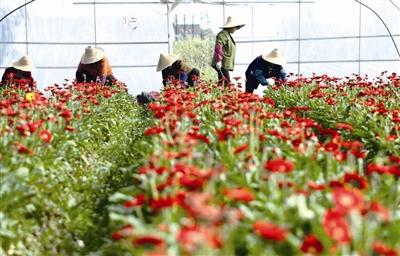
Cultivation Techniques
Sowing and Seedling Raising
Sow the seeds directly into plug trays with cell openings of about 3.5cm. The sowing medium can be slightly fertilized peat, with a pH value between 5.0-5.5 and an EC value between 1.2-1.5mS/cm. Sow one seed per cell, water and add fungicide. Gerbera seeds require light for germination, so do not cover the seeds after sowing. Place the plug trays on the greenhouse seedling bench and cover with a plastic dome. During the germination period, maintain relatively high humidity, and you may irrigate lightly or use overhead misting.
The optimum temperature during the germination period is 22-25°C, and the optimum day length during the germination period is 16 hours. It is recommended to supplement light artificially (3.5-4klx) during periods of low light. Germination begins 3-4 days after sowing. Gradually remove the plastic dome when the cotyledons unfold, and remove the plastic dome completely when the first true leaf unfolds. About 5.5 to 6.5 weeks after sowing, the seedlings are ready, and when 4-5 true leaves have grown, they can be transplanted or potted up.
Planting Out
The cultivation soil should be loose, breathable and rich in humus, with a pH value between 5.0-5.5 and an EC value between 1.2-1.5mS/cm. Gerbera is a year-round flowering plant, and the planting season is not restricted, but from the perspective of production and sales, the most suitable planting period is from late March to mid-April in spring; flowers can be harvested in autumn, and the plants enter the full flowering period in winter. Plant in a staggered arrangement, with a plant-to-row spacing of 40cm x 50cm, and plant 6-8 plants per sq m. If the density is too high, the plants are prone to pests and diseases, and the number of flower buds decreases; if the density is too low, the economic yield is affected. Because the root system of Gerbera has the characteristic of contracting old roots, and the leaves are basal on the stem, planting should follow the principle of shallow planting, requiring the root crown to be slightly exposed above the soil surface. If planted too deep, the plant sinks downward as the old roots contract, the growing point becomes buried in the soil, and the flower buds cannot easily emerge from the ground, affecting flowering.
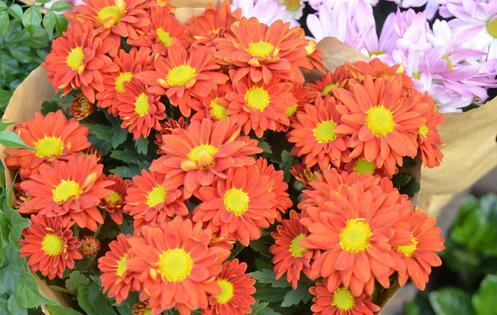
Cultivation Management
Temperature Management
The most suitable growth temperature for Gerbera is 20-25°C. Below 5°C or above 30°C, growth is slow. Gerbera is quite sensitive to temperature differences, and the day-night temperature difference should preferably be maintained at 2-3°C. If the temperature difference is too large, deformed flowers will result. It is recommended to provide shade during strong light to avoid excessively high temperatures, and to spray water during the midday high-temperature period.
Light Management .
Gerbera prefers an environment with abundant sunlight. With sufficient light, the plants grow robustly and the flower colors are vivid. The daily sunshine hours should be no less than 12 hours; during periods of low light, supplement with artificial light at 3.5-4klx. The duration and intensity of light directly affect the yield of Gerbera; the longer the light duration, the higher the flower yield.
Fertilizer and Water Management
Gerbera flowers year-round under protected cultivation, with high nutrient consumption, so topdressing must be carried out continuously throughout the entire growth period. Drip irrigation equipment is preferable, and a nutrient solution should be prepared for drip irrigation. Fertilization should be mainly nitrogen-based, with appropriate additional applications of phosphorus, potassium, calcium, iron and magnesium fertilizers. Special attention should be paid to supplementing potassium fertilizer before the flowering period to promote thick stems and robust flowers and increase flower yield. The relative air humidity should preferably not exceed 70%. To ensure good root growth of the plants, after watering at planting, irrigation should wait until the root system is slightly dry, accompanied by topdressing. Watering should follow the principle of "water thoroughly only when completely dry." When watering during the flowering period, be careful not to let water touch the center of the leaf rosette, to prevent flower bud rot.
Leaf Thinning and Bud Thinning
Gerbera is produced year-round, so timely leaf thinning and bud thinning are necessary. Too many or too few leaves will reduce the number of flowers, so appropriate leaf removal is needed: promptly remove the withered and yellowed leaves at the lower part of the basal leaf rosette, then remove leaves evenly from each stem, keeping 3-4 functional leaves per stem. In the early stage of seedling growth, the flower buds formed early should be removed to promote vegetative growth; during the flowering period, excess flower buds should also be thinned to ensure the quality of cut flowers. At the same time, market and seasonal factors should be considered to determine the number of flowering stems.