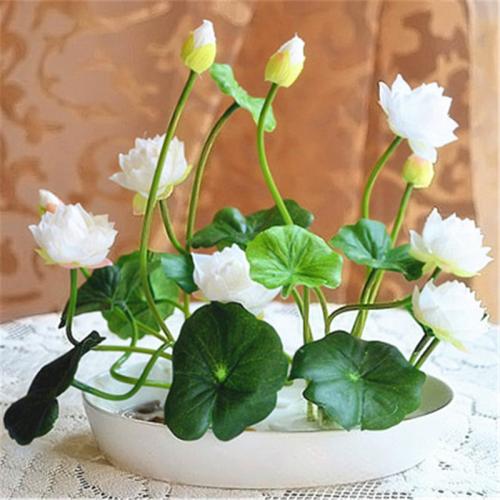
Detailed Explanation of Bowl Lotus Planting Methods and Technical Key Points
Bowl lotus usually refers to the small and medium-sized types of lotus, with the same scientific name as lotus. Also known as pot lotus, bowl lotus, and table lotus, it belongs to the Nymphaeaceae family. It is a perennial aquatic plant with a multi-noded rhizome. The underground stem is long and fleshy, with long nodes; the leaves are peltate and round; the petioles are thick and covered with short spines; the flowering period is from June to September; the number of days a single flower stays open varies by variety, from as few as 3 to 4 days to more than 10 days.

Bowl lotus planting methods:
1. Soak the seeds to promote germination. Soak the seeds whose shells have been cracked in warm water at about 50 degrees. The water used for soaking should be clean, free of grease and dirt, and water higher than 50 degrees should not be used, otherwise germination will be affected. The water temperature will drop naturally, and after *** it should be kept at about 30 degrees; it should not be higher than 40 degrees or lower than 20 degrees. If the water temperature is higher than 40 degrees, although the seeds germinate rapidly on the first day, subsequent growth will be inhibited; if the water temperature is lower than 20 degrees, seed germination and growth will be too slow. For a small amount of seed soaking at home, a thermos bottle can be used to maintain the temperature.
2. At a temperature of 30 degrees, generally 3 days of soaking to promote germination is enough for germination, and the embryo bud extends from the cracked opening. During this period, the water needs to be changed 1 to 3 times a day, and seeds that cannot germinate should be removed in time. Under normal circumstances, seeds that still have not germinated after 7 days will no longer germinate. Seeds without germination ability often float on the water surface, with yellow embryo buds and moldy, foul-smelling cotyledons. (You can also directly use tap water for soaking; there is no need to use warm water or heating, and germination can occur after about two days of soaking.)
3. Begin water culture seedling raising for the seeds. After the seeds sprout, water culture seedling raising should be carried out at about 25°C for 5 to 7 days. During water culture seedling raising, the root absorption capacity of the lotus seedlings is weak, and growth mainly depends on nutrients provided by the seed embryo, so fertilization is generally not needed. During the water culture seedling raising process, the water layer should be kept at a depth of about 10 cm, and sufficient light should be provided; it is not suitable to change the water frequently or turn the seedlings, so as to avoid excessive elongation of the leaves due to frequent changes in their growth direction; the petioles should be kept in the water, and the leaves should be allowed to spread freely and flatly on the water surface. When the lotus leaf opens and the second leaf is about to open and white roots grow, planting can begin.
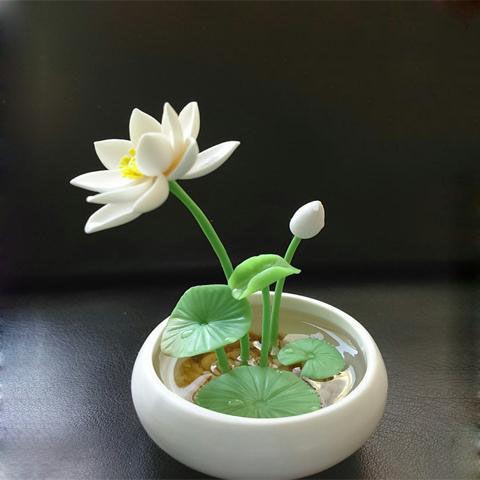
4. Planting. When the buds grow to about 10CM, they can be transplanted. According to the needs of bowl lotus planting, choose soil, put it into a flower pot, then add clean water, and mix the soil and fertilizer evenly. After the muddy water clears, plant the water-cultured seedlings in the center of the flower pot, with the seeds fully entering the mud, so that the leaves spread freely on the water surface. When transplanting, be careful not to break the petioles, so as not to affect growth. After planting, maintain a water layer of 3 to 5 cm, but never submerge the leaves in the water. Bowl lotus likes light, and the flower pot should be placed in a sunny place. The seedlings are delicate, and some may scorch when exposed to sunlight, but they will generally germinate and survive. Do not water too much either; increase the water temperature to promote growth. After 7 to 13 floating leaves grow, standing leaves can appear. Generally speaking, for multi-flower varieties, flower buds can begin to appear after 5 to 17 standing leaves grow. The timing of bud appearance varies by variety, and some varieties even show buds and bloom before standing leaves grow.
5. Light. Bowl lotus likes sufficient sunlight. If there is less than 4 hours of light per day, flower buds cannot form. During the growth period, it needs to be placed on a sunny balcony or a sunny windowsill so that it receives full sunlight. When floating leaves cover the entire pot surface, the floating leaves should also be pressed into the pot mud in time, so as not to affect ventilation and light transmission. Bowl lotus plants are delicate, and in summer and early autumn, appropriate shade is needed around noon to avoid direct strong light. If exposed to direct strong light, both leaves and petals are prone to scorching.
6. Fertilization. Bowl lotus likes fertilizer. If fertilizer is lacking, rooting and leaf growth will be slow and it will lack vitality. Therefore, before planting, a small amount of decomposed cake fertilizer liquid or soybean meal or peanut meal should be mixed into the pot soil as base fertilizer. However, although bowl lotus is a fertilizer-loving plant, fertilizer must not be applied excessively. Generally, mixing a small amount of cake fertilizer powder and other base fertilizer into the culture soil at planting time can meet its needs for the whole year, and no additional topdressing is needed, so as to avoid excessive vegetative growth. However, in order to prolong the flowering period, in summer a piece of decomposed cake fertilizer the size of a plum pit can be used as topdressing, inserted into the mud in the center of the pot. Never apply it around the pot wall. It is easy to cause root damage. Base fertilizer must not be applied too much; otherwise, in mild cases the leaves will be lush but flowers sparse, and in severe cases the seed lotus will be "burned to death."