Detailed Explanation of Apricot Tree Planting Techniques and Management Methods
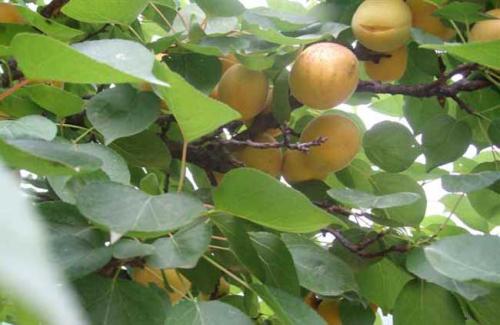
Apricot tree, also known as: apricot, northern plum, guileisi, apricot blossom. Flowers solitary, 2-3 cm in diameter, opening before the leaves; pedicel short, 1-3 mm long, pubescent; calyx purple-green; calyx tube cylindrical, pubescent on the outside at the base; fruit spherical, rarely obovoid, about 2.5 cm or more in diameter, white, yellow to yellow-red, often with a red blush, slightly pubescent; flesh juicy, not splitting when ripe. Flowering period March-April, fruiting period June-July.
Planting methods
Mainly propagated by seed; when sowing, the seeds need to be stratified in moist sand to promote germination; they can also be propagated by grafting using seedlings as rootstock.
Field planting and cultivation: The soil is sandy loam; in the 0-40 cm soil layer, the available nitrogen, phosphorus and potassium contents are 43.3×10⁻⁶ (ppm), 6.83×10⁻⁶ (ppm) and 117.6×10⁻⁶ (ppm) respectively, the organic matter content is 0.68%, and the pH value is 7.14.
Plant in early to mid-March, applying well-decomposed high-quality organic fertilizer. Dig planting trenches, build ridges on the trenches, and plant the seedlings on the ridges, in a north-south row direction, with a spacing of 0.9 m × 1.5-2 m.
Fertilizer and water management: When new shoots grow to about 15 cm, begin applying quick-acting fertilizer, alternating between soil topdressing and foliar spraying. From the end of September to early October, apply organic fertilizer and compound fertilizer. After covering the greenhouse, apply urea before bud break, and after flower drop until the fruit expansion stage, topdress with potassium sulfate compound fertilizer, and spray urea and potassium dihydrogen phosphate every 10-15 days; in addition, 500 times yield-increasing bacteria can be sprayed at the same time.
After the seedlings are planted, water thoroughly once, and thereafter determine the watering amount and watering time according to the specific situation.
Training and pruning: In late May to early June, determine the trunk and select shoots, keeping 7-12 shoots with better angles and removing the rest. When new shoots grow to 40 cm, select 2-4 for key training, using "V"-shaped or open-center training, and pinch the remaining new shoots to promote secondary shoots; repeatedly pinch upright shoots on the back, and remove overly numerous and dense branches. In early November, spray urea to promote early leaf fall.
From fruit expansion to before fruit ripening, pinch the new shoots multiple times to control vigorous new shoot growth and improve fruit set rate and single fruit weight; for upright new shoots on the back, remove them or twist them to prevent "trees growing on trees" from worsening the light inside the canopy. In early to mid-May, after the fruit is harvested and the film is uncovered, combine heading back with branch thinning to adjust the growth balance of the tree and prevent compensatory vigorous growth.
Flower and fruit management: If cultivated in a solar greenhouse, the flowering period of apricot trees can be prolonged, but the opening time of individual flowers is shortened, and relatively high air humidity is not conducive to pollen dispersal and pollination and fertilization. Therefore, measures should be taken to strengthen pollination and fertilization: use stored pollen for spot pollination; use a chicken feather duster for pollination; keep the beehive height during the flowering period similar to the middle and upper part of the canopy, so that bees encounter flowers as soon as they leave the hive.
Thin flowers and fruits, removing late flowers and weak flowers, and removing twin fruits, small fruits and deformed fruits; leave 2-4 fruits on long fruit branches, 2-3 fruits on medium fruit branches, and 1 fruit on short fruit branches, so that the fruits are evenly distributed in the canopy.
Winter pruning: For young trees and trees just beginning to bear fruit, winter pruning should take into account both training and fruiting. For main branches, lateral branches and extension branches, prune lightly and leave them long, generally retaining two-thirds of the total branch length for heading back. Remove crowded branches, multi-forked branches, overlapping branches and vigorous branches, and control the growth of competing branches and upright vigorous branches. For vegetative branches of moderate growth and relatively open angles, leave them unpruned to promote the sprouting of medium and short branches, increase the number of fruiting branches, and after flower formation or fruiting, head them back in time to train them into fruiting branch groups. Medium and short branches with large angles form flowers easily and should be retained as much as possible. For weaker-growing young trees, appropriate heading back is advisable, removing overly dense branches and thin weak branches, retaining more robust branches, and bending upright vigorous branches flat as auxiliary branches to promote the development of thick, strong medium and short fruiting branches.
For trees in full fruiting period, according to branch vigor and the spatial conditions of each part of the canopy, appropriately thin dense branches and cut back weak ones to maintain a stable fruiting position and growth vigor. For weakened main branches, lateral branches, perennial auxiliary branches, fruiting branch groups and drooping branches, head them back at positions with strong branches to restore growth vigor. Timely renew and rejuvenate the branches at the lower part and inside the canopy, so that the fruit tree continuously produces new robust fruiting branches.
For trees in the aging period, use vigorous upright branches with small angles in the middle and lower parts to replace the leader, or head back at relatively upright branch sections to promote the sprouting of latent buds for renewal. For water sprouts in appropriate positions, train them into scaffold branches and fruiting branch groups. For fruiting branch groups and fruiting branches, following the principle of "remove weak and keep strong," select and retain strong branches and strong buds for renewal pruning. For those with extremely weak tree vigor where renewal is difficult to achieve, on the premise of strengthening fertilizer and water management, carry out a whole-tree major renewal of the main and lateral branches and large branch groups at the 10-15-year-old part, completing it in one operation; a large number of new branches can sprout that same year, and through summer bud removal and pinching and winter training and pruning, they can flower and bear fruit the following year and restore a certain yield.
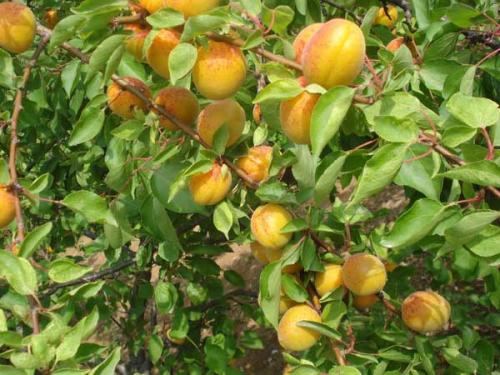
The main diseases and pests of apricot trees include: apricot scab, black spot, gummosis, and pests such as apricot weevil, aphids, red spider mites, globular scale insects, and phalera caterpillar, among which apricot scab, black spot and globular scale insects cause relatively serious damage, and the following integrated measures should be taken for control.
1. From the beginning of winter to before germination, clear dead branches and fallen leaves in the orchard, cut off diseased branches, destroy them centrally, scrape off old bark, eliminate overwintering sources of diseases and pests, and reduce the pest and disease base.
2. Before flowering, spray the trunk and branches with 5 degrees Baumé lime sulfur mixture to control apricot scab, black spot, globular scale insects and other overwintering insect eggs.
3. Mid-March to early April is the period when apricot weevils emerge from the soil and climb the trees to cause damage. Taking advantage of their feigning death, shake the trees in the early morning, manually capture and kill them, remove infested fruits, and promptly spray a mixture of 20% supracide 2000 times solution and 50% carbendazim 600 times solution. To control apricot weevil and apricot scab, black spot and shot hole disease, other insecticides and fungicides can also be selected for mixing.
4. In mid-April, spray 40% fenpropathrin-malathion emulsifiable concentrate 1000 times solution and procymidone 200 times solution, which can control apricot scab, black spot, shot hole disease and green peach aphid.