Millettia speciosa Planting Methods and Key Technical Points
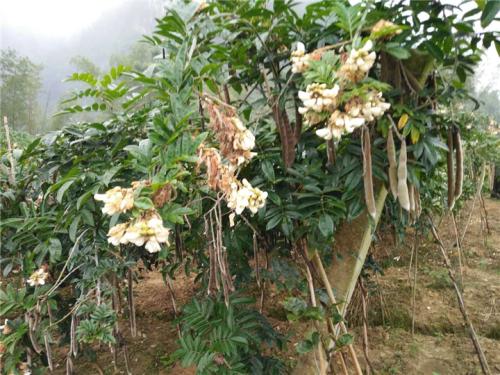
Millettia speciosa, also known as pig's trotter, golden bell root, mountain lotus root, upside-down golden bell, and giant potato. It is a medicinal material. It is a plant of the genus Millettia in the legume family Fabaceae, Millettia speciosa. Millettia speciosa uses its root as medicine, and its main components are protein, starch, and alkaloids, etc.
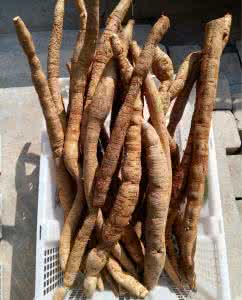
The main planting techniques for Millettia speciosa are as follows
I. Variety Selection
For autumn sowing of Millettia speciosa, mid-to-late maturing varieties are generally used, such as Liuchuan Lixiang, Yechuan, or Da Changgen Bai Neiji Burdock; for spring sowing, early-to-mid maturing varieties are mostly used, such as Liuchuan Lixiang, Dubian Zaosheng, Songzhong Zaosheng, Hantian Zaosheng, or Da Changgen Bai Neiji Burdock.
II. Soil Selection
Millettia speciosa is a deep-rooted vegetable with strict soil requirements. It is suitable for cultivation in sandy soil with deep soil layers, good drainage, and loose fertility. For example, Feng County and Pei County in Jiangsu, and Zhuangwu Town in Cangshan, Shandong, all belong to alluvial soil of large rivers, with uniform upper and lower soil layers, and are very suitable for planting Millettia speciosa. For planting burdock, plots where the previous crop was not a Asteraceae plant should be selected for cultivation, and it is best to use plots where burdock has not been planted for 2-3a. In addition, plots where the previous crop was beans, peanuts, sweet potato, or corn should not be selected.
III. Land Preparation
After the previous crop is harvested, the soil should be deeply plowed and sunned in time. Before deep plowing, apply 75kg of cake fertilizer, more than 5000kg of high-quality decomposed farmyard manure, and 50kg of ammonium bicarbonate per 667 square meters. Then use a burdock machine to open trenches in rows of 70cm, with a depth of about 1m. Because after opening trenches with a burdock machine, a ridge about 40--50cm wide and about 25cm high is naturally formed. Step firmly along both sides of the ridge with feet, or pat firmly along both sides of the ridge with a shovel, to prevent the trench from collapsing when it rains, causing deformation of the burdock.
IV. Sowing
In concentrated production areas of Millettia speciosa, seeds should be disinfected before sowing. The following methods can be used:
1. Soak seeds in warm water at 55°C for 10min.
2. Treat seeds with 0.3% of seed weight of Ridomil (metalaxyl) fungicide, then open a small ditch 3cm deep on top of the ridge, water lightly, and after the water seeps down, sow seeds at a spacing of 3cm, cover with 3cm of soil, using 200g of seed per 667 square meters.
V. Thinning and Final Singling of Seedlings
The first thinning is at 1-2 true leaves, the second at 2-3 true leaves, and final singling at a seedling spacing of 7-10cm. When final singling, remove inferior seedlings and overly vigorous seedlings, and keep seedlings of uniform size. For early harvest and marketing, leave a larger spacing between seedlings; for late harvest and marketing, keep them appropriately denser, so as to avoid too large a spacing causing the burdock taproot to become too thick and affecting appearance quality.
VI. Cultivation, Weeding, and Earthing Up
Burdock seedlings grow slowly, and there are many weeds during the seedling stage, so timely cultivation and weeding should be carried out. The last cultivation before row closure should earth up toward the roots, which is beneficial to the growth and expansion of the taproot. For plots with heavy weeds, herbicides can be used for weeding. Per 667 square meters, 25-30mL of 10.8% can be used, added to 50-60kg of water; after burdock emerges, spraying can be done from weed emergence to the peak growth period. Alternatively, 50-60mL of 50% can be used, mixed with 15-20kg of water, and after burdock seedlings emerge, when weeds are at the 3-5 leaf stage, choose evening for application.
VII. Topdressing
Topdressing can be carried out 3 times throughout the growth period. The first time is when the plants are 30-40cm high, open a ditch on top of the ridge and apply urea, 10kg per 667 square meters; the second time is during vigorous plant growth, broadcast it in the furrow combined with watering, applying 8-10kg of urea per 667 square meters; the third time is after the fleshy root expands, 10kg of diammonium phosphate and 5kg of potassium sulfate can be applied as topdressing, preferably by making holes with a steel bar, applying the fertilizer to a depth of 10-20cm, and then sealing the holes tightly, so as to promote rapid growth of the fleshy root and achieve high yield and good quality.