Sweet pea (Latin scientific name: Lathyrus odoratus) is an annual herb of the genus Lathyrus in the Fabaceae family, 50-200 cm tall, with the whole plant more or less covered in hairs. The stem is climbing, much branched, and winged. The leaves have 1 pair of leaflets, and the stipules are semi-sagittate; the leaf rachis is winged, and the end of the leaf rachis bears branched tendrils; the leaflets are ovate-oblong or elliptical. The seeds are smooth, and the hilum is 1/4 of the circumference. The flowering and fruiting period is June to September. It is a famous ornamental plant. Native to Italy, it is cultivated in various parts of China.
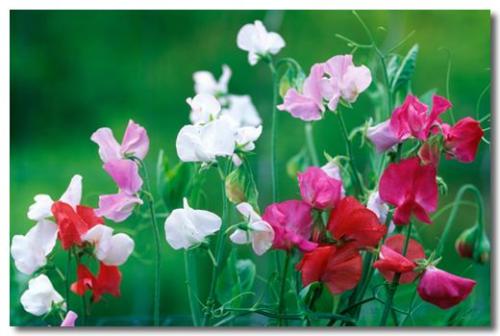
Sowing method for growing sweet peas: sweet peas are generally sown in September each year. To improve the germination rate, they can first be soaked in warm water for 28 hours before sowing by dibbling. At a temperature of 20 degrees and with a certain level of humidity maintained, sweet pea seedlings can be seen in 10 days. After true leaves grow, planting out should be carried out. Sweet peas are deep-rooted plants, so when transplanting, care should be taken not to remove the soil ball, in order to increase the survival rate and shorten the recovery period.
Care Methods
The potting soil for sweet peas is prepared from leaf mold, peat, river sand and some organic fertilizer. Before flowering, apply a diluted liquid fertilizer once every 10 days, and in the early stage of flower bud formation, apply potassium dihydrogen phosphate. Watering should follow the principle of alternating dry and wet. The cultivation temperature should not be too high. Before flowering, the daytime temperature is preferably 9-13 C, and the nighttime temperature 5-8 C. If the temperature is too high, the plant will form buds before it has fully developed, affecting plant growth. During flowering, raising the room temperature to 15-20 C is beneficial for flower formation. When caring for plants in a greenhouse or home, place the potted flowers in front of a window to receive light, and pay attention to ventilation to prevent excessive vegetative growth or bud drop. When the main vine grows to about 20 cm, pinch it to promote the growth of side vines and increase the number of flowers. Climbing varieties can be given support structures for shaping. The flowering period can be controlled by temperature regulation. Plants that flower from December to February-March of the following year can be cared for in a moderately warm greenhouse, while plants that flower in May of the following year can be overwintered in a cold room. During the flowering period, to ensure the number of flowers, remove faded flowers at any time to extend the plant's flowering period. After flowering, seeds form, and the pods in different parts mature at different times, so they must be harvested as they ripen. In greenhouse cultivation or dry environments, red spider mites are prone to occur, and cotton balls dipped in undiluted dichlorvos can be hung up for fumigation control.
When sowing different types of sweet pea varieties in stages before November, the peak flowering periods differ considerably. The peak flowering period of winter-flowering varieties is mostly from late February to March of the following year, while that of spring-flowering varieties is from mid-March to mid-April of the following year; however, for different types of sweet pea varieties sown from mid-to-late November to early December, the peak flowering periods do not differ much, and all peak flowering periods are from late March to the end of April of the following year. For sweet peas bred in the Nanchang area of Jiangxi, the most suitable sowing period is from mid-to-late November to early December. The peak flowering period for sowing at this time is from late March to the end of April, which is consistent with suitable seed-setting temperature conditions.
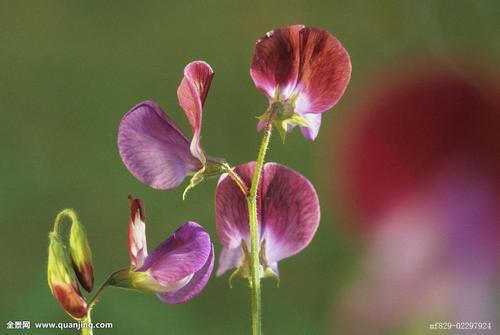
In pollen morphology observation and germination research, it was found that under the same cultivation conditions, the seed-setting ability of different sweet pea varieties varies greatly. Even during the suitable flowering and seed-setting period, some varieties have a very low seed-setting rate. For example, X-10 has the best seed-setting ability and produces many seeds, while X-20 has poor seed-setting ability and produces very few seeds. To understand the reasons for the differences in seed-setting ability among different sweet pea varieties, the author observed the floral organs of sweet peas and found that the pistils of sweet pea varieties with low seed-setting rates develop normally, with 6-10 ovules in the ovary. For this reason, the author further carried out pollen morphology observation and germination experiments.
Based on the differences in seed-setting ability among varieties, the experiment selected the variety with good seed-setting ability X-10, the varieties with medium seed-setting ability X-9, X-18, X-22, and the variety with poor seed-setting ability X-20 as test varieties. Pollen was taken from flower buds about to open and cultured on MS medium at the suitable temperature of 20 C:
Observation found that the pollen grains of X-10 were the fullest and most plump, and after culture the proportion of its pollen germinating to form pollen tubes was the highest, reaching 65%; the pollen grains of X-9, X-18, and X-22 were relatively plump, and after culture the proportions forming pollen tubes were 39%, 10%, and 15% respectively; the pollen grains of X-20 were shriveled to varying degrees, similar to dehydration, indicating that its pollen grains were not fully developed, and after culture the proportion forming pollen tubes was only 6%; this result is consistent with the seed-setting characteristics of different sweet pea varieties (see Table 2). The reasons for the differences in pollen grain development characteristics among different sweet pea varieties, the extent to which they affect seed setting, and solutions remain to be further studied. [
Its peak flowering period is generally from late March to the end of April, which is favorable for flowering and seed setting. The suitable temperature range for sweet pea seed setting is 15 C-28 C. There are obvious differences in seed-setting ability among different varieties. Insufficient pollen grain development in varieties with poor seed-setting ability is one of the reasons for the difficulty in seed setting of the varieties themselves.
When fertilizing sweet peas, attention should be paid to the rational combination of N, P, and K fertilizers. The suitable amounts are: 3000 kg of decomposed barnyard manure, 42 kg of nitrogen fertilizer, 64 kg of phosphorus fertilizer, and 40 kg of potassium fertilizer per mu. Sweet pea pods will automatically burst and scatter seeds after turning yellow and ripe, so they should be harvested promptly when the pods turn yellow. Because a single sweet pea plant opens flowers branch by branch, the pods mature unevenly, so multiple harvests are required.