Detailed Explanation of Pinellia ternata Planting Methods and Technical Points
Pinellia ternata (scientific name: Pinellia ternata), also known as Diwen, Shoutian, etc., belongs to the order Arales, family Araceae, genus Pinellia. It is a medicinal plant with effects of drying dampness and resolving phlegm, directing qi downward and stopping vomiting, and when used raw, reducing boils and swelling; veterinarians use it to treat throat abscesses.
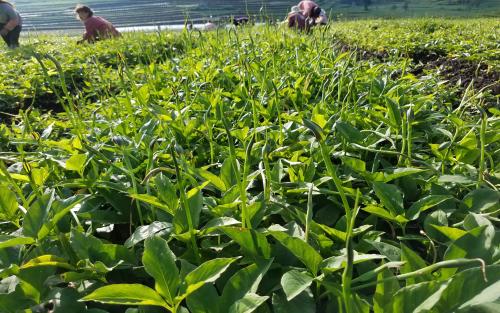
How to plant Pinellia ternata
1. Site selection and land preparation. Pinellia ternata has a relatively short root system and prefers fertile soil, so sandy loam rich in humus is best for planting. Before plowing the land, apply 2500 kg--4000 kg of decomposed organic fertilizer or farmyard manure and 15 kg--20 kg of superphosphate per mu as base fertilizer, deep plow 20 cm, rake fine and level, and make raised beds 1.2 m wide.
2. Propagation, mainly using tubers and bulbils, but seeds can also be used for propagation. Bulbil propagation. After the mother tuber sends out leaves, one bulbil can grow at the lower part of each petiole or at the base of the leaf, with a diameter of 0.3 cm--1 cm, pointed at both ends and larger in the middle. When the bulbils mature, they can be picked for use as seed. Small tuber propagation. Small tubers sprouted from 2-year-old or 3-year-old Pinellia ternata can also be used as propagation material. At harvest, select small tubers with a diameter of 0.7 cm--1 cm as seed, mix with moist sandy soil, and store in a cool place until sowing. Seed propagation. It takes 3 years after sowing to harvest, but this is rarely used in production.
3. Planting. It can be done in all four seasons, but spring planting is preferable, and the earlier in spring the better. Either drilling or broadcasting can be used. For drilling, first open furrows 5 cm--7 cm deep on the bed at a row spacing of 10 cm--15 cm, place the tubers in the furrows at a plant spacing of 2 cm--5 cm, using about 75 kg--100 kg of seed per mu. After sowing, cover with decomposed farmyard manure, then apply decomposed human and livestock manure, and finally cover with soil level with the bed surface.
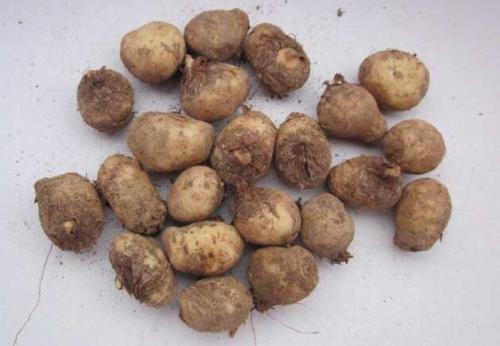
Cultivation techniques for Pinellia ternata
I. Field management
1. Cultivation and weeding. After the seedlings emerge uniformly, weeds should be removed promptly. Use a specially made small hoe for shallow hoeing between rows, and the depth must not exceed 3 cm. Weeds between plants should be pulled by hand.
2. Fertilization. In addition to applying sufficient base fertilizer, during the middle growth stage, especially around "Xiaoman," heavy application of bulbil fertilizer should be made, such as decomposed cake fertilizer, human and livestock manure water, etc. If the base fertilizer is insufficient, apply 10 kg--15 kg of ammonium sulfate per mu as a top dressing in the early stage; another top dressing can be applied before earthing up at "Xiaoshu," and no top dressing is needed in the late growth stage.
3. Earthing up. Since after June, the bulbils on the petioles gradually mature and fall to the ground, and the seeds also mature one after another and fall to the ground as the plants wither, earthing up should be carried out once in early June and once in mid-July.
II. Pest and disease control
1. Leaf spot disease. When the disease occurs, purple-brown spots appear on the leaves, and then the plants gradually wither. Control method: before the disease occurs and in the early stage of the disease, spray 1:1:120 Bordeaux mixture or 65% amobam 500 times dilution, once every 7 days--10 days, for 2 or 3 consecutive times.
2. Viral disease. The leaves of diseased plants curl into a mosaic pattern, and the plants are short and deformed. Control method: remove diseased plants to eliminate sources of infection; select disease-free plants for seed retention.
3. Tuber rot disease. It mostly occurs in places with long-term water accumulation. After the disease occurs, the underground tubers rot and the aboveground parts wither. Ditch drainage is mostly used for control.